
超重和肥胖与孟加拉国青少年使用电子媒体之间的关联程度。
The degree of association between overweight and obesity with the use of electronic media among Bangladeshi adolescents.
机构信息
Department of Nutrition and Food Technology, Jashore University of Science and Technology, Jashore, Bangladesh.
出版信息
PLoS One. 2023 Jan 20;18(1):e0280544. doi: 10.1371/journal.pone.0280544. eCollection 2023.
BACKGROUND
Electronic media usage is recently considered a modifiable risk factor for overweight and obesity among adolescents. The purpose of this present study was to evaluate the association of electronic media (EM) usage with overweight and obesity among school-going adolescents.
METHODS
This cross-sectional study was conducted from October to December 2019 among school-going adolescents (14-16 years old) residing in the Jashore Sadar Upazila, Jashore district of Bangladesh. A standardized questionnaire was used to collect information regarding the socio-economic status, time spent watching television, video games playing, computer, and smart mobile phone use through face-to-face interviews. Age- and sex-specific body mass index (BMI) cut-off values for overweight and obesity were determined for Asian adolescents by the International Obesity Task Force (IOTF). Multinomial logistic regression analysis was carried out to determine the association between electronic media use with overweight and obesity.
FINDINGS
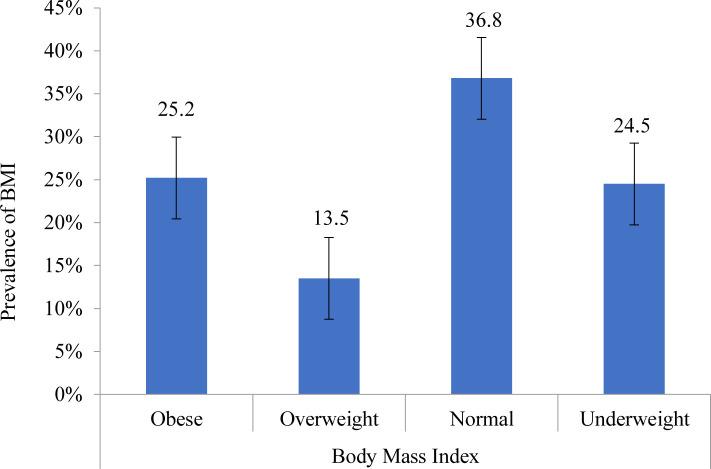
The findings suggest that the overall prevalence of overweight and obesity was 13.5% and 25.2%, respectively. Among the total adolescent students, about 49.1% highly (above 3 hours per day) spent their time on EM use whereas 30.6% moderately (≥121 to 180 min/day) use EM. The regression analysis showed that spending high time using total screen-based electronic devices, television viewing, video game playing, computer use, and smartphone use were significantly associated with overweight (RRR: 7.36, 95% CI: 3.64-11.54; RRR: 4.58, 95% CI: 1.46-7.95; RRR: 4.45, 95% CI: 2.75-6.12; RRR: 3.18, 95% CI: 1.87-4.70; RRR: 2.15, 95% CI: 1.23-3.51) and obesity (RRR: 8.72, 95% CI: 4.64-12.54; RRR: 2.89, 95% CI: 1.31-5.21; RRR: 3.88, 95% CI: 1.74-5.13; RRR: 3.08, 95% CI: 1.32-4.86; RRR: 1.19, 95% CI: 0.93-1.48) in adolescents, respectively.
CONCLUSION
The results support the total time spent using electronic media was associated with an increased risk of being overweight and obesity. Finally, this study strongly suggests the proper use of electronic media may be necessary to reduce the risk of being overweight and obesity in early adolescents.
背景
电子媒体的使用最近被认为是青少年超重和肥胖的可改变风险因素。本研究旨在评估电子媒体(EM)的使用与在校青少年超重和肥胖之间的关系。
方法
本横断面研究于 2019 年 10 月至 12 月在孟加拉国杰索尔县的杰索尔萨达尔分区进行,对象为 14-16 岁的在校青少年。通过面对面访谈,使用标准化问卷收集社会经济状况、看电视、玩视频游戏、使用计算机和智能手机的时间等信息。国际肥胖工作组(IOTF)确定了亚洲青少年超重和肥胖的年龄和性别特异性体重指数(BMI)切点值。采用多变量逻辑回归分析确定电子媒体使用与超重和肥胖之间的关系。
结果
研究结果表明,超重和肥胖的总体患病率分别为 13.5%和 25.2%。在所有青少年学生中,约 49.1%的人高度(每天超过 3 小时)使用电子媒体,30.6%的人中度(≥121 至 180 分钟/天)使用电子媒体。回归分析显示,长时间使用总屏幕电子设备、看电视、玩视频游戏、使用计算机和使用智能手机与超重(RRR:7.36,95%CI:3.64-11.54;RRR:4.58,95%CI:1.46-7.95;RRR:4.45,95%CI:2.75-6.12;RRR:3.18,95%CI:1.87-4.70;RRR:2.15,95%CI:1.23-3.51)和肥胖(RRR:8.72,95%CI:4.64-12.54;RRR:2.89,95%CI:1.31-5.21;RRR:3.88,95%CI:1.74-5.13;RRR:3.08,95%CI:1.32-4.86;RRR:1.19,95%CI:0.93-1.48)显著相关。
结论
结果支持总电子媒体使用时间与超重和肥胖风险增加有关。最后,本研究强烈建议适当使用电子媒体可能有助于降低青少年早期超重和肥胖的风险。


 Zotero 插件