
利用体外和计算机模拟研究评估黄花蒿叶及其分离的次生代谢产物作为天然抗弓形虫和抗癌剂的作用
Evaluation of A. DC. Leaves and Its Isolated Secondary Metabolites as Natural Anti-Toxoplasma and Anti-Cancer Agents Using In Vitro and In Silico Studies.
作者信息
El-Seadawy Hosam M, Abo El-Seoud Kamilia A, El-Aasr Mona, Tawfik Haytham O, Eldehna Wagdy M, Ragab Amany E
机构信息
Department of Pharmacognosy, Faculty of Pharmacy, Tanta University, Tanta 31527, Egypt.
Department of Pharmaceutical Chemistry, Faculty of Pharmacy, Tanta University, Tanta 31527, Egypt.
出版信息
Metabolites. 2022 Dec 21;13(1):10. doi: 10.3390/metabo13010010.
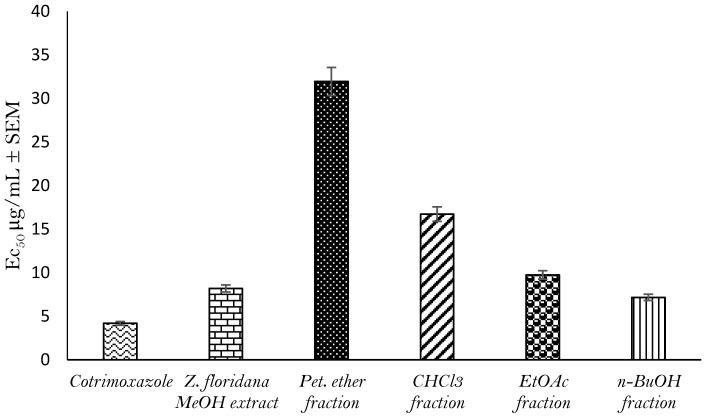
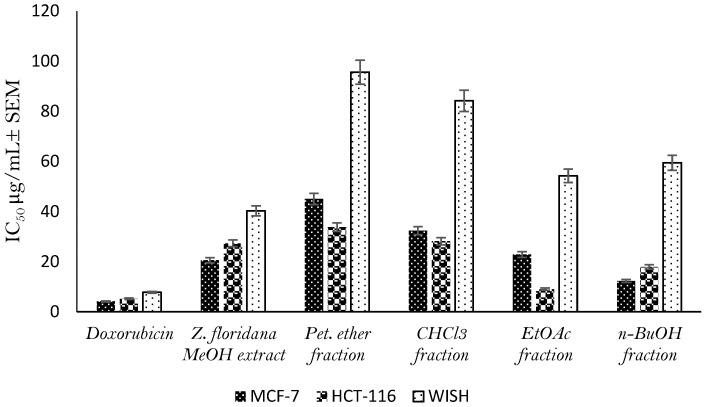
Toxoplasmosis and cancer are life-threatening diseases with worldwide distribution. However, currently used chemosynthetic treatments are not devoid of their own intrinsic problems. Natural metabolites are gaining attention due to their lower side effects. In this study, we investigated for the first time Zamia floridana leaves extract and its different fractions for their toxoplasmocidal activity, using Virulent RH Toxoplasma gondii, and cytotoxic activity against MCF-7 and HCT-116 cancer cell lines using MTT assay. The n-butanol fraction was the most potent fraction against T. gondii with an EC50 of 7.16 ± 0.4 µg/mL compared to cotrimoxazole (4.18 ± 0.3 µg/mL). In addition, the n-BuOH fraction showed a significant cytotoxicity against MCF-7 and HCT-116 with IC50 of 12.33 ± 1.1 and 17.88 ± 1.4 µg/mL, respectively, compared to doxorubicin (4.17 ± 0.2 and 5.23 ± 0.3 µg/mL, respectively), with higher safety index against normal cell line (WISH). Therefore, the n-BuOH fraction was investigated for its phytochemicals using extensive chromatographic techniques, which led to the isolation of six compounds that were fully characterized using different spectroscopic techniques. Three biflavonoids (1, 2 and 4) in addition to two phenolic acid derivatives (3 and 5) and a flavonoid glycoside (6) were isolated. Compounds (1, 3, 5 and 6) were reported for the first time from Z. floridana. In silico docking studies for toxoplasmocidal and cytotoxic effects of these compounds revealed that compounds (1, 2, 4 and 6) have promising inhibition potential of either thymidylate synthase-dihydrofolate reductase (TS-DHFR) or cyclin dependent kinase 2 (CDK2) target proteins. This study is considered the first report of chemical and biological investigation of Z. floridana leaves.
弓形虫病和癌症是在全球范围内分布的危及生命的疾病。然而,目前使用的化学合成治疗方法也存在其自身固有的问题。天然代谢产物因其较低的副作用而受到关注。在本研究中,我们首次使用强毒株RH型刚地弓形虫研究了弗罗里达泽米叶提取物及其不同馏分的杀弓形虫活性,并使用MTT法检测了其对MCF-7和HCT-116癌细胞系的细胞毒性活性。正丁醇馏分是对弓形虫最有效的馏分,其半数有效浓度(EC50)为7.16±0.4微克/毫升,而复方新诺明的EC50为4.18±0.3微克/毫升。此外,正丁醇馏分对MCF-7和HCT-116显示出显著的细胞毒性,其半数抑制浓度(IC50)分别为12.33±1.1和17.88±1.4微克/毫升,相比之下,阿霉素对这两种细胞系的IC50分别为4.17±0.2和5.23±0.3微克/毫升,且对正常细胞系(WISH)具有更高的安全指数。因此,我们使用广泛的色谱技术对正丁醇馏分的植物化学成分进行了研究,通过不同的光谱技术对分离得到的六种化合物进行了全面表征。分离得到了三种双黄酮(1、2和4),以及两种酚酸衍生物(3和5)和一种黄酮糖苷(6)。化合物(1、3、5和6)首次从弗罗里达泽米中分离得到。对这些化合物的杀弓形虫和细胞毒性作用的计算机模拟对接研究表明,化合物(1、2、4和6)对胸苷酸合成酶-二氢叶酸还原酶(TS-DHFR)或细胞周期蛋白依赖性激酶2(CDK2)靶蛋白具有有前景的抑制潜力。本研究被认为是对弗罗里达泽米叶进行化学和生物学研究的首次报道。



 Zotero 插件