
基于纳米技术的伏立康唑给药方法在侵袭性真菌感染中的应用
Nanotechnology-Based Approaches for Voriconazole Delivery Applied to Invasive Fungal Infections.
作者信息
de Almeida Campos Laís, Fin Margani Taise, Santos Kelvin Sousa, de Lima Gualque Marcos William, Freire Cabral Ana Karla Lima, Khalil Najeh Maissar, Fusco-Almeida Ana Marisa, Mainardes Rubiana Mara, Mendes-Giannini Maria José Soares
机构信息
Pharmaceutical Nanotechnology Laboratory, Department of Pharmacy, Midwest State University (UNICENTRO), Alameda Élio Antonio Dalla Vecchia St, 838, Guarapuava 85040-167, PR, Brazil.
Department of Clinical Analysis, School of Pharmaceutical Sciences, São Paulo State University (UNESP), Rodovia Araraquara Jaú, Km 01, Araraquara 14801-902, SP, Brazil.
出版信息
Pharmaceutics. 2023 Jan 12;15(1):266. doi: 10.3390/pharmaceutics15010266.
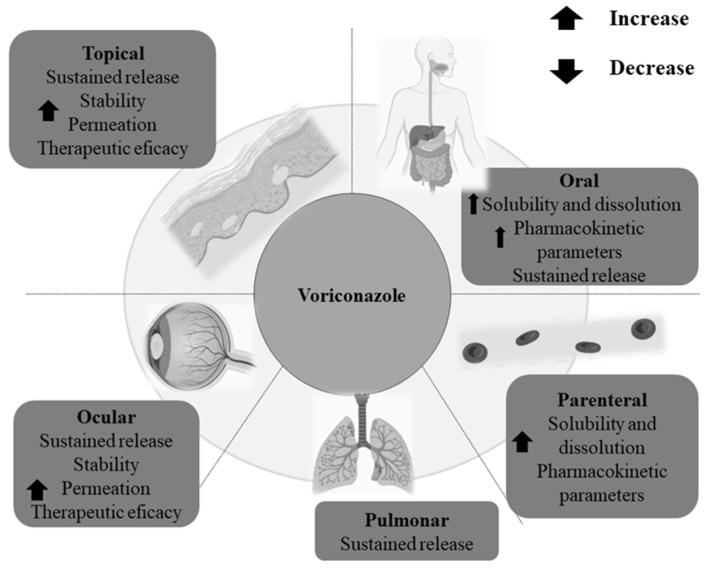
Invasive fungal infections increase mortality and morbidity rates worldwide. The treatment of these infections is still limited due to the low bioavailability and toxicity, requiring therapeutic monitoring, especially in the most severe cases. Voriconazole is an azole widely used to treat invasive aspergillosis, other hyaline molds, many dematiaceous molds, spp., including those resistant to fluconazole, and for infections caused by endemic mycoses, in addition to those that occur in the central nervous system. However, despite its broad activity, using voriconazole has limitations related to its non-linear pharmacokinetics, leading to supratherapeutic doses and increased toxicity according to individual polymorphisms during its metabolism. In this sense, nanotechnology-based drug delivery systems have successfully improved the physicochemical and biological aspects of different classes of drugs, including antifungals. In this review, we highlighted recent work that has applied nanotechnology to deliver voriconazole. These systems allowed increased permeation and deposition of voriconazole in target tissues from a controlled and sustained release in different routes of administration such as ocular, pulmonary, oral, topical, and parenteral. Thus, nanotechnology application aiming to delivery voriconazole becomes a more effective and safer therapeutic alternative in the treatment of fungal infections.
侵袭性真菌感染在全球范围内增加了死亡率和发病率。由于生物利用度低和毒性问题,这些感染的治疗仍然有限,需要进行治疗监测,尤其是在最严重的病例中。伏立康唑是一种唑类药物,广泛用于治疗侵袭性曲霉病、其他透明霉菌、许多暗色霉菌、包括对氟康唑耐药的菌株,以及由地方性真菌病引起的感染,此外还用于治疗中枢神经系统发生的感染。然而,尽管伏立康唑具有广泛的活性,但由于其非线性药代动力学,使用伏立康唑存在局限性,在其代谢过程中会根据个体多态性导致超治疗剂量和毒性增加。从这个意义上说,基于纳米技术的药物递送系统已成功改善了包括抗真菌药物在内的不同类别药物的物理化学和生物学特性。在这篇综述中,我们重点介绍了最近将纳米技术应用于递送伏立康唑的研究工作。这些系统通过在眼内、肺部、口服、局部和肠胃外等不同给药途径中实现可控和持续释放,使伏立康唑在靶组织中的渗透和沉积增加。因此,旨在递送伏立康唑的纳米技术应用成为治疗真菌感染更有效、更安全的治疗选择。
 Zotero 插件