
非洲动物锥虫病耐药性:系统评价与荟萃分析。
African animal trypanocide resistance: A systematic review and meta-analysis.
作者信息
Kasozi Keneth Iceland, MacLeod Ewan Thomas, Welburn Susan Christina
机构信息
Infection Medicine, Deanery of Biomedical Sciences, College of Medicine and Veterinary Medicine, University of Edinburgh, Edinburgh, United Kingdom.
School of Medicine, Kabale University, Kabale, Uganda.
出版信息
Front Vet Sci. 2023 Jan 4;9:950248. doi: 10.3389/fvets.2022.950248. eCollection 2022.
BACKGROUND
African animal trypanocide resistance (AATr) continues to undermine global efforts to eliminate the transmission of African trypanosomiasis in endemic communities. The continued lack of new trypanocides has precipitated drug misuse and overuse, thus contributing to the development of the AATr phenotype. In this study, we investigated the threat associated with AATr by using the major globally available chemotherapeutical agents.
METHODS
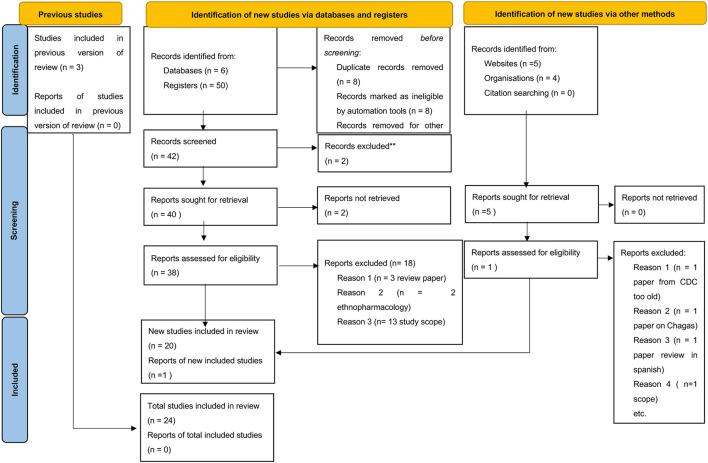
A total of seven electronic databases were screened for an article on trypanocide resistance in AATr by using keywords on preclinical and clinical trials with the number of animals with treatment relapse, days taken to relapse, and resistant gene markers using the PRISMA checklist. Data were cleaned using the SR deduplicator and covidence and analyzed using Cochrane RevMan®. Dichotomous outputs were presented using risk ratio (RR), while continuous data were presented using the standardized mean difference (SMD) at a 95% confidence interval.
RESULTS
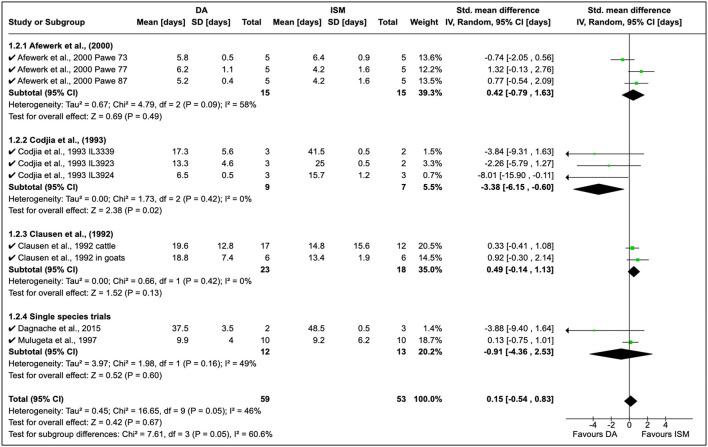
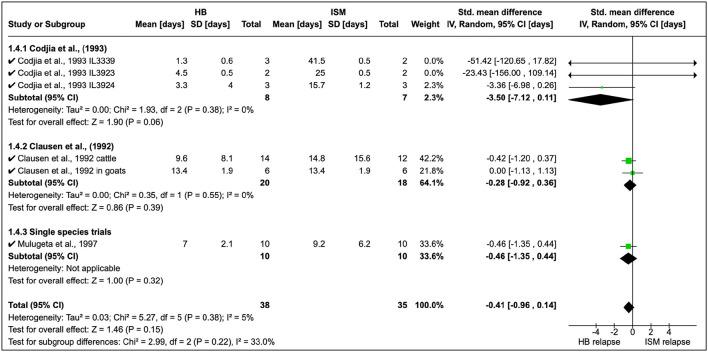
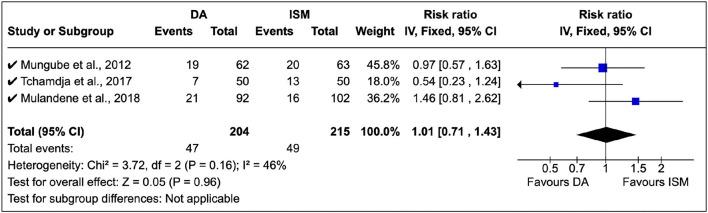
A total of eight publications in which diminazene aceturate (DA), isometamidium chloride (ISM), and homidium chloride/bromide (HB) were identified as the major trypanocides were used. In all preclinical studies, the development of resistance was in the order of HB > ISM > DA. DA vs. ISM (SMD = 0.15, 95% CI: -0.54, 0.83; = 46%, = 0.05), DA vs. HB (SMD = 0.96, 95% CI: 0.47, 1.45; = 0%, = 0.86), and HB vs. ISM (SMD = -0.41, 95% CI: -0.96, 0.14; = 5%, = 0.38) showed multiple cross-resistance. Clinical studies also showed evidence of multi-drug resistance on DA and ISM (RR = 1.01, 95% CI: 0.71-1.43; = 46%, = 0.16). To address resistance, most preclinical studies increased the dosage and the treatment time, and this failed to improve the patient's prognosis. Major markers of resistance explored include AT1, P1/P2 transporters, folate transporters, such as F-I, F-II, F-III, and polyamine biosynthesis inhibitors. In addition, immunosuppressed hosts favor the development of AATr.
CONCLUSION
AATr is a threat that requires a shift in the current disease control strategies in most developing nations due to inter-species transmission. Multi-drug cross-resistance against the only accessible trypanocides is a major public health risk, justifying the need to revise the policy in developing countries to promote control of African trypanosomiasis.
背景
非洲动物锥虫耐药性(AATr)持续破坏全球在流行社区消除非洲锥虫病传播的努力。新的锥虫杀灭剂持续短缺促使药物滥用和过度使用,进而导致AATr表型的出现。在本研究中,我们使用全球主要可用的化疗药物调查了与AATr相关的威胁。
方法
通过使用关于临床前和临床试验的关键词,以及治疗复发动物数量、复发天数和耐药基因标记,在总共七个电子数据库中筛选关于AATr中锥虫耐药性的文章,使用PRISMA清单。数据使用SR去重器和Covidence进行清理,并使用Cochrane RevMan®进行分析。二分法输出使用风险比(RR)呈现,而连续数据在95%置信区间使用标准化均差(SMD)呈现。
结果
总共使用了八篇将乙酰氨基苯磺酰苯脒(DA)、氯异甲酰胺(ISM)和氯化/溴化百浪多息(HB)确定为主要锥虫杀灭剂的出版物。在所有临床前研究中,耐药性的发展顺序为HB > ISM > DA。DA与ISM(SMD = 0.15,95% CI:-0.54,-0.83;I² = 46%,P = 0.05)、DA与HB(SMD = 0.96,95% CI:0.47,1.45;I² = 0%,P = 0.86)以及HB与ISM(SMD = -0.41,95% CI:-0.96,0.14;I² = 5%,P = 0.38)显示出多重交叉耐药性。临床研究也显示出DA和ISM存在多药耐药性的证据(RR = 1.01,95% CI:0.71 - 1.43;I² = 46%,P = 0.16)。为解决耐药性问题,大多数临床前研究增加了剂量和治疗时间,但这未能改善患者的预后。探索的主要耐药标记包括AT1、P1/P2转运蛋白、叶酸转运蛋白,如F-I、F-II、F-III以及多胺生物合成抑制剂。此外,免疫抑制宿主有利于AATr的发展。
结论
由于种间传播,AATr是一种威胁,需要大多数发展中国家改变当前的疾病控制策略。对唯一可获得的锥虫杀灭剂的多药交叉耐药性是一项重大公共卫生风险,这证明有必要修订发展中国家的政策以促进非洲锥虫病的控制。



 Zotero 插件