
美国电子健康记录数据库中 BRCA 阳性转移性乳腺癌女性人群的癫痫发作风险。
Risk of seizures in a population of women with BRCA-positive metastatic breast cancer from an electronic health record database in the United States.
机构信息
AbbVie Inc, North Chicago, IL, USA.
AbbVie Limited, Dublin, Ireland.
出版信息
BMC Cancer. 2023 Jan 24;23(1):78. doi: 10.1186/s12885-023-10554-6.
BACKGROUND
Incidence and risk factors for seizures among women with advanced breast cancer (BC) and brain metastases are not well characterized across treatment-related or clinical subtypes. This study leveraged a large real-world dataset to describe incidence and risk factors for seizures in BRCA-associated metastatic breast cancer.
METHODS
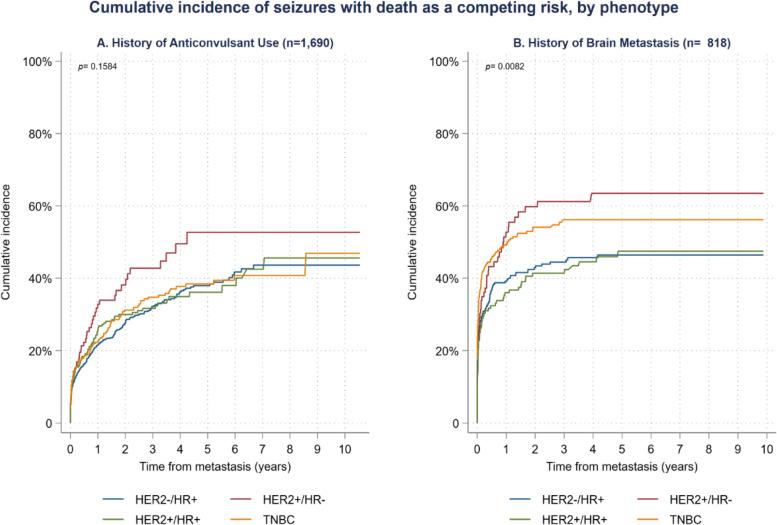
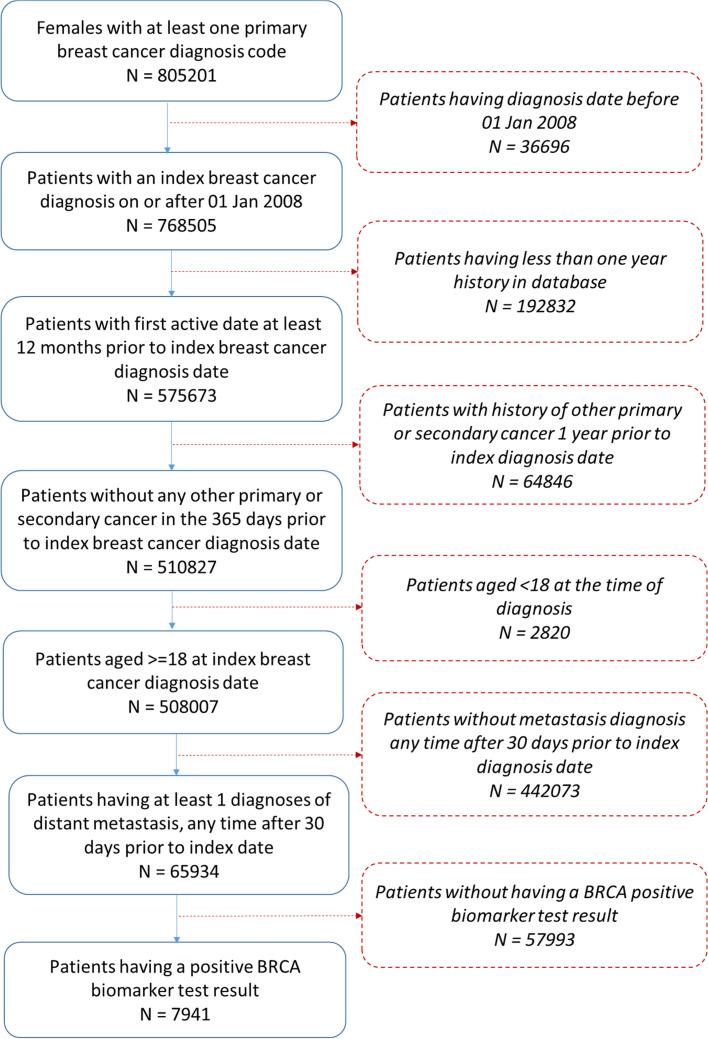
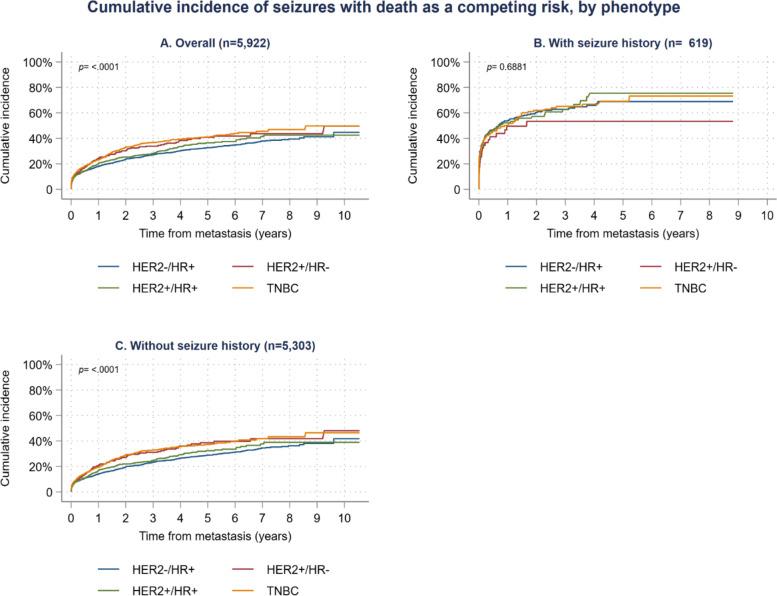
The Optum® de-identified electronic health records database was used. Females with a BC diagnoses between 2008 and 2018, with clinic visits 12 months before BC index date, evidence of BRCA mutation (BRCA+), evidence of metastasis, and no previous cancers were included. Analyses were stratified by the overall BRCA+ cohort and 4 molecular phenotypes: HER2+/HR- (human epidermal growth factor 2/hormone receptor), HER2-/HR+, HER2+/HR+, and triple negative BC (TNBC; HER2-/HR-). Seizures were identified using diagnosis codes and natural language processing. Incidence, occurrence rates, and cumulative incidence of seizures from the diagnosis of metastasis to the end of follow up were calculated. Comparisons were made between phenotypes and stratified on PARP inhibitor use, diagnosed brain metastases, history of seizures, and anticonvulsants use before BC. All comparisons included age at metastasis, number of prior lines of treatment, and metastasis location as covariates.
RESULTS
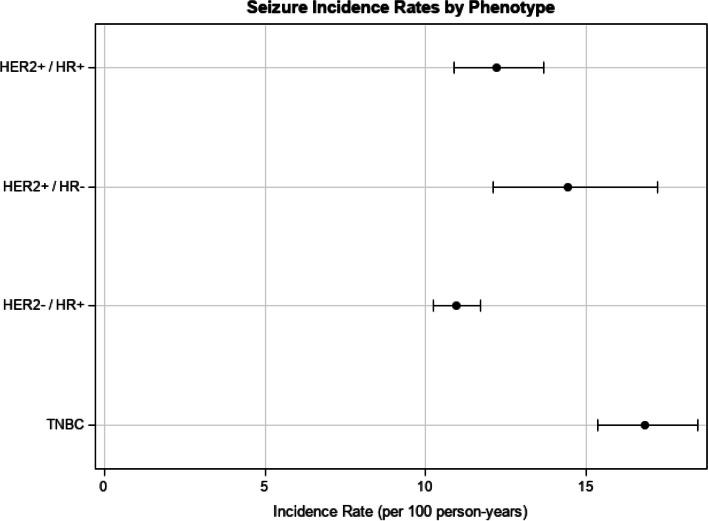
27.8% of 7941 BRCA+ patients had ≥1 seizure over a mean follow-up time of 2.35 years. Incidence and occurrence rates were 11.83 (95% CI: 11.35-12.33) and 201.3 (95% CI: 198.05-204.50), respectively, per 100 person-years. HER2-/HR+ and TNBC patients had the lowest and highest seizure incidence rates, respectively (10.94 [95% CI: 10.23-11.71] and 16.83 [95% CI: 15.34-18.46]). With HER2-/HR+ as the reference group in a competing risk analysis, TNBC (hazard ratio, HR = 1.35; 95%CI: 1.21, 1.52; p < 0.001) and HER2+/HR- (HR = 1.29; 95%CI: 1.07, 1.56; p < 0.01) patients had a greater risk of seizures. Patients with diagnosed brain metastases or a history of seizures had higher seizure rates. Incidence trended higher with PARP inhibitor use, but patient numbers were low.
CONCLUSIONS
This study provides novel real-world evidence on seizure incidence rates in BRCA+ BC patients, even those without diagnosed brain metastases, and underscores the need to understand patients' tumor phenotypes when assessing seizure risk. These findings may have implications for clinical practice and assessment of benefit-risk ratios of new therapeutic agents.
背景
在患有晚期乳腺癌(BC)和脑转移的女性中,癫痫发作的发生率和风险因素在治疗相关或临床亚型方面尚未得到很好的描述。本研究利用大型真实世界数据集,描述了与 BRCA 相关的转移性乳腺癌中癫痫发作的发生率和风险因素。
方法
使用 Optum®去识别电子健康记录数据库。2008 年至 2018 年期间患有 BC 的女性,在 BC 索引日期前 12 个月有就诊记录,有 BRCA 突变(BRCA+)证据、有转移证据且无既往癌症的女性被纳入研究。分析分为总体 BRCA+队列和 4 种分子表型:HER2+/HR-(人表皮生长因子 2/激素受体)、HER2-/HR+、HER2+/HR+和三阴性乳腺癌(TNBC;HER2-/HR-)。使用诊断代码和自然语言处理来识别癫痫发作。从转移的诊断到随访结束,计算癫痫发作的发生率、发生率和累积发生率。在 PARP 抑制剂的使用、诊断性脑转移、癫痫发作史和 BC 前抗癫痫药物的使用情况上进行表型之间的比较。所有比较均包括转移时的年龄、治疗前的线数和转移部位作为协变量。
结果
7941 例 BRCA+患者中有 27.8%有≥1 次癫痫发作,平均随访时间为 2.35 年。发病率和发生率分别为 11.83(95%CI:11.35-12.33)和 201.3(95%CI:198.05-204.50),每 100 人年。HER2-/HR+和 TNBC 患者的癫痫发作发病率最低和最高,分别为 10.94(95%CI:10.23-11.71)和 16.83(95%CI:15.34-18.46)。在竞争风险分析中,以 HER2-/HR+为参考组,TNBC(风险比,HR=1.35;95%CI:1.21,1.52;p<0.001)和 HER2+/HR-(HR=1.29;95%CI:1.07,1.56;p<0.01)患者的癫痫发作风险更高。有诊断性脑转移或癫痫发作史的患者癫痫发作率更高。PARP 抑制剂的使用与发病率呈趋势性增高,但患者人数较少。
结论
本研究提供了 BRCA+BC 患者癫痫发作发生率的新的真实世界证据,即使是那些没有诊断性脑转移的患者,也强调了在评估癫痫发作风险时需要了解患者的肿瘤表型。这些发现可能对临床实践和评估新治疗药物的获益风险比具有重要意义。
 Zotero 插件