
使用神经网络实现更快、更准确的几何光学光力计算。
Faster and More Accurate Geometrical-Optics Optical Force Calculation Using Neural Networks.
作者信息
Bronte Ciriza David, Magazzù Alessandro, Callegari Agnese, Barbosa Gunther, Neves Antonio A R, Iatì Maria Antonia, Volpe Giovanni, Maragò Onofrio M
机构信息
CNR-IPCF, Istituto per i Processi Chimico-Fisici, I-98158Messina, Italy.
Department of Physics, University of Gothenburg, SE-41296Gothenburg, Sweden.
出版信息
ACS Photonics. 2022 Dec 19;10(1):234-241. doi: 10.1021/acsphotonics.2c01565. eCollection 2023 Jan 18.
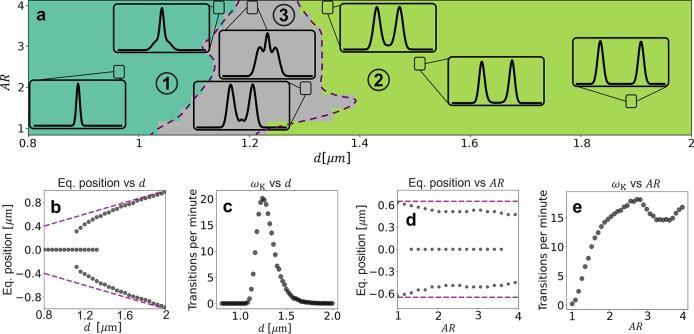
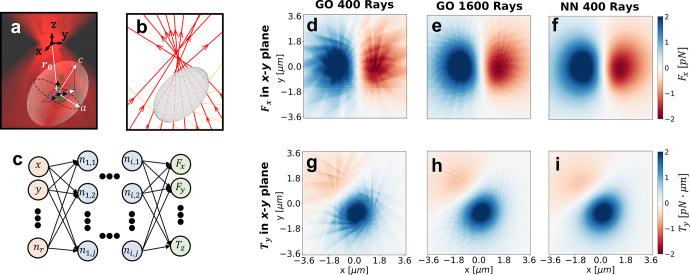
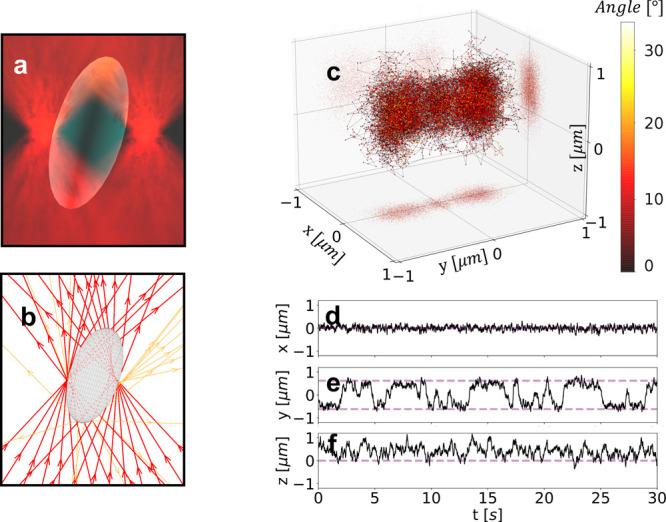
Optical forces are often calculated by discretizing the trapping light beam into a set of rays and using geometrical optics to compute the exchange of momentum. However, the number of rays sets a trade-off between calculation speed and accuracy. Here, we show that using neural networks permits overcoming this limitation, obtaining not only faster but also more accurate simulations. We demonstrate this using an optically trapped spherical particle for which we obtain an analytical solution to use as ground truth. Then, we take advantage of the acceleration provided by neural networks to study the dynamics of ellipsoidal particles in a double trap, which would be computationally impossible otherwise.
光力通常通过将捕获光束离散为一组光线,并使用几何光学来计算动量交换来进行计算。然而,光线的数量在计算速度和精度之间进行了权衡。在这里,我们表明使用神经网络可以克服这一限制,不仅可以获得更快的模拟,而且可以获得更准确的模拟。我们使用一个光学捕获的球形粒子来证明这一点,对于该粒子我们获得了一个解析解作为基准真值。然后,我们利用神经网络提供的加速来研究双阱中椭球形粒子的动力学,否则这在计算上是不可能的。


 Zotero 插件