
不同植物油对C57/BL小鼠非酒精性脂肪性肝病的影响
Effects of Different Vegetable Oils on the Nonalcoholic Fatty Liver Disease in C57/BL Mice.
作者信息
Manca Camila Sanches, Cordeiro Simões-Ambrosio Lívia Maria, Ovídio Paula Payão, Ramalho Leandra Zambelli, Jordao Alceu Afonso
机构信息
Department of Internal Medicine, Faculty of Medicine of Ribeirão Preto, University of São Paulo, Av. Bandeirantes 3900, Ribeirão Preto, SP 14049-900, Brazil.
Department of Pathology, Faculty of Medicine of Ribeirão Preto, University of São Paulo, Ribeirão Preto, São Paulo, Brazil.
出版信息
Evid Based Complement Alternat Med. 2023 Jan 14;2023:4197955. doi: 10.1155/2023/4197955. eCollection 2023.
BACKGROUND
Nonalcoholic fatty liver disease (NAFLD) is the most common hepatic disorder, affecting 22-28% of the adult population and more than 50% of obese people all over the world. Modulation of the fatty acids in diet as a means of prevention against nonalcoholic fatty liver disease in animal models (NAFLD) remains unclear. The treatment of NAFLD has not been described in specific guidelines so far. Thus, the justification for the study is to check modifications in macronutrients composition, fatty acids, in particular, play a significant role in the treatment of NAFLD regardless of weight loss.
AIM
To investigate different vegetable oils in prevention and progression of NAFLD in animal models.
METHODS
For the experiment were used fifty C57BL/6J mice male fed with high fat and fructose diet (HFD) to induce the NAFLD status and they received different commercial vegetable oils for 16 weeks to prevent steatosis. Liver steatosis and oxidative stress parameters were analyzed using biochemical and histological methods. Fatty acids profile in the oils and in the liver samples was obtained.
RESULTS
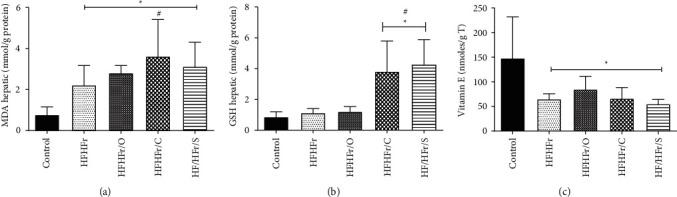
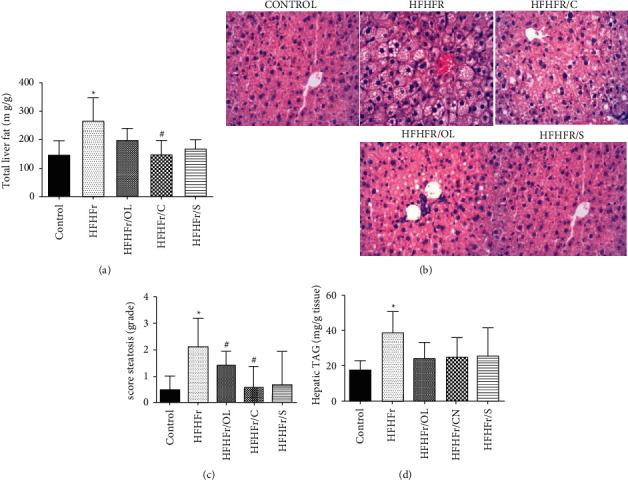
The high fat and fructose diet led to obesity and the vegetable oils offered were effective in maintaining body weight similar to the control group. At the end of the experiment (16 weeks), the HFHFr group had a greater body weight compared to control and treated groups (HFHFr: 44.20 ± 2.34 g/animal vs. control: 34.80 ± 3.45 g/animal; < 0.001; HFHFr/OL: 35.40 ± 4.19 g/animal; HFHFr/C: 36.10 ± 3.92 g/animal; HFHFr/S: 36.25 ± 5.70 g/animal; < 0.01). Furthermore, the HFD diet has caused an increase in total liver fat compared to control ( < 0.01). Among the treated groups, the animals receiving canola oil showed a reduction of hepatic and retroperitoneal fat ( < 0.05). These biochemical levels were positively correlated with the hepatic histology findings. Hepatic levels of omega-3 decreased in the olive oil and high fat diet groups compared to the control group, whereas these levels increased in the groups receiving canola and soybean oil compared to control and the high fat groups.
CONCLUSION
In conclusion, the commercial vegetable oils either contributed to the prevention or reduction of induced nonalcoholic fatty liver with high fat and fructose diet, especially canola oil.
背景
非酒精性脂肪性肝病(NAFLD)是最常见的肝脏疾病,影响着全球22%-28%的成年人口以及超过50%的肥胖人群。在动物模型中,通过调节饮食中的脂肪酸来预防非酒精性脂肪性肝病(NAFLD)的方法仍不明确。目前尚无针对NAFLD治疗的具体指南。因此,本研究的目的是检验常量营养素组成的变化,尤其是脂肪酸,无论体重减轻与否,在NAFLD治疗中都起着重要作用。
目的
研究不同植物油对动物模型中NAFLD的预防和进展情况。
方法
选用50只雄性C57BL/6J小鼠,喂食高脂肪和高果糖饮食(HFD)以诱导NAFLD状态,并给予不同的市售植物油,持续16周以预防脂肪变性。采用生化和组织学方法分析肝脏脂肪变性和氧化应激参数。获取植物油和肝脏样本中的脂肪酸谱。
结果
高脂肪和高果糖饮食导致肥胖,所提供的植物油在维持体重方面与对照组相似。实验结束时(16周),HFHFr组的体重高于对照组和治疗组(HFHFr:44.20±2.34g/只 vs. 对照组:34.80±3.45g/只;<0.001;HFHFr/OL:35.40±4.19g/只;HFHFr/C:36.10±3.92g/只;HFHFr/S:36.25±5.70g/只;<0.01)。此外,与对照组相比,HFD饮食导致肝脏总脂肪增加(<0.01)。在治疗组中,接受菜籽油的动物肝脏和腹膜后脂肪减少(<0.05)。这些生化水平与肝脏组织学结果呈正相关。与对照组相比,橄榄油和高脂肪饮食组的肝脏ω-3水平降低,而与对照组和高脂肪组相比,接受菜籽油和大豆油的组中这些水平升高。
结论
总之,市售植物油有助于预防或减轻高脂肪和高果糖饮食诱导的非酒精性脂肪肝,尤其是菜籽油。

 Zotero 插件