
父母受教育程度与 45 个中低收入国家父母和儿童同时营养不良之间的关联。
Association Between Parental Education and Simultaneous Malnutrition Among Parents and Children in 45 Low- and Middle-Income Countries.
机构信息
Vanke School of Public Health, Tsinghua University, Beijing, China.
Institute for Healthy China, Tsinghua University, Beijing, China.
出版信息
JAMA Netw Open. 2023 Jan 3;6(1):e2251727. doi: 10.1001/jamanetworkopen.2022.51727.
IMPORTANCE
Parental education is known to be associated with the health status of parents and their offspring. However, the association between parental education and the simultaneous manifestation of multiple forms of malnutrition within households remains underinvestigated globally.
OBJECTIVE
To assess the association between parental education and the simultaneous manifestation of malnutrition of both parent and child (either overnutrition or undernutrition)-referred to as the double burden of malnutrition (DBM)-at the household level in mother-child and father-child pairs in low- and middle-income countries (LMICs).
DESIGN, SETTING, AND PARTICIPANTS: This cross-sectional study used data from the US Agency for International Development Demographic and Health Surveys (January 1, 2010, to December 31, 2021) to identify mother-child pairs and father-child pairs from LMICs. The eligibility criteria were as follows: (1) children aged 0 to 59 months; (2) nonpregnant mothers at the time of the survey in the sample of mother-child pairs; and (3) valid measures of the weight, height, and hemoglobin level for the child and at least 1 of their parents.
EXPOSURES
Highest level of parental education obtained and number of years of education completed.
MAIN OUTCOMES AND MEASURES
Four sets of multivariable logistic regression models were constructed to assess the association between parental education and DBM, and analysis was performed between March 10 and May 15, 2022.
RESULTS
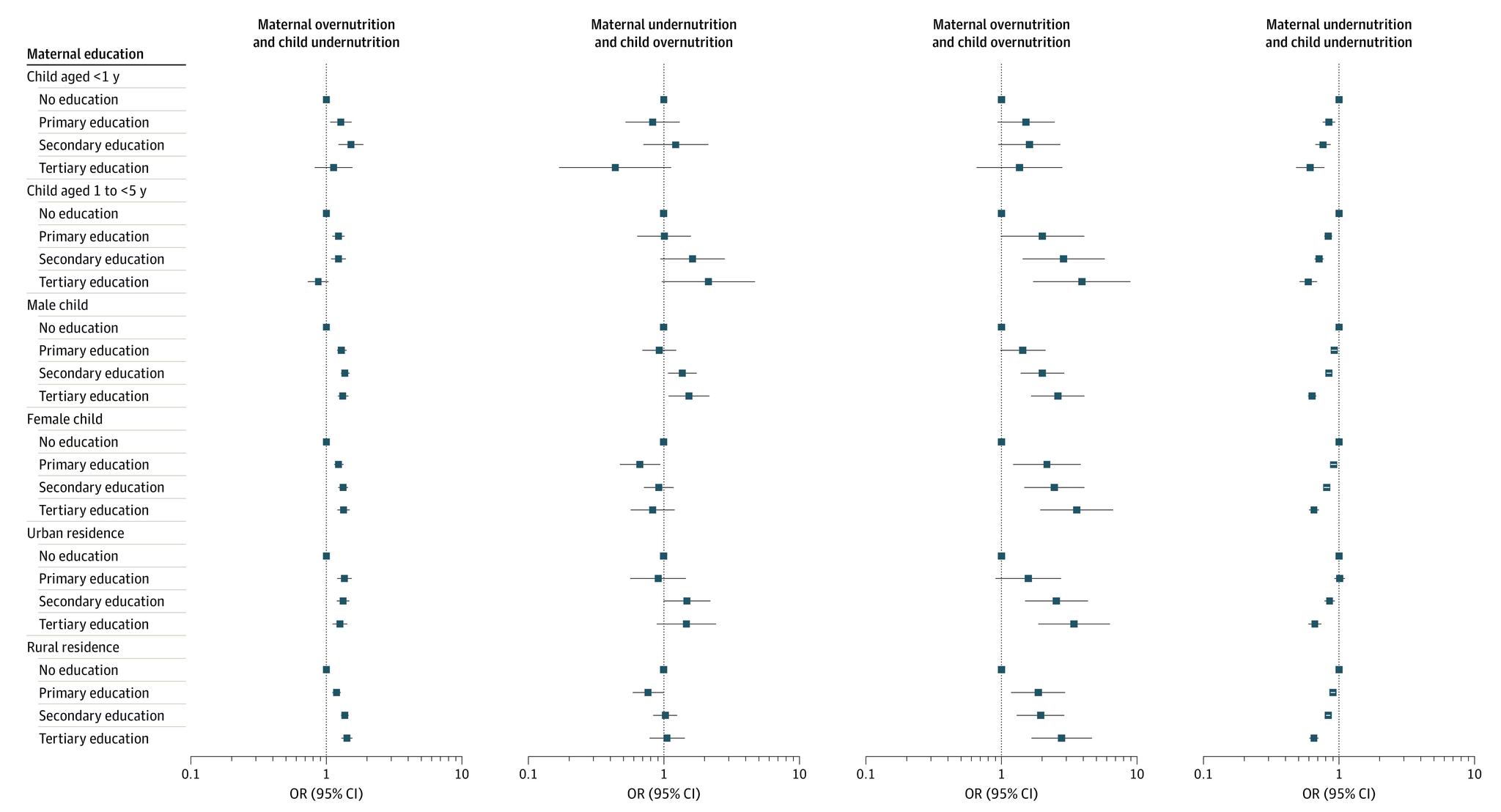
This study included 423 340 mother-child pairs from 45 LMICs and 56 720 father-child pairs from 16 LMICs. The mean (SD) age of the mother-child pairs was 28.2 (6.1) and 1.9 (1.4) years, respectively; 48.8% of the children were female. We observed that 49.0% of mother-child pairs experienced DBM. Compared with mother-child pairs with no maternal education, higher maternal education was associated with a lower risk of DBM. For example, the odds ratio (OR) for tertiary maternal education was 0.71 (95% CI, 0.67-0.74). However, the association differed by DBM subtypes: higher maternal education was associated with a lower risk of both mothers and children being undernourished but with a higher risk of almost all DBM subtypes involving overnutrition. For example, compared with mother-child pairs with no maternal education, those with secondary education were less likely to develop simultaneous maternal and child undernutrition (OR, 0.83 [95% CI, 0.80-0.86]) but were more likely to experience simultaneous maternal and child overnutrition (OR, 2.20 [95% CI, 1.61-3.00]); similar results were observed for pairs with primary and tertiary education. The results in mother-child pairs remained consistent after controlling for paternal education. Among the father-child pairs, 26.5% had DBM, with fathers with tertiary education significantly more likely to experience simultaneous paternal overnutrition and child undernutrition (OR, 1.55 [95% CI, 1.23-1.95]) compared with pairs with no paternal education; they were also less likely to have both paternal and child undernutrition (OR, 0.70 [95% CI, 0.59-0.84]).
CONCLUSIONS AND RELEVANCE
In this study, maternal education and paternal education were independently associated with DBM, and the associations differed by DBM subtypes. These findings suggest that the different risks of malnutrition faced by households with various levels of education should thus be considered in policy evaluation.
重要性
已知父母的受教育程度与父母和他们后代的健康状况有关。然而,全球范围内对父母教育与家庭中多种形式营养不良同时出现之间的关联仍研究不足。
目的
评估父母教育与母子和父子对子中父母和孩子(超重或营养不足)同时出现营养不良(DBM)的关联——称为营养不良的双重负担(DBM)——在中低收入国家(LMIC)的家庭层面。
设计、设置和参与者:这项横断面研究使用了美国国际开发署人口与健康调查(2010 年 1 月 1 日至 2021 年 12 月 31 日)的数据,从 LMIC 中确定母子对子和父子对子。入选标准如下:(1)0 至 59 月龄儿童;(2)在母子对子样本中,调查时非怀孕母亲;(3)儿童的体重、身高和血红蛋白水平的有效测量值,以及至少 1 位父母的这些值。
暴露情况
获得的最高父母教育水平和完成的教育年限。
主要结果和测量
构建了四组多变量逻辑回归模型来评估父母教育与 DBM 的关联,并于 2022 年 3 月 10 日至 5 月 15 日之间进行了分析。
结果
本研究包括来自 45 个 LMIC 的 423340 对母子对子和来自 16 个 LMIC 的 56720 对父子对子。母子对子的平均(SD)年龄分别为 28.2(6.1)和 1.9(1.4)岁,分别为 48.8%的儿童为女性。我们观察到 49.0%的母子对子经历了 DBM。与没有母亲教育的母子对子相比,较高的母亲教育与 DBM 的风险较低相关。例如,母亲接受高等教育的优势比(OR)为 0.71(95%CI,0.67-0.74)。然而,这种关联因 DBM 亚型而异:较高的母亲教育与母亲和儿童营养不足的风险降低有关,但与涉及营养过剩的几乎所有 DBM 亚型的风险升高有关。例如,与没有母亲教育的母子对子相比,接受中等教育的母子对子更不可能同时出现母亲和儿童营养不足(OR,0.83[95%CI,0.80-0.86]),但更有可能同时出现母亲和儿童营养过剩(OR,2.20[95%CI,1.61-3.00]);接受小学和高等教育的对子也观察到了类似的结果。在控制了父亲的教育之后,母子对子的结果仍然一致。在父子对子中,26.5%的对子存在 DBM,与没有父亲教育的对子相比,父亲接受高等教育更有可能同时出现父亲营养过剩和儿童营养不足(OR,1.55[95%CI,1.23-1.95]);他们也不太可能同时出现父亲和儿童营养不足(OR,0.70[95%CI,0.59-0.84])。
结论和相关性
在这项研究中,母亲教育和父亲教育与 DBM 独立相关,而且这种关联因 DBM 亚型而异。这些发现表明,应在政策评估中考虑具有不同教育水平的家庭面临的不同营养不良风险。

 Zotero 插件