
奥密克戎变异株增加了严重急性呼吸综合征冠状病毒2(SARS-CoV-2)刺突蛋白的结构域间相互作用并减少了表位暴露。
Omicron mutations increase interdomain interactions and reduce epitope exposure in the SARS-CoV-2 spike.
作者信息
Wieczór Miłosz, Tang Phu K, Orozco Modesto, Cossio Pilar
机构信息
Institute for Research in Biomedicine (IRB Barcelona), Barcelona Institute of Science and Technology, 08028 Barcelona, Spain.
Department of Physical Chemistry, Gdansk University of Technology, 80-233 Gdansk, Poland.
出版信息
iScience. 2023 Feb 17;26(2):105981. doi: 10.1016/j.isci.2023.105981. Epub 2023 Jan 20.
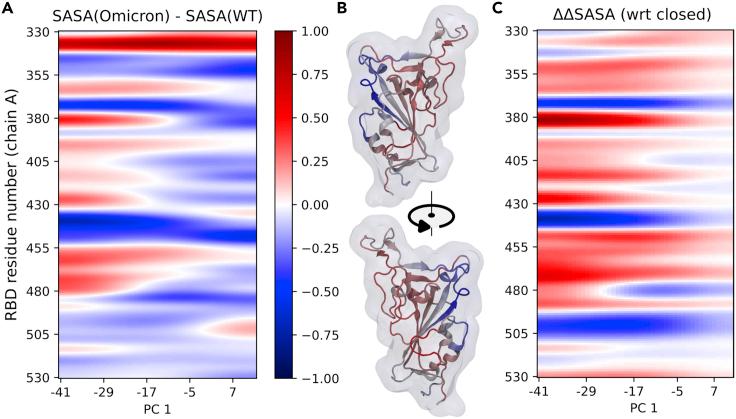
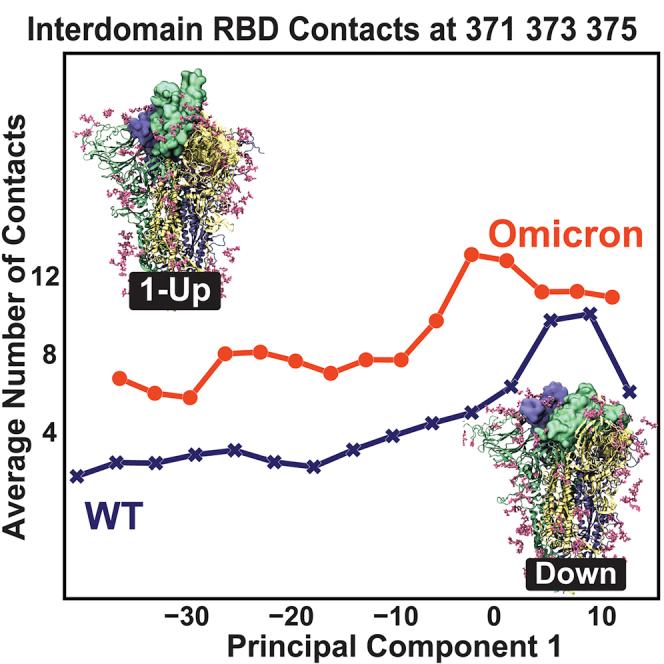
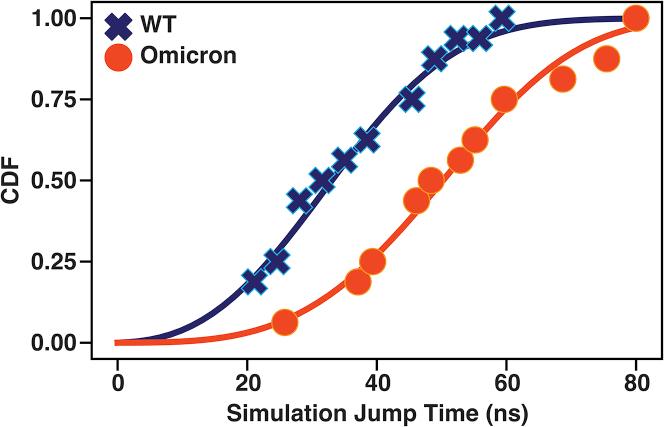
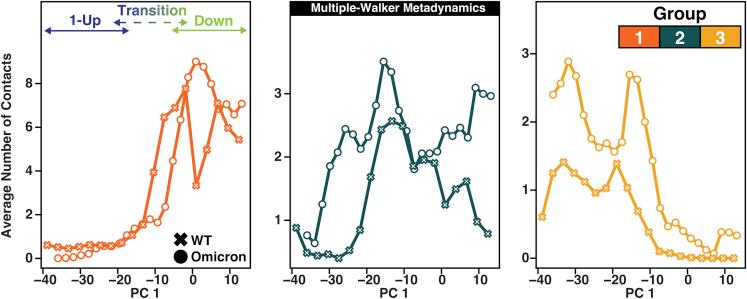
Omicron BA.1 is a highly infectious variant of SARS-CoV-2 that carries more than thirty mutations on the spike protein in comparison to the Wuhan wild type (WT). Some of the Omicron mutations, located on the receptor-binding domain (RBD), are exposed to the surrounding solvent and are known to help evade immunity. However, the impact of buried mutations on the RBD conformations and on the mechanics of the spike opening is less evident. Here, we use all-atom molecular dynamics (MD) simulations with metadynamics to characterize the thermodynamic RBD-opening ensemble, identifying significant differences between WT and Omicron. Specifically, the Omicron mutations S371L, S373P, and S375F make more RBD interdomain contacts during the spike's opening. Moreover, Omicron takes longer to reach the transition state than WT. It stabilizes up-state conformations with fewer RBD epitopes exposed to the solvent, potentially favoring immune or antibody evasion.
奥密克戎BA.1是一种传染性很强的严重急性呼吸综合征冠状病毒2(SARS-CoV-2)变体,与武汉野生型(WT)相比,其刺突蛋白携带30多个突变。奥密克戎的一些突变位于受体结合域(RBD),暴露于周围溶剂中,已知有助于逃避免疫。然而,RBD中埋藏突变对其构象和刺突开放机制的影响尚不明显。在此,我们使用带有元动力学的全原子分子动力学(MD)模拟来表征热力学RBD开放系综,确定WT和奥密克戎之间的显著差异。具体而言,奥密克戎突变S371L、S373P和S375F在刺突开放过程中形成更多的RBD结构域间接触。此外,奥密克戎达到过渡态的时间比WT更长。它稳定了上态构象,暴露于溶剂中的RBD表位较少,这可能有利于逃避免疫或抗体。


 Zotero 插件