
急性肾损伤与适应性不良的肾脏修复中的自噬
Autophagy in acute kidney injury and maladaptive kidney repair.
作者信息
Xiang Yu, Fu Ying, Wu Wenwen, Tang Chengyuan, Dong Zheng
机构信息
Department of Nephrology, Hunan Key Laboratory of Kidney Disease and Blood Purification, The Second Xiangya Hospital at Central South University, Changsha 410000, Hunan Province, China.
Department of Cellular Biology and Anatomy, Medical College of Georgia at Augusta University and Charlie Norwood VA Medical Center, Augusta, GA 30912, USA.
出版信息
Burns Trauma. 2023 Jan 22;11:tkac059. doi: 10.1093/burnst/tkac059. eCollection 2023.
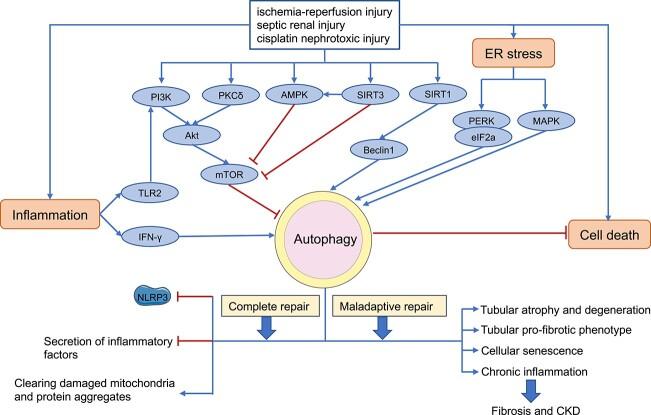
Acute kidney injury (AKI) is a major renal disease characterized by a sudden decrease in kidney function. After AKI, the kidney has the ability to repair, but if the initial injury is severe the repair may be incomplete or maladaptive and result in chronic kidney problems. Autophagy is a highly conserved pathway to deliver intracellular contents to lysosomes for degradation. Autophagy plays an important role in maintaining renal function and is involved in the pathogenesis of renal diseases. Autophagy is activated in various forms of AKI and acts as a defense mechanism against kidney cell injury and death. After AKI, autophagy is maintained at a relatively high level in kidney tubule cells during maladaptive kidney repair but the role of autophagy in maladaptive kidney repair has been controversial. Nonetheless, recent studies have demonstrated that autophagy may contribute to maladaptive kidney repair after AKI by inducing tubular degeneration and promoting a profibrotic phenotype in renal tubule cells. In this review, we analyze the role and regulation of autophagy in kidney injury and repair and discuss the therapeutic strategies by targeting autophagy.
急性肾损伤(AKI)是一种主要的肾脏疾病,其特征是肾功能突然下降。AKI发生后,肾脏具有修复能力,但如果初始损伤严重,修复可能不完全或不适应,从而导致慢性肾脏问题。自噬是一种高度保守的途径,可将细胞内物质输送到溶酶体进行降解。自噬在维持肾功能中起重要作用,并参与肾脏疾病的发病机制。自噬在各种形式的AKI中被激活,并作为对抗肾细胞损伤和死亡的防御机制。AKI发生后,在适应性不良的肾脏修复过程中,自噬在肾小管细胞中维持在相对较高的水平,但自噬在适应性不良的肾脏修复中的作用一直存在争议。尽管如此,最近的研究表明,自噬可能通过诱导肾小管变性和促进肾小管细胞中的促纤维化表型而导致AKI后适应性不良的肾脏修复。在这篇综述中,我们分析了自噬在肾脏损伤和修复中的作用及调控,并讨论了以自噬为靶点的治疗策略。
 Zotero 插件