
尽管胰岛β细胞丧失,人胰腺毛细血管和神经纤维在 1 型糖尿病中仍然存在。
Human pancreatic capillaries and nerve fibers persist in type 1 diabetes despite beta cell loss.
机构信息
Department of Molecular Physiology and Biophysics, Vanderbilt University, Nashville, Tennessee, United States.
Division of Diabetes, Endocrinology, and Metabolism, Department of Medicine, Vanderbilt University Medical Center, Nashville, Tennessee, United States.
出版信息
Am J Physiol Endocrinol Metab. 2023 Mar 1;324(3):E251-E267. doi: 10.1152/ajpendo.00246.2022. Epub 2023 Jan 25.
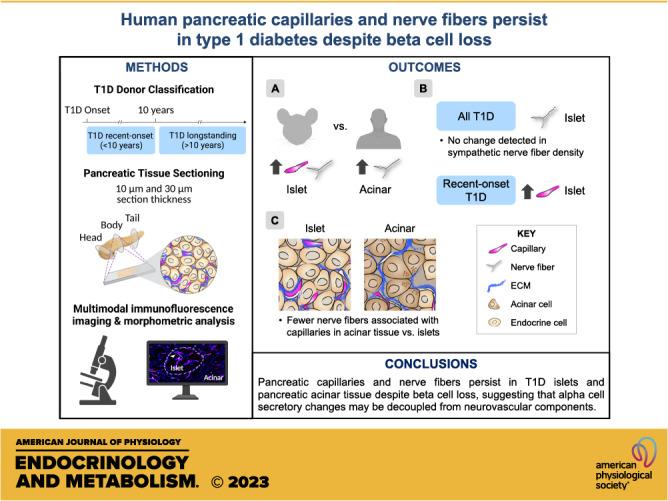
The autonomic nervous system regulates pancreatic function. Islet capillaries are essential for the extension of axonal projections into islets, and both of these structures are important for appropriate islet hormone secretion. Because beta cells provide important paracrine cues for islet glucagon secretion and neurovascular development, we postulated that beta cell loss in type 1 diabetes (T1D) would lead to a decline in intraislet capillaries and reduction of islet innervation, possibly contributing to abnormal glucagon secretion. To define morphological characteristics of capillaries and nerve fibers in islets and acinar tissue compartments, we analyzed neurovascular assembly across the largest cohort of T1D and normal individuals studied thus far. Because innervation has been studied extensively in rodent models of T1D, we also compared the neurovascular architecture between mouse and human pancreas and assembled transcriptomic profiles of molecules guiding islet angiogenesis and neuronal development. We found striking interspecies differences in islet neurovascular assembly but relatively modest differences at transcriptome level, suggesting that posttranscriptional regulation may be involved in this process. To determine whether islet neurovascular arrangement is altered after beta cell loss in T1D, we compared pancreatic tissues from non-diabetic, recent-onset T1D (<10-yr duration), and longstanding T1D (>10-yr duration) donors. Recent-onset T1D showed greater islet and acinar capillary density compared to non-diabetic and longstanding T1D donors. Both recent-onset and longstanding T1D had greater islet nerve fiber density compared to non-diabetic donors. We did not detect changes in sympathetic axons in either T1D cohort. Additionally, nerve fibers overlapped with extracellular matrix (ECM), supporting its role in the formation and function of axonal processes. These results indicate that pancreatic capillaries and nerve fibers persist in T1D despite beta cell loss, suggesting that alpha cell secretory changes may be decoupled from neurovascular components. Defining the neurovascular architecture in the pancreas of individuals with type 1 diabetes (T1D) is crucial to understanding the mechanisms of dysregulated glucagon secretion. In the largest T1D cohort of biobanked tissues analyzed to date, we found that pancreatic capillaries and nerve fibers persist in human T1D despite beta cell loss, suggesting that alpha cell secretory changes may be decoupled from neurovascular components. Because innervation has been studied extensively in rodent T1D models, our studies also provide the first rigorous direct comparisons of neurovascular assembly in mouse and human, indicating dramatic interspecies differences.
自主神经系统调节胰腺功能。胰岛毛细血管对于轴突投射进入胰岛的延伸至关重要,这两种结构对于适当的胰岛激素分泌都很重要。由于β细胞为胰岛胰高血糖素分泌和神经血管发育提供重要的旁分泌线索,我们假设 1 型糖尿病(T1D)中的β细胞损失会导致胰岛内毛细血管减少和胰岛神经支配减少,这可能导致胰高血糖素分泌异常。为了定义胰岛和腺泡组织隔室中毛细血管和神经纤维的形态特征,我们分析了迄今为止研究过的最大 T1D 和正常个体队列中的神经血管组装。由于在 T1D 的啮齿动物模型中已经广泛研究了神经支配,我们还比较了小鼠和人胰腺的神经血管结构,并组装了指导胰岛血管生成和神经元发育的分子的转录组谱。我们发现胰岛神经血管组装在物种间存在显著差异,但在转录组水平上差异相对较小,这表明转录后调节可能参与了这一过程。为了确定 T1D 中β细胞损失后胰岛神经血管排列是否发生改变,我们比较了非糖尿病、近期发病(<10 年)和长期(>10 年)T1D 供体的胰腺组织。与非糖尿病和长期 T1D 供体相比,近期发病的 T1D 胰岛和腺泡毛细血管密度更高。近期发病和长期 T1D 的胰岛神经纤维密度均高于非糖尿病供体。我们在两个 T1D 队列中均未检测到交感神经轴突的变化。此外,神经纤维与细胞外基质(ECM)重叠,支持其在轴突过程的形成和功能中的作用。这些结果表明,尽管存在β细胞损失,但胰腺毛细血管和神经纤维在 T1D 中仍然存在,这表明α细胞分泌变化可能与神经血管成分脱耦。定义 1 型糖尿病(T1D)个体的神经血管结构对于理解胰高血糖素分泌失调的机制至关重要。在迄今为止分析的最大 T1D 生物库组织队列中,我们发现尽管存在β细胞损失,但人类 T1D 中的胰腺毛细血管和神经纤维仍然存在,这表明α细胞分泌变化可能与神经血管成分脱耦。由于在啮齿动物 T1D 模型中已经广泛研究了神经支配,我们的研究还首次提供了小鼠和人类神经血管组装的严格直接比较,表明存在显著的种间差异。
 Zotero 插件