
采用 LC-MS/MS 法测定脑缺血再灌注损伤大鼠及氧糖剥夺 HT22 细胞内源性神经鞘脂含量。
Determination of endogenous sphingolipid content in stroke rats and HT22 cells subjected to oxygen-glucose deprivation by LC‒MS/MS.
机构信息
Department of Pharmaceutics, College of Chinese Materia Medica, Guangzhou University of Chinese Medicine, Guangdong, 51006, Guangzhou, China.
出版信息
Lipids Health Dis. 2023 Jan 25;22(1):13. doi: 10.1186/s12944-022-01762-3.
BACKGROUND
Stroke is the leading cause of death in humans worldwide, and its incidence increases every year. It is well documented that lipids are closely related to stroke. Analyzing the changes in lipid content in the stroke model after absolute quantification and investigating whether changes in lipid content can predict stroke severity provides a basis for the combination of clinical stroke and quantitative lipid indicators.
METHODS
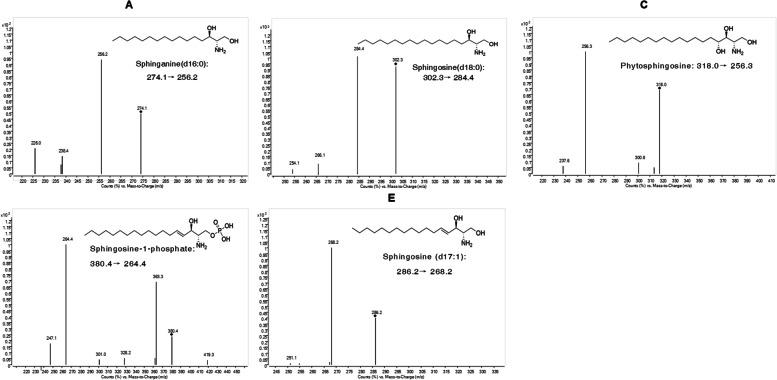
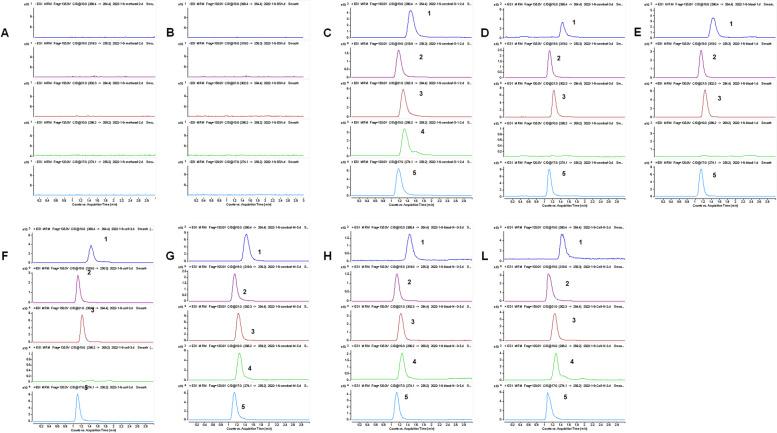
This paper establishes a rapid, sensitive, and reliable LC‒MS/MS analytical method for the detection of endogenous sphingolipids in rat serum and brain tissue and HT22 cells and quantifies the changes in sphingolipid content in the serum and brain tissue of rats from the normal and pMCAO groups and in cells from the normal and OGD/R groups. Using sphingosine (d17:1) as the internal standard, a chloroform: methanol (9:1) mixed system was used for protein precipitation and lipid extraction, followed by analysis by reversed-phase liquid chromatography coupled to triple quadrupole mass spectrometry.
RESULTS
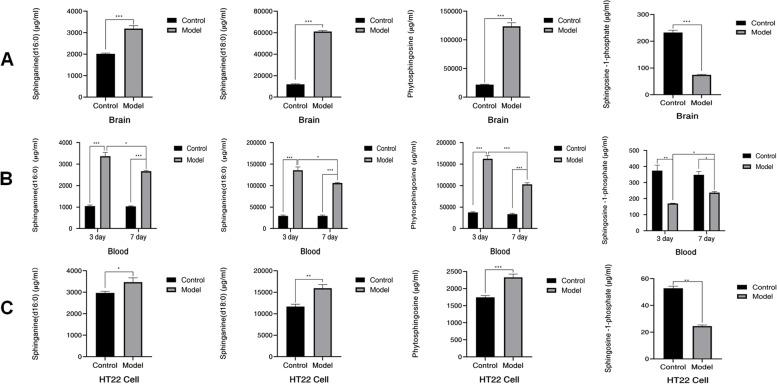
Based on absolute quantitative analysis of lipids in multiple biological samples, our results show that compared with those in the normal group, the contents of sphinganine (d16:0), sphinganine (d18:0), and phytosphingosine were significantly increased in the model group, except sphingosine-1-phosphate, which was decreased in various biological samples. The levels of each sphingolipid component in serum fluctuate with time.
CONCLUSION
This isotope-free and derivatization-free LC‒MS/MS method can achieve absolute quantification of sphingolipids in biological samples, which may also help identify lipid biomarkers of cerebral ischemia.
背景
脑卒中是全球范围内导致死亡的首要原因,其发病率逐年上升。有充分的文献记载表明,脂质与脑卒中密切相关。分析绝对定量后脑卒中模型中脂质含量的变化,研究脂质含量的变化是否可以预测脑卒中的严重程度,为临床脑卒中与定量脂质指标相结合提供依据。
方法
本研究建立了一种快速、灵敏、可靠的 LC-MS/MS 分析方法,用于检测大鼠血清和脑组织及 HT22 细胞内源性神经鞘脂,并定量检测正常和 pMCAO 组大鼠血清和脑组织及正常和 OGD/R 组细胞内神经鞘脂含量的变化。采用十六烷酸-d17:1 作为内标,采用氯仿-甲醇(9:1)混合体系进行蛋白沉淀和脂质提取,然后进行反相液相色谱-串联三重四极杆质谱分析。
结果
基于对多种生物样本脂质的绝对定量分析,我们的结果表明,与正常组相比,模型组大鼠血清和脑组织中神经鞘氨醇(d16:0)、神经鞘氨醇(d18:0)和植物鞘氨醇的含量明显升高,而神经鞘氨醇-1-磷酸在各种生物样本中则降低。血清中各神经鞘脂成分的水平随时间波动。
结论
本研究建立的无需同位素标记和衍生化的 LC-MS/MS 方法可实现生物样本中神经鞘脂的绝对定量,这可能有助于鉴定脑缺血的脂质生物标志物。
 Zotero 插件