
从自由基到无自由基:光介导生物制造的范式转变。
From Free-Radical to Radical-Free: A Paradigm Shift in Light-Mediated Biofabrication.
机构信息
Tissue Engineering + Biofabrication Laboratory, Department of Health Sciences & Technology, ETH Zürich, Otto-Stern-Weg 7, Zürich, 8093, Switzerland.
出版信息
Adv Sci (Weinh). 2023 Mar;10(8):e2205302. doi: 10.1002/advs.202205302. Epub 2023 Jan 25.
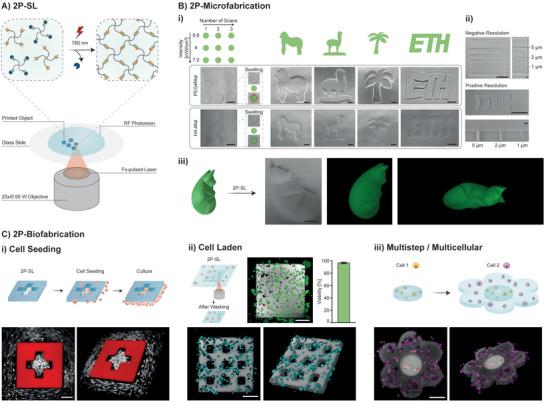
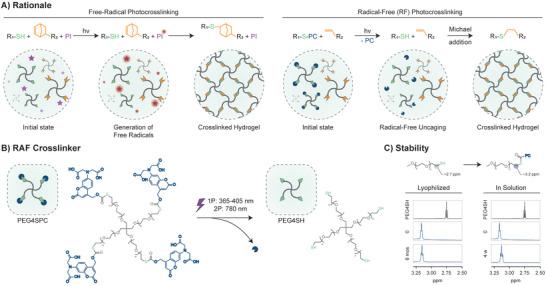
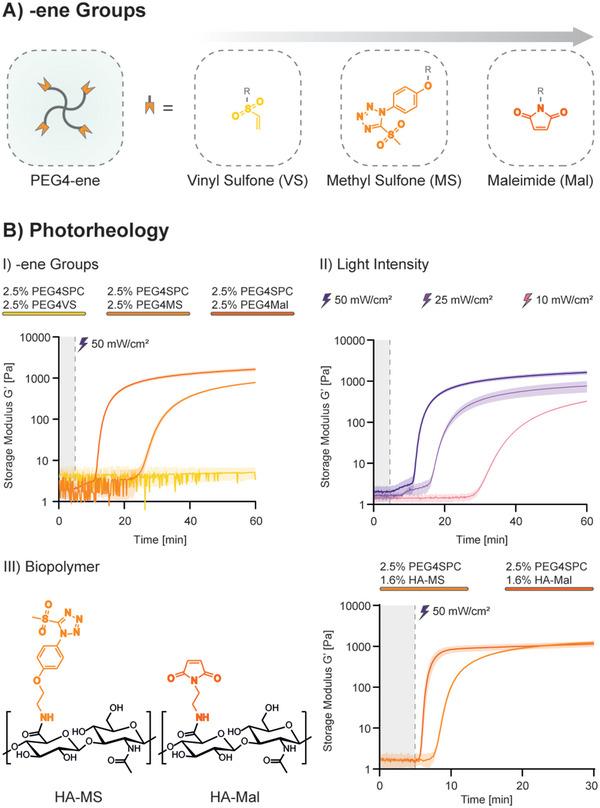
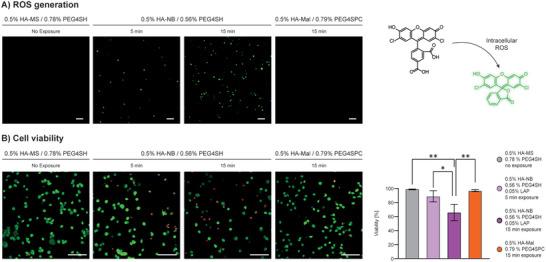
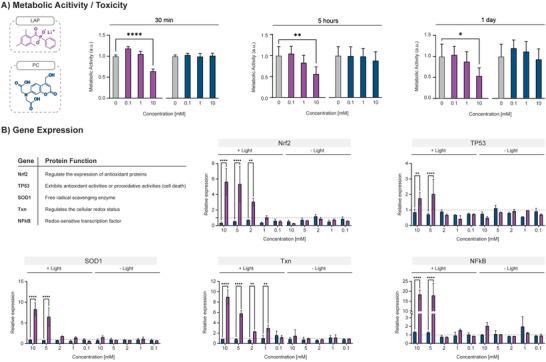
In recent years, the development of novel photocrosslinking strategies and photoactivatable materials has stimulated widespread use of light-mediated biofabrication techniques. However, despite great progress toward more efficient and biocompatible photochemical strategies, current photoresins still rely on photoinitiators (PIs) producing radical-initiating species to trigger the so-called free-radical crosslinking/polymerization. In the context of bioprinting, where cells are encapsulated in the bioink, the presence of radicals raises concerns of potential cytotoxicity. In this work, a universal, radical-free (RF) photocrosslinking strategy to be used for light-based technologies is presented. Leveraging RF uncaging mechanisms and Michael addition, cell-laden constructs are photocrosslinked by means of one- and two-photon excitation with high biocompatibility. A hydrophilic coumarin-based group is used to cage a universal RF photocrosslinker based on 4-arm-PEG-thiol (PEG4SH). Upon light exposure, thiols are uncaged and react with an alkene counterpart to form a hydrogel. RF photocrosslinker is shown to be highly stable, enabling potential for off-the-shelf products. While PI-based systems cause a strong upregulation of reactive oxygen species (ROS)-associated genes, ROS are not detected in RF photoresins. Finally, optimized RF photoresin is successfully exploited for high resolution two-photon stereolithography (2P-SL) using remarkably low polymer concentration (<1.5%), paving the way for a shift toward radical-free light-based bioprinting.
近年来,新型光交联策略和光活化材料的发展刺激了光介导生物制造技术的广泛应用。然而,尽管在更高效和更生物相容的光化学策略方面取得了巨大进展,但当前的光致树脂仍然依赖于产生自由基引发剂的光引发剂(PI)来触发所谓的自由基交联/聚合。在生物打印中,细胞被包裹在生物墨水中,自由基的存在引起了潜在细胞毒性的担忧。在这项工作中,提出了一种用于基于光的技术的通用、无自由基(RF)光交联策略。利用 RF 解笼机制和迈克尔加成,通过单光子和双光子激发,以高生物相容性对载细胞构建体进行光交联。使用亲水性香豆素基基团对基于 4 臂-PEG-巯基(PEG4SH)的通用 RF 光交联剂进行笼封。光暴露时,硫醇被解笼,并与烯烃对应物反应形成水凝胶。RF 光交联剂高度稳定,为即用型产品提供了可能性。虽然 PI 基系统会强烈上调与活性氧(ROS)相关的基因,但在 RF 光致树脂中未检测到 ROS。最后,优化的 RF 光致树脂成功地用于使用低至 1.5%(聚合物浓度)的高分辨率双光子立体光刻(2P-SL),为向无自由基的基于光的生物打印转变铺平了道路。
 Zotero 插件