
坚持终止高血压膳食方法饮食可降低患乳腺癌风险:一项系统评价与荟萃分析。
Adherence to the Dietary Approaches to Stop Hypertension diet reduces the risk of breast cancer: A systematic review and meta-analysis.
作者信息
Shu Long, Huang Yi-Qian, Zhang Xiao-Yan, Zheng Pei-Fen, Zhu Qin, Zhou Jian-Ying
机构信息
Department of Nutrition, Zhejiang Hospital, Hangzhou, Zhejiang, China.
Department of Digestion, Zhejiang Hospital, Hangzhou, Zhejiang, China.
出版信息
Front Nutr. 2023 Jan 9;9:1032654. doi: 10.3389/fnut.2022.1032654. eCollection 2022.
BACKGROUND
Despite increasing evidence for the association of adherence to the Dietary approaches to stop hypertension (DASH) diet with breast cancer risk, the results remain inconclusive. The purpose of the current systematic review was to summarize the evidence from previous observational studies and explore the potential association between DASH diet and breast cancer risk using meta-analysis.
METHODS
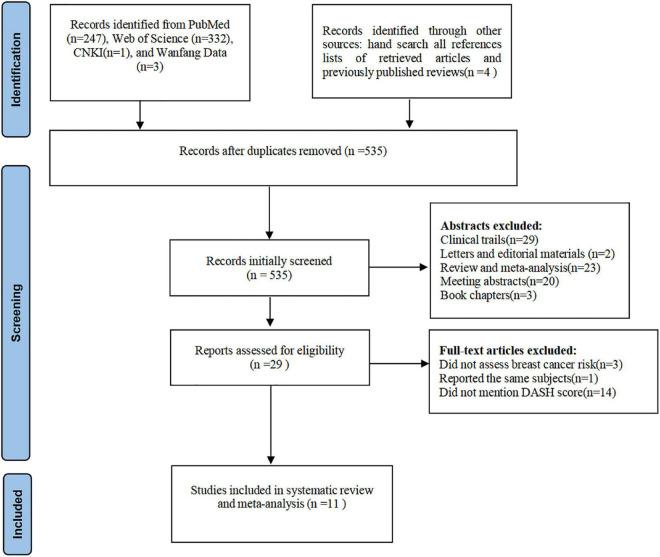
A comprehensive literature search was conducted using the databases of PubMed, Web of Science, CNKI and Wanfang Data to identify the relevant publications from inception up to July 2022. The pooled relative risks (RRs) and 95% confidence intervals (CIs) were calculated for the highest versus the lowest categories of DASH score in relation to breast cancer risk, using a random-effects model. The Cochran's test and I-squared ( ) statistic were used to detect the sources of heterogeneity among the included studies.
RESULTS
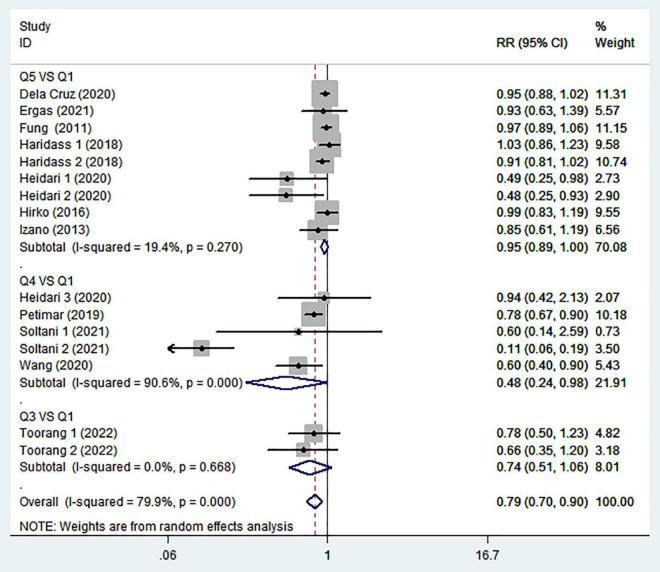
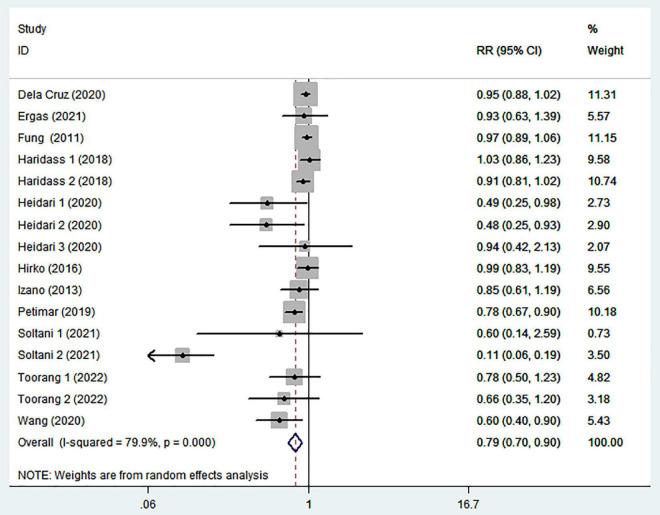
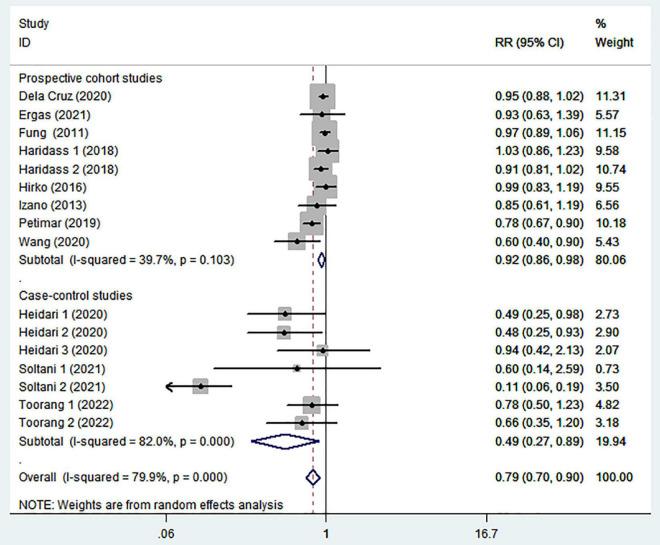
Overall, eleven studies, involving 23,254 breast cancer cases and 449,273 participants, were included in this systematic review and meta-analysis. Combining 16 effect sizes from 11 studies, a significant inverse association between adherence to the DASH diet and risk of breast cancer was observed (RR = 0.79; 95% CI: 0.70, 0.90, < 0.0001). Stratified analysis showed a significant association between adherence to the DASH diet and risk of breast cancer in case-control studies (RR = 0.49; 95% CI: 0.27-0.89, = 0.019), and a marginally significant association in prospective cohort studies (RR = 0.92; 95% CI: 0.86-0.98, = 0.014), respectively. Besides, a more significant association between DASH score and reduced risk of breast cancer was observed in Asian countries (RR = 0.50; 95% CI: 0.31-0.81, = 0.005) than in the United States (RR = 0.93; 95% CI: 0.89-0.99, = 0.012). Similarly, when we conducted analyses separately by menopausal status, we found a significant inverse association between DASH diet and breast cancer risk in postmenopausal women (RR = 0.58; 95% CI: 0.39-0.87, = 0.008).
CONCLUSION
The results of this systematic review and meta-analysis indicate a significant inverse association between adherence to the DASH diet and risk of breast cancer. Further large prospective studies and randomized controlled trials are required to confirm our findings.
背景
尽管越来越多的证据表明坚持终止高血压膳食疗法(DASH)饮食与乳腺癌风险相关,但结果仍无定论。本系统评价的目的是总结以往观察性研究的证据,并通过荟萃分析探讨DASH饮食与乳腺癌风险之间的潜在关联。
方法
利用PubMed、Web of Science、中国知网和万方数据等数据库进行全面的文献检索,以识别从开始到2022年7月的相关出版物。使用随机效应模型计算DASH评分最高类别与最低类别相比与乳腺癌风险相关的合并相对风险(RRs)和95%置信区间(CIs)。采用Cochran's检验和I²统计量来检测纳入研究之间异质性的来源。
结果
总体而言,本系统评价和荟萃分析纳入了11项研究,涉及23254例乳腺癌病例和449273名参与者。合并11项研究的16个效应量,观察到坚持DASH饮食与乳腺癌风险之间存在显著的负相关(RR = 0.79;95%CI:0.70,0.90,P < 0.0001)。分层分析显示,在病例对照研究中,坚持DASH饮食与乳腺癌风险之间存在显著关联(RR = 0.49;95%CI:0.27 - 0.89,P = 0.019),在前瞻性队列研究中存在边缘显著关联(RR = 0.92;95%CI:0.86 - 0.98,P = 0.014)。此外,在亚洲国家观察到DASH评分与降低的乳腺癌风险之间的关联比在美国更显著(RR = 0.50;95%CI:0.31 - 0.81,P = 0.005)(RR = 0.93;95%CI:0.89 - 0.99,P = 0.012)。同样,当我们按绝经状态分别进行分析时,我们发现绝经后女性中DASH饮食与乳腺癌风险之间存在显著的负相关(RR = 0.58;95%CI:0.39 - 0.87,P = 0.008)。
结论
本系统评价和荟萃分析的结果表明坚持DASH饮食与乳腺癌风险之间存在显著的负相关。需要进一步的大型前瞻性研究和随机对照试验来证实我们的发现。


 Zotero 插件