
针对患有严重功能性躯体障碍患者的互联网提供治疗:一项随机对照试验方案。
Internet-delivered treatment for patients suffering from severe functional somatic disorders: Protocol for a randomized controlled trial.
作者信息
Pedersen Heidi Frølund, Lamm Thomas Tandrup, Fink Per, Ørnbøl Eva, Frostholm Lisbeth
机构信息
Research Clinic for Functional Disorders and Psychosomatics, Aarhus University Hospital, Aarhus, Denmark.
Department of Clinical Medicine, Aarhus University, Aarhus, Denmark.
出版信息
Contemp Clin Trials Commun. 2023 Jan 18;32:101069. doi: 10.1016/j.conctc.2023.101069. eCollection 2023 Apr.
BACKGROUND
Functional somatic disorders (FSDs) with symptoms from multiple organs, i.e., multi-system type, are common in the general population and may lead to disability and reduced quality of life. Evidence for efficient treatment programs has been established, however, there is a need for making treatments accessible to a larger group of patients. Internet-delivered therapy has become prevalent and has proven as effective as face-to-face therapy, while providing a flexible and easily accessible treatment alternative. The aim of the current study is to compare the efficacy of the therapist-assisted internet-delivered treatment program One step at a time (OneStep) with the internet-delivered self-help program Get started (GetStarted).
METHODS
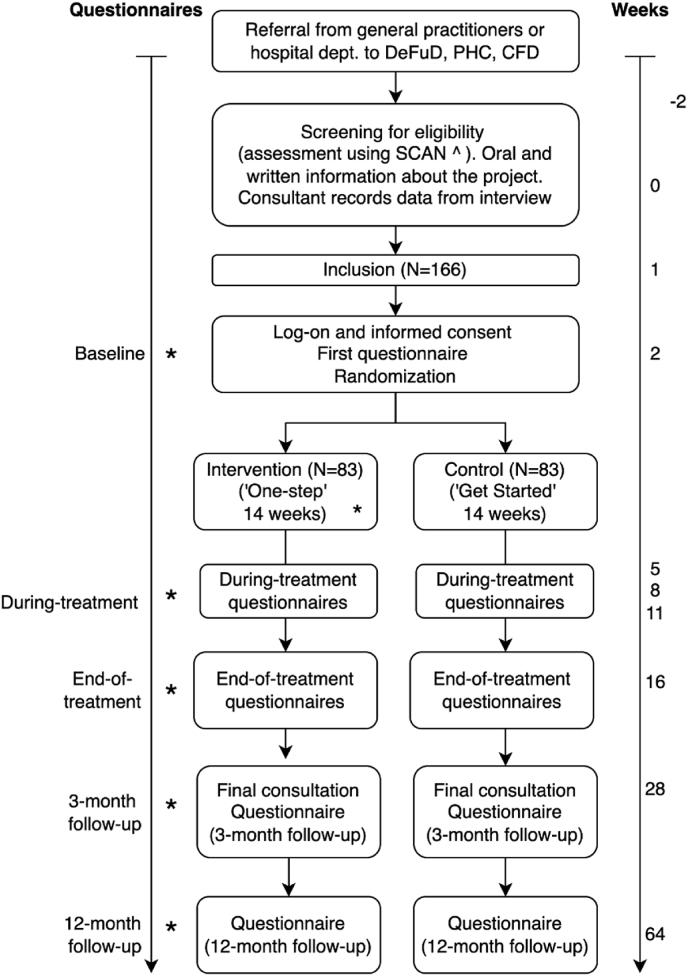
A total of 166 participants aged 18-60 years diagnosed with multi-system FSD will be assessed and randomized to either 1) OneStep: a 14-week program consisting of 11 treatment modules based on principles from cognitive behavioural therapy or 2) GetStarted consisting of 1 module on psychoeducation. The primary outcome is physical health, assessed by a Short Form Health Survey (SF-36) aggregate score of the subscales vitality, physical functioning, and bodily pain 3 months after end-of-treatment and self-reported improvement assessed by the Clinical Global Improvement Scale. Secondary outcomes include symptom load, depression, anxiety, and illness worry. Process measures include emotional distress, illness perception, illness behaviour, and symptom interference.
CONCLUSIONS
This study is the first study to test an internet-delivered treatment program for FSD, multi-system type and has the potential to show the importance of making evidence-based internet-delivered treatment for FSD more accessible.
背景
具有多器官症状的功能性躯体障碍(FSDs),即多系统类型,在普通人群中很常见,可能导致残疾和生活质量下降。虽然已经确立了有效治疗方案的证据,但仍需要让更多患者能够获得治疗。互联网提供的治疗已变得普遍,并且已被证明与面对面治疗一样有效,同时提供了一种灵活且易于获得的治疗选择。本研究的目的是比较治疗师辅助的互联网提供的“一次一步”(OneStep)治疗方案与互联网提供的自助方案“开始行动”(GetStarted)的疗效。
方法
总共166名年龄在18至60岁之间、被诊断为多系统FSD的参与者将接受评估,并随机分为两组:1)OneStep组:一个为期14周的方案,包括基于认知行为疗法原则的11个治疗模块;2)GetStarted组:包括1个关于心理教育的模块。主要结局是身体健康,通过治疗结束后3个月的简短健康调查问卷(SF - 36)中活力、身体功能和身体疼痛分量表的总分来评估,以及通过临床总体改善量表自我报告的改善情况。次要结局包括症状负荷、抑郁、焦虑和疾病担忧。过程指标包括情绪困扰、疾病认知、疾病行为和症状干扰。
结论
本研究是第一项测试针对多系统类型FSD的互联网提供治疗方案的研究,有可能显示使基于证据的FSD互联网提供治疗更容易获得的重要性。

 Zotero 插件