
伏硫西汀在伴有阿尔茨海默病共病的重度抑郁症患者常规临床实践中的有效性:韩国一项上市后监测研究的分析。
Effectiveness of vortioxetine in patients with major depressive disorder and comorbid Alzheimer's disease in routine clinical practice: An analysis of a post-marketing surveillance study in South Korea.
作者信息
Cumbo Eduardo, Adair Michael, Åstrom Daniel Oudin, Christensen Michael Cronquist
机构信息
Neurodegenerative Disorders Unit, ASP 2 Caltanissetta, Caltanissetta, Italy.
H. Lundbeck A/S, Valby, Denmark.
出版信息
Front Aging Neurosci. 2023 Jan 9;14:1037816. doi: 10.3389/fnagi.2022.1037816. eCollection 2022.
BACKGROUND
Vortioxetine has demonstrated procognitive effects in patients with major depressive disorder (MDD). We assessed the effectiveness and safety of vortioxetine in a cohort of patients with MDD and comorbid Alzheimer's disease participating in a large post-marketing surveillance study in South Korea.
METHODS
Subgroup analysis of a 6-month, prospective, multicenter, non-interventional cohort study in outpatients with MDD with a pre-baseline diagnosis of Alzheimer's disease receiving vortioxetine in routine care settings ( = 207). Patients were assessed at baseline and after 8 weeks; a subset of patients was also assessed after 24 weeks. Depression severity was assessed using the Montgomery-Åsberg Depression Rating Scale (MADRS) and Clinical Global Impression (CGI) scale, cognitive symptoms using the Perceived Deficits Questionnaire-Depression, Korean version (PDQ-K), and cognitive performance using the Digit Symbol Substitution Test (DSST).
RESULTS
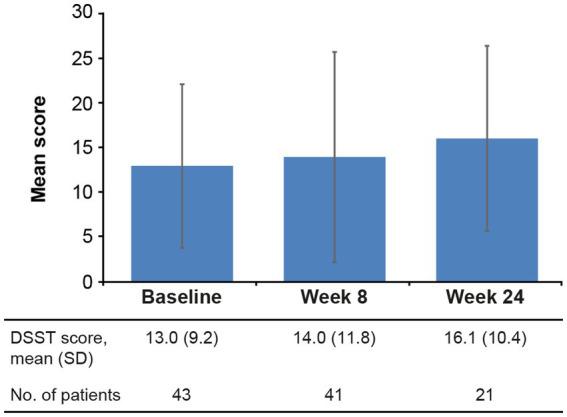
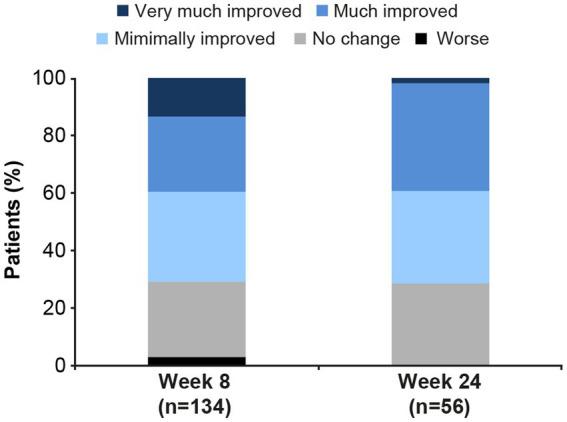
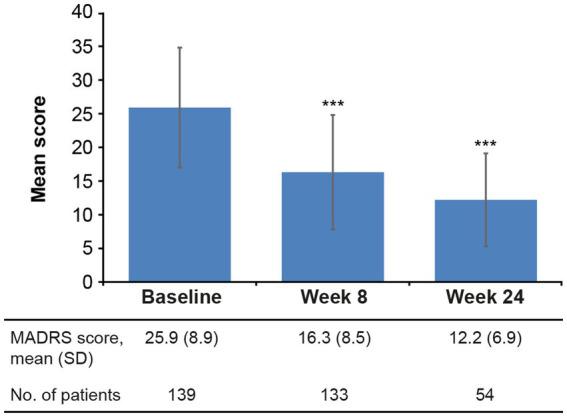
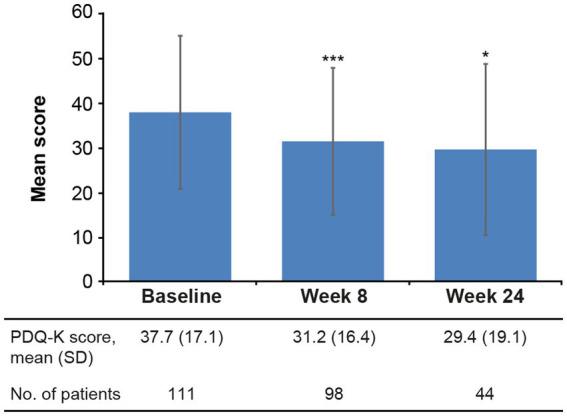
Most patients were receiving a mean daily vortioxetine dose of 5 mg/day (174/190 patients; 91.6%). After 24 weeks of vortioxetine treatment, 71.4% of patients (40/56) had experienced overall clinical improvement (i.e., CGI-Improvement score ≤3) and 51.9% (28/54) had achieved remission from depressive symptoms (i.e., MADRS total score ≤10 points). Respective mean changes in MADRS, PDQ-K, and DSST total scores from baseline to week 24 were -11.5 ( < 0.0001), -5.1 ( = 0.03), and +3.8 points ( = 0.0524). Adverse events were reported by 27 patients (13.0%) and were mostly mild (89.2%).
CONCLUSION
Patients with MDD and comorbid Alzheimer's disease receiving vortioxetine in routine care settings in South Korea demonstrated clinically meaningful improvements in depressive symptoms, cognitive symptoms, and objective cognitive performance over the 6-month treatment period. Treatment with vortioxetine was well tolerated in this patient cohort, with reported adverse events consistent with the established tolerability profile of vortioxetine.
背景
伏硫西汀已在重度抑郁症(MDD)患者中显示出促认知作用。我们在韩国一项大型上市后监测研究中,评估了伏硫西汀在一组患有MDD合并阿尔茨海默病患者中的有效性和安全性。
方法
对一项为期6个月的前瞻性、多中心、非干预性队列研究进行亚组分析,该研究纳入了在常规护理环境中接受伏硫西汀治疗且基线前诊断为阿尔茨海默病的MDD门诊患者(n = 207)。在基线和8周后对患者进行评估;部分患者在24周后也进行了评估。使用蒙哥马利-Åsberg抑郁评定量表(MADRS)和临床总体印象(CGI)量表评估抑郁严重程度,使用感知缺陷问卷-抑郁韩国版(PDQ-K)评估认知症状,使用数字符号替换测验(DSST)评估认知表现。
结果
大多数患者接受的伏硫西汀平均日剂量为5毫克/天(174/190名患者;91.6%)。伏硫西汀治疗24周后,71.4%的患者(40/56)出现了总体临床改善(即CGI-改善评分≤3),51.9%(28/54)的患者实现了抑郁症状缓解(即MADRS总分≤10分)。从基线到第24周,MADRS、PDQ-K和DSST总分的平均变化分别为-11.5(P < 0.0001)、-5.1(P = 0.03)和+3.8分(P = 0.0524)。27名患者(13.0%)报告了不良事件,且大多为轻度(89.2%)。
结论
在韩国常规护理环境中接受伏硫西汀治疗的MDD合并阿尔茨海默病患者,在6个月的治疗期内,抑郁症状、认知症状和客观认知表现均有临床意义的改善。该患者队列对伏硫西汀治疗耐受性良好,报告的不良事件与伏硫西汀既定的耐受性特征一致。
 Zotero 插件