
轻度阿尔茨海默病中功能连接模式的增加:一项静息态功能磁共振成像研究。
Increased functional connectivity patterns in mild Alzheimer's disease: A rsfMRI study.
作者信息
Penalba-Sánchez Lucía, Oliveira-Silva Patrícia, Sumich Alexander Luke, Cifre Ignacio
机构信息
Facultat de Psicologia, Ciències de l'educació i de l'Esport, Blanquerna, Universitat Ramon Llull, Barcelona, Spain.
Human Neurobehavioral Laboratory (HNL), Research Centre for Human Development (CEDH), Faculdade de Educação e Psicologia, Universidade Católica Portuguesa, Porto, Portugal.
出版信息
Front Aging Neurosci. 2023 Jan 9;14:1037347. doi: 10.3389/fnagi.2022.1037347. eCollection 2022.
BACKGROUND
Alzheimer's disease (AD) is the most common age-related neurodegenerative disorder. In view of our rapidly aging population, there is an urgent need to identify Alzheimer's disease (AD) at an early stage. A potential way to do so is by assessing the functional connectivity (FC), i.e., the statistical dependency between two or more brain regions, through novel analysis techniques.
METHODS
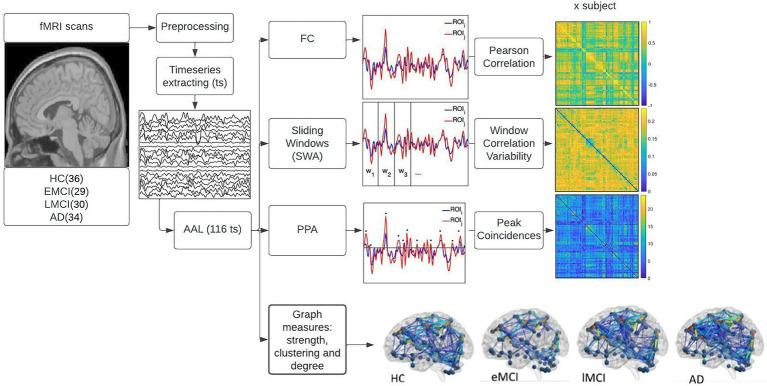
In the present study, we assessed the static and dynamic FC using different approaches. A resting state (rs)fMRI dataset from the Alzheimer's disease neuroimaging initiative (ADNI) was used ( = 128). The blood-oxygen-level-dependent (BOLD) signals from 116 regions of 4 groups of participants, i.e., healthy controls (HC; = 35), early mild cognitive impairment (EMCI; = 29), late mild cognitive impairment (LMCI; = 30), and Alzheimer's disease (AD; = 34) were extracted and analyzed. FC and dynamic FC were extracted using Pearson's correlation, sliding-windows correlation analysis (SWA), and the point process analysis (PPA). Additionally, graph theory measures to explore network segregation and integration were computed.
RESULTS
Our results showed a longer characteristic path length and a decreased degree of EMCI in comparison to the other groups. Additionally, an increased FC in several regions in LMCI and AD in contrast to HC and EMCI was detected. These results suggest a maladaptive short-term mechanism to maintain cognition.
CONCLUSION
The increased pattern of FC in several regions in LMCI and AD is observable in all the analyses; however, the PPA enabled us to reduce the computational demands and offered new specific dynamic FC findings.
背景
阿尔茨海默病(AD)是最常见的与年龄相关的神经退行性疾病。鉴于我国人口迅速老龄化,迫切需要在早期阶段识别出阿尔茨海默病(AD)。一种可能的方法是通过新颖的分析技术评估功能连接(FC),即两个或多个脑区之间的统计依赖性。
方法
在本研究中,我们使用不同方法评估了静态和动态FC。使用了来自阿尔茨海默病神经影像倡议(ADNI)的静息态(rs)fMRI数据集(n = 128)。提取并分析了4组参与者(即健康对照(HC;n = 35)、早期轻度认知障碍(EMCI;n = 29)、晚期轻度认知障碍(LMCI;n = 30)和阿尔茨海默病(AD;n = 34))116个脑区的血氧水平依赖(BOLD)信号。使用Pearson相关性、滑动窗口相关性分析(SWA)和点过程分析(PPA)提取FC和动态FC。此外,还计算了用于探索网络分离和整合的图论指标。
结果
我们的结果显示,与其他组相比,EMCI的特征路径长度更长且度降低。此外,与HC和EMCI相比,在LMCI和AD的几个区域中检测到FC增加。这些结果表明存在一种维持认知的适应不良短期机制。
结论
在所有分析中均观察到LMCI和AD的几个区域中FC增加的模式;然而,PPA使我们能够降低计算需求并提供新的特定动态FC结果。


 Zotero 插件