
慢性心力衰竭与衰弱指数之间的关联:一项基于1999年至2018年美国国家健康与营养检查调查的研究。
The association between chronic heart failure and frailty index: A study based on the National Health and Nutrition Examination Survey from 1999 to 2018.
作者信息
Chen Xiaozhe, Hou Chunlei, Yao Lei, Ma Yulong, Li Yunfeng, Li Jianhua, Gui Mingtai, Wang Mingzhu, Zhou Xunjie, Lu Bo, Fu Deyu
机构信息
Department of Cardiology, Yueyang Hospital of Integrated Traditional Chinese and Western Medicine, Shanghai University of Traditional Chinese Medicine, Shanghai, China.
出版信息
Front Cardiovasc Med. 2023 Jan 9;9:1057587. doi: 10.3389/fcvm.2022.1057587. eCollection 2022.
OBJECTIVE
This study aims to explore the association between the frailty index and chronic heart failure (CHF).
METHODS
We collected data from the National Health and Nutrition Examination Survey (NHANES) (1998-2018) database to assess the association between CHF and frailty. Demographic, inquiry, laboratory examinations, and characteristics were gathered to compare CHF and non-CHF groups. Multiple logistic regression analysis was performed to explore the relationship between frailty and CHF. Cox proportional hazards models were used to estimate hazard ratios (HR) and 95% confidence interval (CI) for mortality from all causes and cardiovascular disease (CVD).
RESULTS
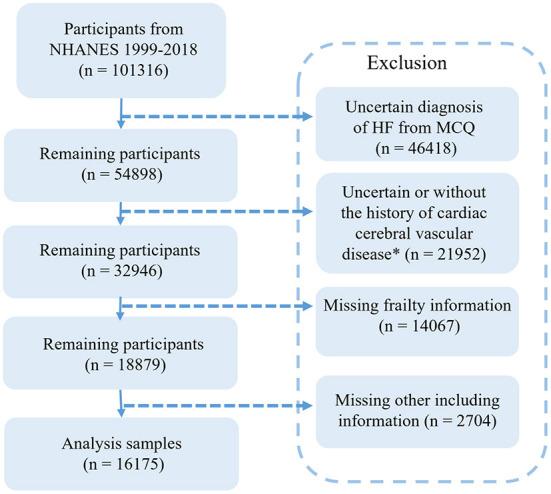
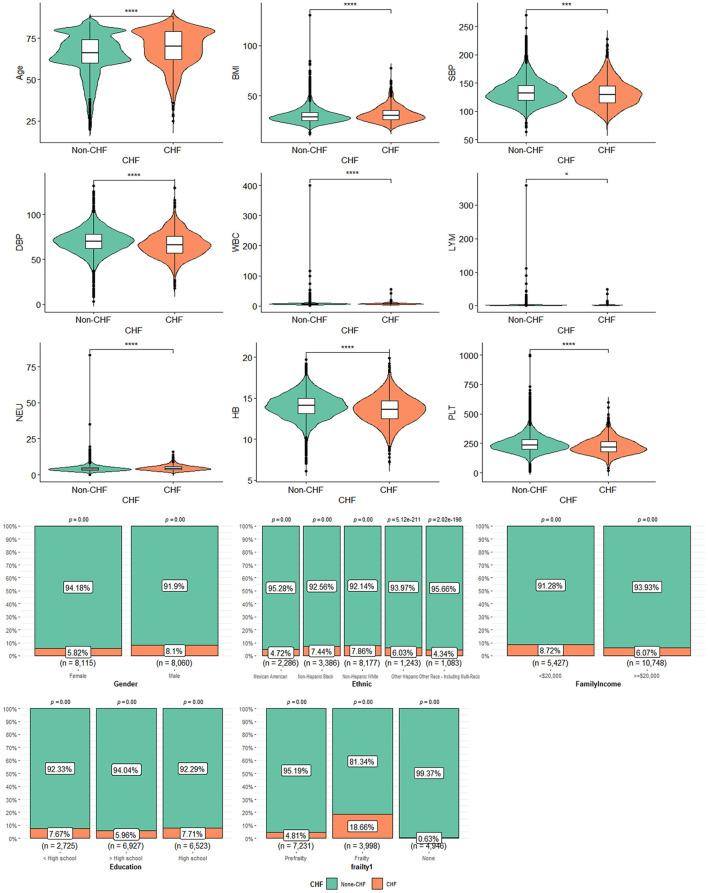
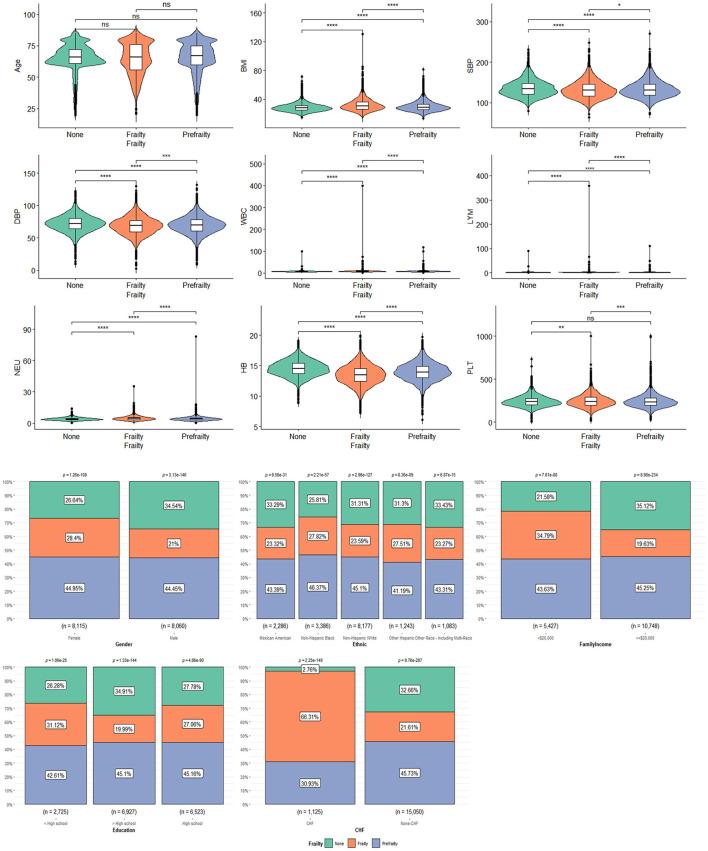
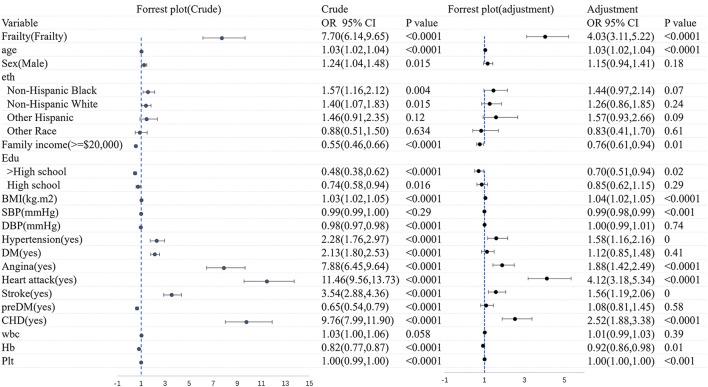
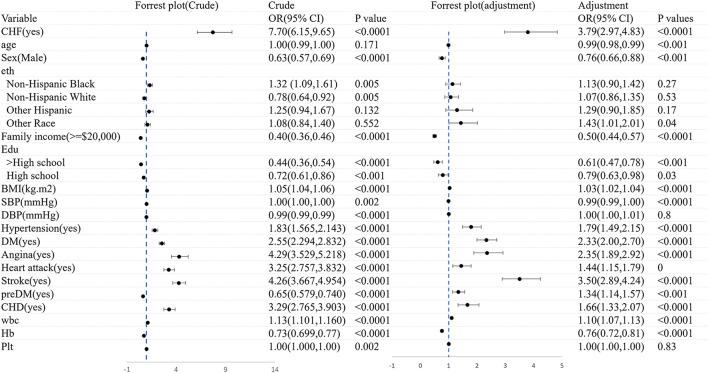
A total of 16,175 participants with cardiac and cerebrovascular disease were categorized into CHF ( = 1,125) and non-CHF ( = 15,050) groups. In patients with CHF, the prevalence of frailty, pre-frailty, and non-frailty were 66.31, 30.93, and 2.75%, respectively. In multiple logistic regression, patients with CHF who were male (OR = 0.63, 95% CI: 3.11-5.22), whose annual family income was over $20,000 (OR = 0.52, 95% CI: 0.37-0.72, < 0.001), or with normal hemoglobin level (OR = 0.77, 95% CI: 0.68-0.88, < 0.001) had a lower likelihood of frailty. CHF patients with hypertension (OR = 3.60, 95% CI: 2.17-5.99, < 0.0001), coronary heart disease (OR = 1.76, 95% CI: 1.10-2.84, = 0.02), diabetes mellitus (OR = 1.89, 95% CI: 1.28-2.78, < 0.001), and stroke (OR = 2.52, 95% CI: 1.53-4.15, < 0.001) tended to be frail. Survival analysis suggested that pre-frailty and frailty were related to poor all-cause deaths (HR = 1.48, 95% CI: 1.36-1.66; HR = 2.77, 95% CI: 2.40-3.18) and CVD mortality (HR = 1.58, 95% CI: 1.26-1.97; HR = 2.55, 95% CI: 2.02-3.21). CHF patients with frailty were strongly connected with all-cause death (HR = 2.14, 95% CI: 1.27-3.62).
CONCLUSION
Frailty was positively associated with CHF. Patients with CHF who were male, whose annual family income was over $20,000, or with normal hemoglobin level were negatively correlated to frailty. For patients with cardiac and cerebrovascular disease as well as CHF, frailty was strongly connected with all-cause death.
目的
本研究旨在探讨衰弱指数与慢性心力衰竭(CHF)之间的关联。
方法
我们从国家健康与营养检查调查(NHANES)(1998 - 2018年)数据库中收集数据,以评估CHF与衰弱之间的关联。收集人口统计学、询问、实验室检查及特征数据,用于比较CHF组和非CHF组。进行多因素逻辑回归分析,以探讨衰弱与CHF之间的关系。使用Cox比例风险模型估计全因死亡率和心血管疾病(CVD)死亡率的风险比(HR)及95%置信区间(CI)。
结果
共有16175名患有心脑血管疾病的参与者被分为CHF组(n = 1125)和非CHF组(n = 15050)。在CHF患者中,衰弱、前期衰弱和非衰弱的患病率分别为66.31%、30.93%和2.75%。在多因素逻辑回归中,男性CHF患者(OR = 0.63,95%CI:3.11 - 5.22)、家庭年收入超过20000美元的患者(OR = 0.52,95%CI:0.37 - 0.72,P < 0.001)或血红蛋白水平正常的患者(OR = 0.77,95%CI:0.68 - 0.88,P < 0.001)发生衰弱的可能性较低。患有高血压(OR = 3.60,95%CI:2.17 - 5.99,P < 0.0001)、冠心病(OR = 1.76,95%CI:1.10 - 2.84,P = 0.02)、糖尿病(OR = 1.89,95%CI:1.28 - 群2.78,P < 0.001)和中风(OR = 2.52,95%CI:1.53 - 4.15,P < 0.001)的CHF患者往往更易衰弱。生存分析表明,前期衰弱和衰弱与全因死亡风险增加相关(HR = 1.48,95%CI:1.36 - 1.66;HR = 2.77,95%CI:2.40 - 3.18)以及CVD死亡风险增加相关(HR = 1.58,95%CI:1.26 - 1.97;HR = 2.55,95%CI:2.02 - 3.21)。衰弱的CHF患者与全因死亡密切相关(HR = 2.14,95%CI:1.27 - 3.62)。
结论
衰弱与CHF呈正相关。男性、家庭年收入超过20000美元或血红蛋白水平正常的CHF患者与衰弱呈负相关。对于患有心脑血管疾病及CHF的患者,衰弱与全因死亡密切相关。


 Zotero 插件