
大型动物缺血模型中右心室压力监测用于评估右心室收缩功能障碍的纵向验证
Longitudinal Validation of Right Ventricular Pressure Monitoring for the Assessment of Right Ventricular Systolic Dysfunction in a Large Animal Ischemic Model.
作者信息
Couture Etienne J, Moses Kevin, Monge García Manuel Ignacio, Potes Cristhian, Haddad Francois, Grønlykke Lars, Garcia Fernando, Paster Eden, Pibarot Philippe, Denault André Y
机构信息
Department of Anesthesiology & Division of Intensive Care Medicine, Institut Universitaire de Cardiologie et de Pneumologie de Québec, Québec, QC, Canada.
Edwards Lifesciences, Irvine, CA.
出版信息
Crit Care Explor. 2023 Jan 18;5(1):e0847. doi: 10.1097/CCE.0000000000000847. eCollection 2023 Jan.
UNLABELLED
Right ventricular (RV) dysfunction is a major cause of morbidity and mortality in intensive care and cardiac surgery. Early detection of RV dysfunction may be facilitated by continuous monitoring of RV waveform obtained from a pulmonary artery catheter. The objective is to evaluate the extent to which RV pressure monitoring can detect changes in RV systolic performance assess by RV end-systolic elastance (E) following the development of an acute RV ischemic in a porcine model.
HYPOTHESIS
RV pressure monitoring can detect changes in RV systolic performance assess by RV E following the development of an acute RV ischemic model.
METHODS AND MODELS
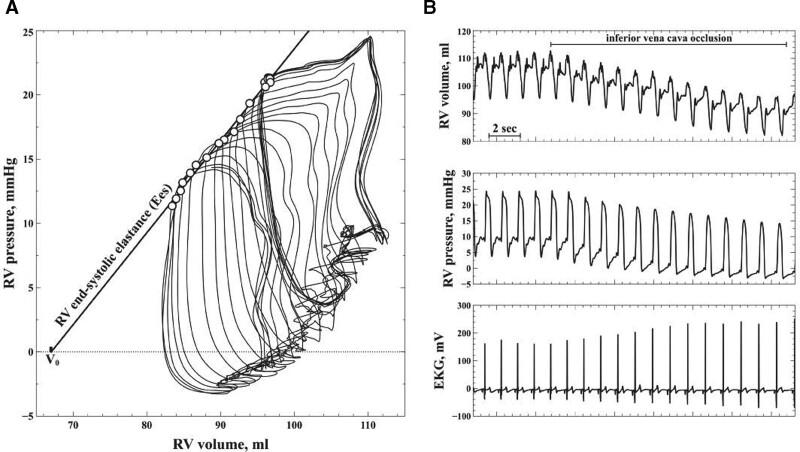
Acute ischemic RV dysfunction was induced by progressive embolization of microsphere in the right coronary artery to mimic RV dysfunction clinically experienced during cardiopulmonary bypass separation caused by air microemboli. RV hemodynamic performance was assessed using RV pressure waveform-derived parameters and RV E obtained using a conductance catheter during inferior vena cava occlusions.
RESULTS
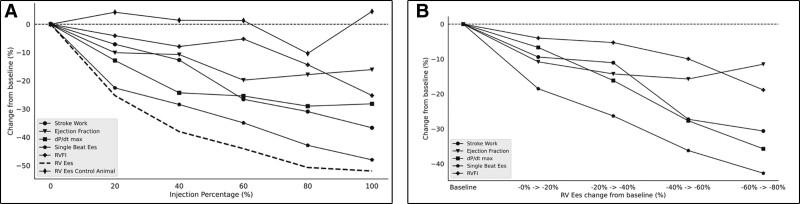
Acute ischemia resulted in a significant reduction in RV E from 0.26 mm Hg/mL (interquartile range, 0.16-0.32 mm Hg/mL) to 0.14 mm Hg/mL (0.11-0.19 mm Hg/mL; < 0.010), cardiac output from 6.3 L/min (5.7-7 L/min) to 4.5 (3.9-5.2 L/min; = 0.007), mean systemic arterial pressure from 72 mm Hg (66-74 mm Hg) to 51 mm Hg (46-56 mm Hg; < 0.001), and mixed venous oxygen saturation from 65% (57-72%) to 41% (35-45%; < 0.001). Linear mixed-effect model analysis was used to assess the relationship between E and RV pressure-derived parameters. The reduction in RV E best correlated with a reduction in RV maximum first derivative of pressure during isovolumetric contraction (dP/dt) and single-beat RV E. Adjusting RV dP/dt for heart rate resulted in an improved surrogate of RV E.
INTERPRETATION AND CONCLUSIONS
Stepwise decreases in RV E during acute ischemic RV dysfunction were accurately tracked by RV dP/dt derived from the RV pressure waveform.
未标注
右心室(RV)功能障碍是重症监护和心脏手术中发病和死亡的主要原因。通过持续监测从肺动脉导管获得的RV波形,可能有助于早期发现RV功能障碍。目的是评估在猪模型中发生急性RV缺血后,RV压力监测能够检测到通过RV收缩末期弹性(E)评估的RV收缩功能变化的程度。
假设
在急性RV缺血模型建立后,RV压力监测能够检测到通过RV E评估的RV收缩功能变化。
方法和模型
通过右冠状动脉内微球逐步栓塞诱导急性缺血性RV功能障碍,以模拟体外循环分离期间因空气微栓子导致的临床RV功能障碍。在腔静脉闭塞期间,使用RV压力波形衍生参数和通过电导导管获得的RV E评估RV血流动力学性能。
结果
急性缺血导致RV E从0.26 mmHg/mL(四分位间距,0.16 - 0.32 mmHg/mL)显著降至0.14 mmHg/mL(0.11 - 0.19 mmHg/mL;P < 0.010),心输出量从6.3 L/min(5.7 - 7 L/min)降至4.5(3.9 - 5.2 L/min;P = 0.007),平均体动脉压从72 mmHg(66 - 74 mmHg)降至51 mmHg(46 - 56 mmHg;P < 0.001),以及混合静脉血氧饱和度从65%(57 - 72%)降至41%(35 - 45%;P < 0.001)。使用线性混合效应模型分析评估E与RV压力衍生参数之间的关系。RV E的降低与等容收缩期间RV压力最大一阶导数(dP/dt)和单搏RV E的降低最相关。对心率校正RV dP/dt可改善RV E的替代指标。
解读与结论
在急性缺血性RV功能障碍期间,通过RV压力波形得出的RV dP/dt准确跟踪了RV E的逐步下降。
 Zotero 插件