
用于牛血清和血浆孕酮测量的全自动化学发光免疫分析方法的验证
Validation of a fully automated chemiluminescent immunoassay for cattle serum and plasma progesterone measurement.
作者信息
Megahed Ameer A, Jones Kristi L, Bisinotto Rafael S, Chebel Ricardo C, Galvão Klibs N, Chan Ann M, Bittar João H J
机构信息
Department of Large Animal Clinical Sciences, College of Veterinary Medicine, University of Florida, Gainesville, FL, United States.
Department of Animal Medicine (Internal Medicine), Faculty of Veterinary Medicine, Benha University, Moshtohor-Toukh, Kalyobiya, Egypt.
出版信息
Front Vet Sci. 2023 Jan 9;9:1064201. doi: 10.3389/fvets.2022.1064201. eCollection 2022.
INTRODUCTION
Monitoring circulating progesterone concentration ([P4]) is an important component of basic and applied reproduction research and clinical settings. IMMULITE 2000 XPi (Siemens Healthineers, Cary, NC) is a newly upgraded fully automated immunoassay system marketed for human use to measure concentrations of different measurands including P4.
OBJECTIVES
Our objective was therefore to characterize the analytical performance of the IMMULITE 2000 XPi P4 immunoassay (IPI) across the reportable range in serum and plasma of cattle.
METHODS
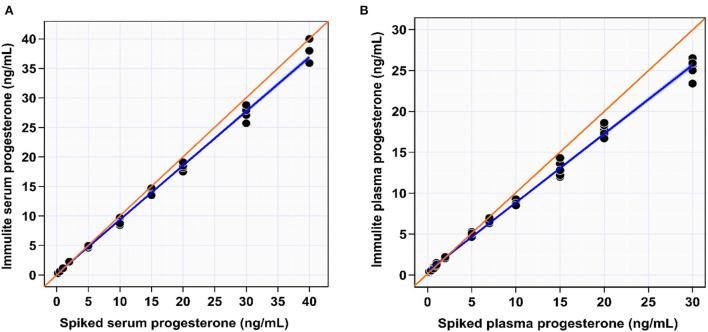
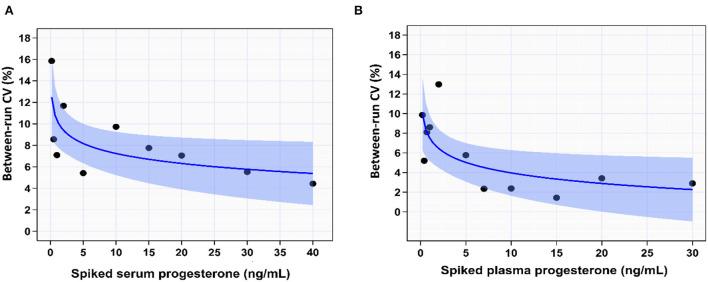
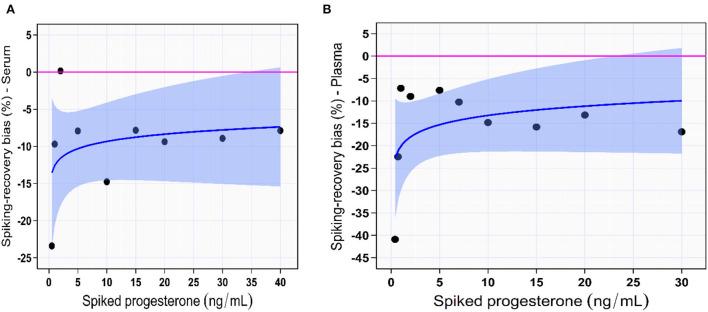
The IPI validation protocols included characterization of the method linearity, within-run, and between-run precision through calculation of the coefficient of variation (CV). The method accuracy was assessed through the calculation of the spiking-recovery (SR) bias across the reportable range (0.2-40.0 ng/mL). Passing-Bablok regression and Bland-Altman plots were used to determine the interlaboratory bias for two laboratories. Three types of observed total error (TEo) were calculated based on the considered type of bias, TEo (spiking-recovery), TEo (range-based bias), and TEo (average-based bias).
RESULTS
The IPI was linearly related to the true value ( = 0.997) across the reportable range. The within-run and between-run precision (CV%) of the IPI for both serum and plasma [P4] of clinical relevance (1, 2, 5, and 10 ng/mL) were <5 and <10%, respectively. The TEo reported here for serum and plasma at [P4] of 1 and 5 ng/mL was ~20 and 25%, respectively. Of interest, the three types of TEo were relatively similar regardless of the considered bias.
CONCLUSIONS
We concluded that the automated IPI provides a precise, accurate, reliable, and safe method for measuring [P4] in both serum and plasma of cattle. Consistent with the manufacturer's recommendations, the serum matrix is more accurate than plasma.
引言
监测循环孕酮浓度([P4])是基础生殖研究、应用生殖研究及临床环境中的一个重要组成部分。IMMULITE 2000 XPi(西门子医疗,北卡罗来纳州卡里)是一种新升级的全自动免疫分析系统,用于人体测量包括P4在内的不同被测量物的浓度。
目的
因此,我们的目的是在牛血清和血浆的可报告范围内,对IMMULITE 2000 XPi P4免疫分析(IPI)的分析性能进行表征。
方法
IPI验证方案包括通过计算变异系数(CV)来表征方法的线性、批内精密度和批间精密度。通过计算可报告范围(0.2 - 40.0 ng/mL)内的加标回收率(SR)偏差来评估方法的准确性。采用Passing - Bablok回归和Bland - Altman图来确定两个实验室之间的实验室间偏差。基于所考虑的偏差类型计算三种类型的观察总误差(TEo),即TEo(加标回收率)、TEo(基于范围的偏差)和TEo(基于平均值的偏差)。
结果
在可报告范围内,IPI与真实值呈线性相关( = 0.997)。对于临床相关的血清和血浆[P4](1、2、5和10 ng/mL),IPI的批内和批间精密度(CV%)分别<5%和<10%。此处报告的血清和血浆在[P4]为1和5 ng/mL时的TEo分别约为20%和25%。有趣的是,无论考虑哪种偏差,三种类型的TEo相对相似。
结论
我们得出结论,自动化IPI为测量牛血清和血浆中的[P4]提供了一种精确、准确、可靠且安全的方法。与制造商的建议一致,血清基质比血浆更准确。



 Zotero 插件