
AI4AVP:一种采用生成对抗网络数据增强的深度学习方法的抗病毒肽预测器。
AI4AVP: an antiviral peptides predictor in deep learning approach with generative adversarial network data augmentation.
作者信息
Lin Tzu-Tang, Sun Yih-Yun, Wang Ching-Tien, Cheng Wen-Chih, Lu I-Hsuan, Lin Chung-Yen, Chen Shu-Hwa
机构信息
Institute of Information Science, Academia Sinica, Taipei 115, Taiwan.
Graduate Institute of Biomedical Electronics and Bioinformatics, College of Electrical Engineering and Computer Science, National Taiwan University, Taipei 106, Taiwan.
出版信息
Bioinform Adv. 2022 Oct 26;2(1):vbac080. doi: 10.1093/bioadv/vbac080. eCollection 2022.
MOTIVATION
Antiviral peptides (AVPs) from various sources suggest the possibility of developing peptide drugs for treating viral diseases. Because of the increasing number of identified AVPs and the advances in deep learning theory, it is reasonable to experiment with peptide drug design using methods.
RESULTS
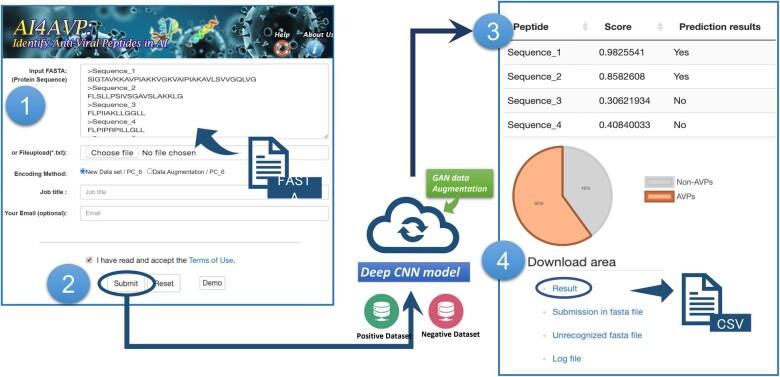
We collected the most up-to-date AVPs and used deep learning to construct a sequence-based binary classifier. A generative adversarial network was employed to augment the number of AVPs in the positive training dataset and enable our deep learning convolutional neural network (CNN) model to learn from the negative dataset. Our classifier outperformed other state-of-the-art classifiers when using the testing dataset. We have placed the trained classifiers on a user-friendly web server, AI4AVP, for the research community.
AVAILABILITY AND IMPLEMENTATION
AI4AVP is freely accessible at http://axp.iis.sinica.edu.tw/AI4AVP/; codes and datasets for the peptide GAN and the AVP predictor CNN are available at https://github.com/lsbnb/amp_gan and https://github.com/LinTzuTang/AI4AVP_predictor.
SUPPLEMENTARY INFORMATION
Supplementary data are available at online.
动机
来自各种来源的抗病毒肽(AVP)表明开发用于治疗病毒性疾病的肽类药物具有可能性。由于已鉴定的AVP数量不断增加以及深度学习理论的进展,使用相关方法进行肽类药物设计的实验是合理的。
结果
我们收集了最新的AVP,并使用深度学习构建了一个基于序列的二元分类器。采用生成对抗网络来增加正训练数据集中AVP的数量,并使我们的深度学习卷积神经网络(CNN)模型能够从负数据集中学习。在使用测试数据集时,我们的分类器优于其他现有最先进的分类器。我们已将经过训练的分类器放置在一个用户友好的网络服务器AI4AVP上,供研究社区使用。
可用性和实现方式
补充信息
补充数据可在网上获取。

 Zotero 插件