
卡铂和依托泊苷治疗身体状况差的老年广泛期小细胞肺癌患者的疗效和安全性。
Efficacy and safety of carboplatin and etoposide in older extensive-stage small-cell lung cancer patients with a poor performance status.
机构信息
Division of Thoracic Oncology, Shizuoka Cancer Center, Shizuoka, Japan.
Division of Respiratory Medicine, Nihon University School of Medicine, Tokyo, Japan.
出版信息
Thorac Cancer. 2023 Mar;14(9):805-814. doi: 10.1111/1759-7714.14811. Epub 2023 Jan 25.
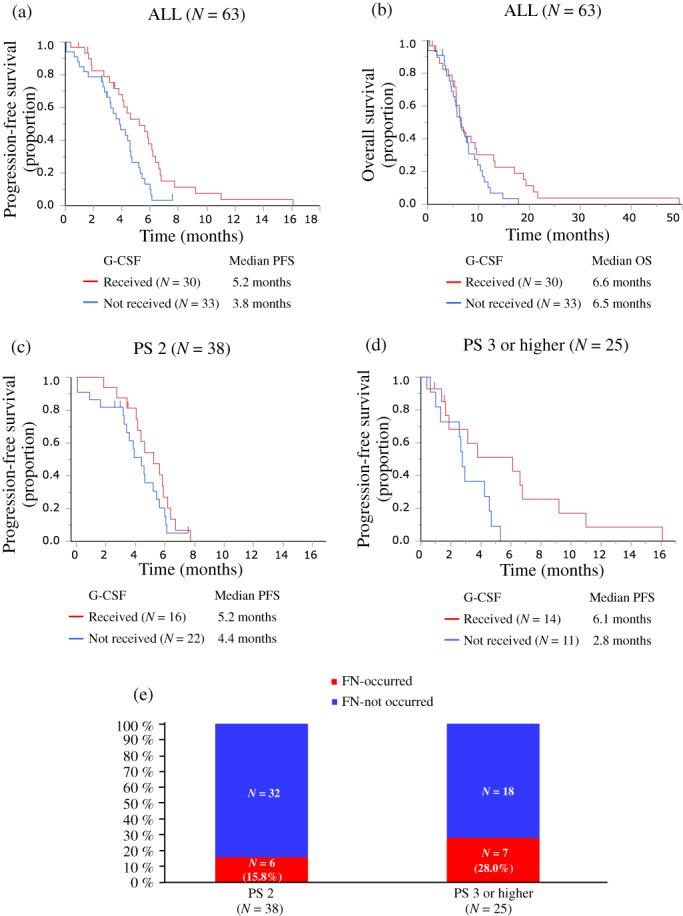
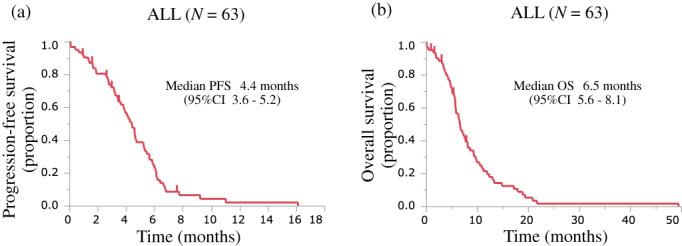
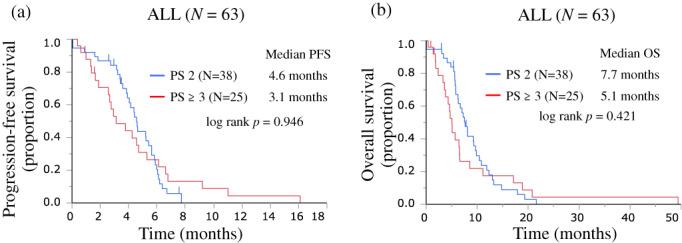
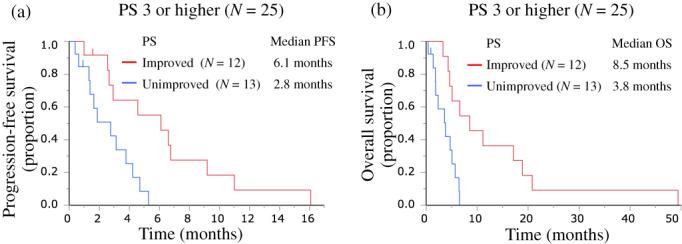
Carboplatin plus etoposide is a standard treatment for older extensive-stage small-cell lung cancer (ES-SCLC) patients with performance status (PS) 2. However, older patients often exhibit poor PS (3, 4), and the treatment effect in them is poorly understood. To determine the therapeutic efficacy and safety of carboplatin plus etoposide therapy for this population, we retrospectively analyzed 63 patients with ES-SCLC with PS ≥2, aged ≥71 years, who had received first-line carboplatin plus etoposide therapy. We compared the treatment efficacy and safety in patients with baseline PS 2 versus those with PS 3-4. In the PS 2 (38 patients) and PS ≥3 (25 patients) groups, the overall response rate was 71.1% and 72.0%, median progression-free survival was 4.6 and 3.1 months, and overall survival was 7.7 and 5.1 months, respectively. PS improved to 0-1 post-treatment in 65.8% and 48.0% of the patients in the PS 2 and PS ≥3 groups, respectively. Patients with PS ≥3 showing improved PS had a progression-free survival of 6.1 months. A higher incidence of grade ≥3 decreased neutrophil counts, febrile neutropenia, and treatment-related death was observed in the PS ≥3 group. The progression-free survival of patients administered prophylactic granulocyte colony-stimulating factor (G-CSF) was 5.2 and 6.1 months in the PS2 and PS ≥3 groups. Overall, carboplatin plus etoposide therapy provided comparable tumor shrinkage, but shorter progression-free and overall survival in older ES-SCLC patients with PS ≥3 than in those with PS 2. Thus, supportive care, such as prophylactic G-CSF administration, may be necessary to ensure safety and survival.
卡铂联合依托泊苷是体能状态(PS)2 的老年广泛期小细胞肺癌(ES-SCLC)患者的标准治疗方法。然而,老年患者常表现出较差的 PS(3、4),且其治疗效果尚不清楚。为了确定卡铂联合依托泊苷治疗该人群的疗效和安全性,我们回顾性分析了 63 例 PS≥2、年龄≥71 岁的 ES-SCLC 患者,这些患者接受了一线卡铂联合依托泊苷治疗。我们比较了基线 PS 2 与 PS 3-4 的患者的治疗效果和安全性。PS 2(38 例)和 PS≥3(25 例)组的总缓解率分别为 71.1%和 72.0%,中位无进展生存期分别为 4.6 个月和 3.1 个月,总生存期分别为 7.7 个月和 5.1 个月。PS 2 组和 PS≥3 组中分别有 65.8%和 48.0%的患者治疗后 PS 改善至 0-1。PS≥3 组中 PS 改善的患者无进展生存期为 6.1 个月。PS≥3 组中更常见的 3 级以上中性粒细胞减少、发热性中性粒细胞减少和治疗相关死亡。接受预防性粒细胞集落刺激因子(G-CSF)治疗的患者无进展生存期分别为 PS 2 组和 PS≥3 组的 5.2 个月和 6.1 个月。总的来说,卡铂联合依托泊苷治疗为体能状态(PS)≥3 的老年广泛期小细胞肺癌(ES-SCLC)患者提供了相当的肿瘤退缩效果,但无进展生存期和总生存期较短。因此,为了确保安全性和生存,可能需要支持性护理,如预防性 G-CSF 治疗。
 Zotero 插件