
韩国亨廷顿舞蹈症10年患病率上升:通过国家医疗保健系统对医疗支出的分析
Increased 10-Year Prevalence of Huntington's Disease in South Korea: An Analysis of Medical Expenditure Through the National Healthcare System.
作者信息
Lee Chan Young, Ro Jun-Soo, Jung Hyemin, Kim Manho, Jeon Beomseok, Lee Jee-Young
机构信息
Department of Neurology, School of Medicine, Ewha Womans University Mokdong Hospital, Seoul, Korea.
Public Healthcare Center, Seoul National University Hospital, Seoul, Korea.
出版信息
J Clin Neurol. 2023 Mar;19(2):147-155. doi: 10.3988/jcn.2022.0212. Epub 2023 Jan 17.
BACKGROUND AND PURPOSE
This study aimed to determine the updated 10-year prevalence of Huntington's disease (HD) in South Korea and the medical and economic burdens across the duration of the disease.
METHODS
Data from the National Health Insurance database during 2010-2019 were analyzed. We identified HD cases using predefined criteria. Information on age at diagnosis, sex, and common nonneurological comorbidities were collected. We analyzed individual patterns of the use of medical services and yearly medical expenditure. Incidence rates, 10-year prevalence rates, and longitudinal medical expenditure changes were assessed.
RESULTS
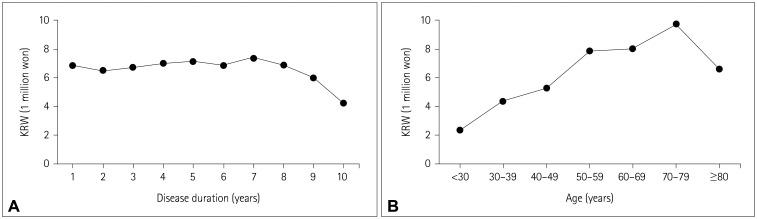
New patients with HD (average=152.10) were detected every year, with an annual incidence of 0.29 per 100,000. The estimated 10-year prevalence of HD was 2.2 per 100,000. The most common ages at the time of diagnosis were 50-59 years (23.3%). In 2019, 56.4% of patients with HD were followed-up at referral or general hospitals, and 32.2% were managed at long-term-care hospitals. The annual medical cost for an individual was KRW 6,569,341±895,097 (mean±SD) (mean≈USD 5,653). Medical expenditure was the highest in those aged 60-79 years, and lowest in those younger than 30 years. However, in all age groups, the annual medical expenditure was highest during the 9 years following a diagnosis.
CONCLUSIONS
This study found that the actual prevalence of HD in South Korea was higher than previously thought and that patients are in a situation with high medical expenditure that persists over time.
背景与目的
本研究旨在确定韩国亨廷顿舞蹈症(HD)的最新10年患病率以及疾病全过程中的医疗和经济负担。
方法
分析了2010 - 2019年期间国家健康保险数据库的数据。我们使用预定义标准识别HD病例。收集了诊断时的年龄、性别以及常见非神经科合并症的信息。我们分析了医疗服务使用的个体模式和年度医疗支出。评估了发病率、10年患病率以及纵向医疗支出变化。
结果
每年检测到新的HD患者(平均 = 152.10),年发病率为每10万人0.29例。HD的估计10年患病率为每10万人2.2例。诊断时最常见的年龄为50 - 59岁(23.3%)。2019年,56.4%的HD患者在转诊医院或综合医院接受随访,32.2%在长期护理医院接受治疗。个体的年度医疗费用为6,569,341±895,097韩元(均值±标准差)(均值≈5,653美元)。医疗支出在60 - 79岁人群中最高,在30岁以下人群中最低。然而,在所有年龄组中,年度医疗支出在诊断后的9年中最高。
结论
本研究发现韩国HD的实际患病率高于先前的估计,且患者面临着长期持续的高医疗支出状况。

 Zotero 插件