
考虑到易感染者消耗偏差,两剂BNT162b2和mRNA-1273疫苗对有症状的SARS-CoV-2感染的有效性减弱情况。
Waning of 2-Dose BNT162b2 and mRNA-1273 Vaccine Effectiveness Against Symptomatic SARS-CoV-2 Infection Accounting for Depletion-of-Susceptibles Bias.
作者信息
Andrejko Kristin L, Pry Jake M, Myers Jennifer F, Mehrotra Megha, Lamba Katherine, Lim Esther, Fukui Nozomi, DeGuzman Jennifer L, Openshaw John, Watt James, Jain Seema, Lewnard Joseph A, Covid-Case-Control Study Team On Behalf Of The California
出版信息
Am J Epidemiol. 2023 Jun 2;192(6):895-907. doi: 10.1093/aje/kwad017.
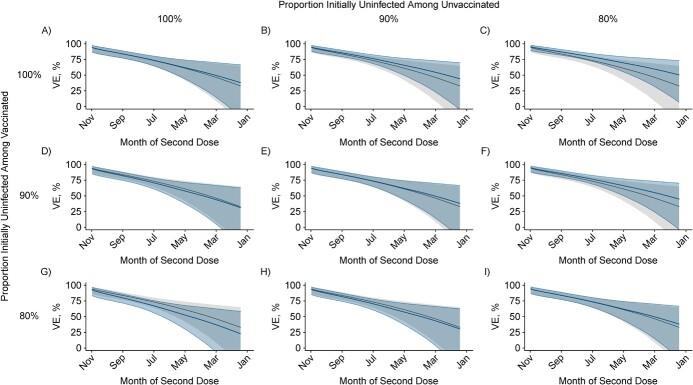
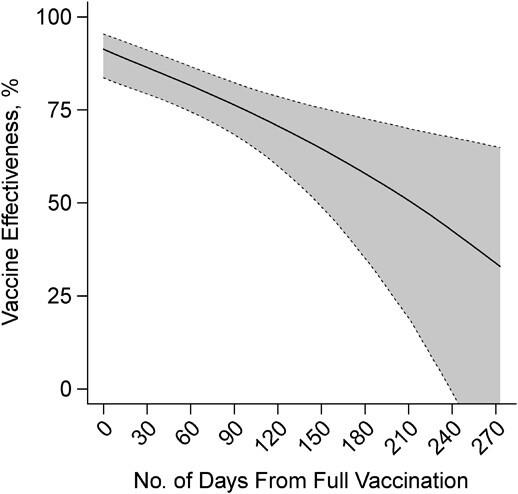
Concerns about the duration of protection conferred by coronavirus disease 2019 (COVID-19) vaccines have arisen in postlicensure evaluations. "Depletion of susceptibles," a bias driven by differential accrual of infection among vaccinated and unvaccinated individuals, may obscure vaccine effectiveness (VE) estimates, hindering interpretation. We enrolled California residents who received molecular SARS-CoV-2 tests in a matched, test-negative design, case-control study to estimate VE of mRNA-based COVID-19 vaccines between February 23 and December 5, 2021. We analyzed waning protection following 2 vaccine doses using conditional logistic regression models. Additionally, we used data from a population-based serological study to adjust for "depletion-of-susceptibles" bias and estimated VE for 3 doses, by time since second dose receipt. Pooled VE of BNT162b2 and mRNA-1273 against symptomatic SARS-CoV-2 infection was 91.3% (95% confidence interval (CI): 83.8, 95.4) at 14 days after second-dose receipt and declined to 50.8% (95% CI: 19.7, 69.8) at 7 months. Adjusting for depletion-of-susceptibles bias, we estimated VE of 53.2% (95% CI: 23.6, 71.2) at 7 months after primary mRNA vaccination series. A booster dose of BN162b2 or mRNA-1273 increased VE to 95.0% (95% CI: 82.8, 98.6). These findings confirm that observed waning of protection is not attributable to epidemiologic bias and support ongoing efforts to administer additional vaccine doses to mitigate burden of COVID-19.
在新冠病毒2019(COVID-19)疫苗获得许可后的评估中,人们对其提供的保护持续时间产生了担忧。“易感人群的减少”是一种由接种疫苗和未接种疫苗个体之间感染累积差异导致的偏差,可能会掩盖疫苗效力(VE)的估计值,从而妨碍解读。我们在一项匹配的、检测呈阴性设计的病例对照研究中,纳入了接受过新冠病毒分子检测的加利福尼亚居民,以估计2021年2月23日至12月5日期间基于mRNA的COVID-19疫苗的VE。我们使用条件逻辑回归模型分析了两剂疫苗后保护作用的减弱情况。此外,我们利用一项基于人群的血清学研究数据,对“易感人群减少”偏差进行调整,并按自接种第二剂疫苗后的时间,估计了三剂疫苗的VE。BNT162b2和mRNA-1273针对有症状的SARS-CoV-2感染的合并VE在接种第二剂疫苗后14天为91.3%(95%置信区间(CI):83.8,95.4),在7个月时降至50.8%(95%CI:19.7,69.8)。调整“易感人群减少”偏差后,我们估计在完成mRNA初次疫苗接种系列7个月后,VE为53.2%(95%CI:23.6,71.2)。一剂BN162b2或mRNA-1273加强针可将VE提高至95.0%(95%CI:82.8,98.6)。这些发现证实,观察到的保护作用减弱并非归因于流行病学偏差,并支持持续努力接种额外剂量疫苗以减轻COVID-19负担。

 Zotero 插件