
意大利、葡萄牙和西班牙医院环境中生物类似物肿瘤坏死因子-α抑制剂使用决定因素的探索。
An exploration of biosimilar TNF-alpha inhibitors uptake determinants in hospital environments in Italy, Portugal, and Spain.
作者信息
Barcina Lacosta Teresa, Vulto Arnold G, Huys Isabelle, Simoens Steven
机构信息
Department of Pharmaceutical and Pharmacological Sciences, KU Leuven, Leuven, Belgium.
Hospital Pharmacy, Erasmus University Medical Center, Rotterdam, Netherlands.
出版信息
Front Med (Lausanne). 2023 Jan 10;9:1029040. doi: 10.3389/fmed.2022.1029040. eCollection 2022.
BACKGROUND
The availability of biosimilar medicines in Southern European markets has allowed purchasing biologics at a lower cost for healthcare systems. However, the capacity to seize this cost-reduction opportunity in the long run depends on fostering a sustainable competitive environment for all the market players involved. Diverse policies and information campaigns have been launched in Italy, Portugal and Spain to support uptake of "best-value" biologics (BVB). Despite these measures, the utilization of lower-cost biologics in certain regions is low, especially when it comes to the treatment of chronic conditions.
OBJECTIVE
We aim to identify biosimilar uptake determinants in hospital environments in Italy, Portugal and Spain, using the class of TNF-alpha inhibitors as an example.
METHODS
This is a mixed-methods study based on (1) the quantitative analysis of regional uptake data for TNF-alpha inhibitor biosimilars and (2) the qualitative processing of semi-structured interviews capturing experts' views on uptake determinants for biosimilars.
RESULTS
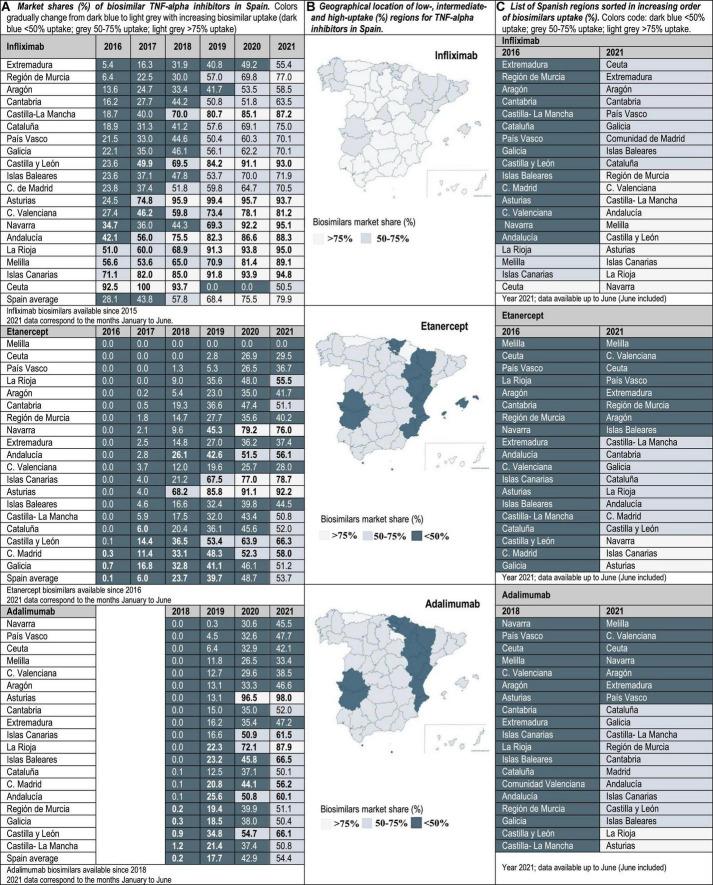
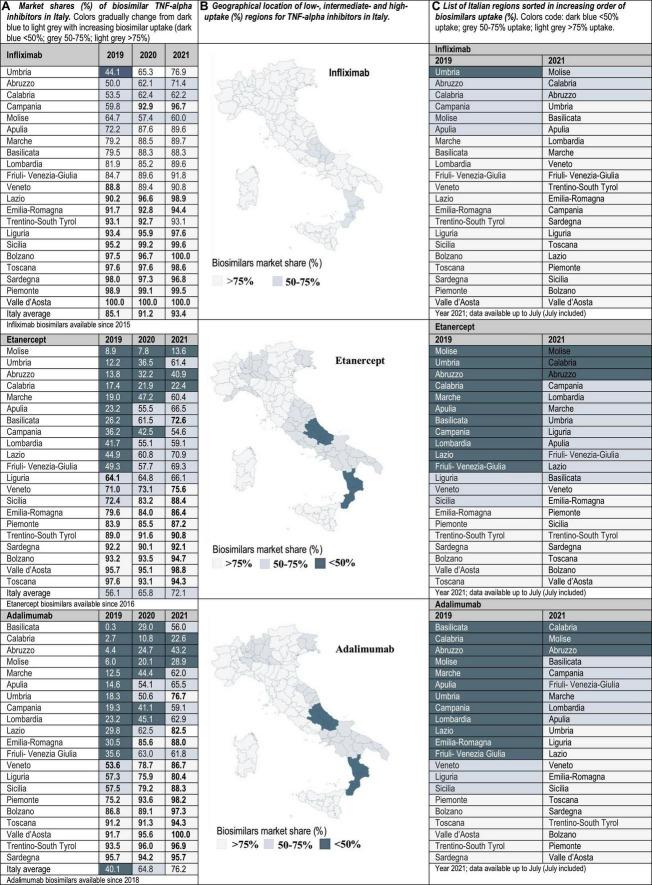
The organization of multi-stakeholder information campaigns supporting TNF-alpha inhibitor biosimilars use in Italy, Portugal and Spain has resulted in an increased familiarity of healthcare professionals and patients with the prescription/use of these products. However, barriers persist that impede high biosimilars uptake, especially in chronic patient populations eligible for a switch. These are: (1) the late publication of position statements on biosimilars interchangeability by regulatory health authorities; (2) the vague positioning of (national/regional) health authorities on best switching practices (including multiple biosimilar-to-biosimilar switches); (3) the existence of policy frameworks that do not necessarily support the initiation of switching protocols; (4) the establishment of sometimes inefficient purchasing procedures that limit biosimilars potential to compete for market shares. Diverse approaches taken regionally to address these barriers have contributed to heterogeneous TNF-alpha inhibitor biosimilars uptake across Southern Europe.
CONCLUSION
Our research signaled the limited reach of biosimilar policies implemented locally, if not supported by a national policy framework. This study highlights the need for the coordinated implementation of policy measures fostering biosimilars use at the regional and national level in Italy, Portugal and Spain. These measures should account for the particularities of off-patent biologic and biosimilar markets and should jointly address supply- and demand-side challenges.
背景
生物类似药在南欧市场的出现,使医疗保健系统能够以较低成本购买生物制剂。然而,从长远来看,抓住这一降低成本机会的能力取决于为所有相关市场参与者营造一个可持续的竞争环境。意大利、葡萄牙和西班牙已推出各种政策和宣传活动,以支持采用“最具性价比”的生物制剂(BVB)。尽管采取了这些措施,但某些地区低成本生物制剂的利用率仍然很低,尤其是在慢性病治疗方面。
目的
我们旨在以肿瘤坏死因子-α抑制剂(TNF-α抑制剂)为例,确定意大利、葡萄牙和西班牙医院环境中生物类似药的采用决定因素。
方法
这是一项混合方法研究,基于(1)对TNF-α抑制剂生物类似药区域采用数据的定量分析,以及(2)对捕捉专家对生物类似药采用决定因素看法的半结构化访谈进行定性处理。
结果
在意大利、葡萄牙和西班牙开展的支持使用TNF-α抑制剂生物类似药的多利益相关方宣传活动,提高了医疗保健专业人员和患者对这些产品处方/使用的熟悉程度。然而,阻碍生物类似药高采用率的障碍依然存在,尤其是在适合换药的慢性病患者群体中。这些障碍包括:(1)监管卫生当局关于生物类似药可互换性的立场声明发布较晚;(2)(国家/地区)卫生当局在最佳换药做法(包括多次生物类似药之间的换药)上的定位模糊;(3)存在不一定支持启动换药方案的政策框架;(4)有时建立的低效采购程序限制了生物类似药争夺市场份额的潜力。各地区为解决这些障碍采取的不同方法导致了南欧各地TNF-α抑制剂生物类似药的采用情况参差不齐。
结论
我们的研究表明,如果没有国家政策框架的支持,地方实施的生物类似药政策的覆盖范围有限。本研究强调,在意大利、葡萄牙和西班牙,需要在区域和国家层面协调实施促进生物类似药使用的政策措施。这些措施应考虑专利过期生物制剂和生物类似药市场的特殊性,并应共同应对供应和需求方面的挑战。

 Zotero 插件