
一种用于在线预测老年急性蛛网膜下腔出血患者血管内栓塞术后不良结局风险的新型视觉动态列线图:一项回顾性研究。
A novel visual dynamic nomogram to online predict the risk of unfavorable outcome in elderly aSAH patients after endovascular coiling: A retrospective study.
作者信息
Lu Wei, Tong YuLan, Zhang Cheng, Xiang Lan, Xiang Liang, Chen Chen, Guo LeHeng, Shan YaJie, Li XueMei, Zhao Zheng, Pan XiDing, Zhao ZhiHong, Zou JianJun
机构信息
School of Basic Medicine and Clinical Pharmacy, China Pharmaceutical University, Nanjing, China.
Department of Pharmacy, Nanjing First Hospital, Nanjing Medical University, Nanjing, China.
出版信息
Front Neurosci. 2023 Jan 10;16:1037895. doi: 10.3389/fnins.2022.1037895. eCollection 2022.
BACKGROUND
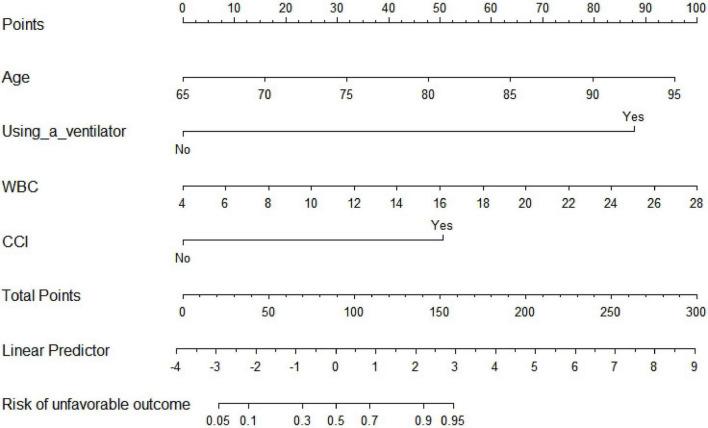
Aneurysmal subarachnoid hemorrhage (aSAH) is a significant cause of morbidity and mortality throughout the world. Dynamic nomogram to predict the prognosis of elderly aSAH patients after endovascular coiling has not been reported. Thus, we aimed to develop a clinically useful dynamic nomogram to predict the risk of 6-month unfavorable outcome in elderly aSAH patients after endovascular coiling.
METHODS
We conducted a retrospective study including 209 elderly patients admitted to the People's Hospital of Hunan Province for aSAH from January 2016 to June 2021. The main outcome measure was 6-month unfavorable outcome (mRS ≥ 3). We used multivariable logistic regression analysis and forwarded stepwise regression to select variables to generate the nomogram. We assessed the discriminative performance using the area under the curve (AUC) of receiver-operating characteristic and the risk prediction model's calibration using the Hosmer-Lemeshow goodness-of-fit test. The decision curve analysis (DCA) and the clinical impact curve (CIC) were used to measure the clinical utility of the nomogram.
RESULTS
The cohort's median age was 70 (interquartile range: 68-74) years and 133 (36.4%) had unfavorable outcomes. Age, using a ventilator, white blood cell count, and complicated with cerebral infarction were predictors of 6-month unfavorable outcome. The AUC of the nomogram was 0.882 and the Hosmer-Lemeshow goodness-of-fit test showed good calibration of the nomogram ( = 0.3717). Besides, the excellent clinical utility and applicability of the nomogram had been indicated by DCA and CIC. The eventual value of unfavorable outcome risk could be calculated through the dynamic nomogram.
CONCLUSION
This study is the first visual dynamic online nomogram that accurately predicts the risk of 6-month unfavorable outcome in elderly aSAH patients after endovascular coiling. Clinicians can effectively improve interventions by taking targeted interventions based on the scores of different items on the nomogram for each variable.
背景
动脉瘤性蛛网膜下腔出血(aSAH)是全球发病和死亡的重要原因。尚未有关于预测老年aSAH患者血管内栓塞术后预后的动态列线图的报道。因此,我们旨在开发一种临床上有用的动态列线图,以预测老年aSAH患者血管内栓塞术后6个月不良结局的风险。
方法
我们进行了一项回顾性研究,纳入了2016年1月至2021年6月在湖南省人民医院因aSAH入院的209例老年患者。主要结局指标为6个月不良结局(改良Rankin量表评分≥3分)。我们使用多变量逻辑回归分析和逐步向前回归来选择变量以生成列线图。我们使用受试者操作特征曲线下面积(AUC)评估鉴别性能,并使用Hosmer-Lemeshow拟合优度检验评估风险预测模型的校准。决策曲线分析(DCA)和临床影响曲线(CIC)用于衡量列线图的临床实用性。
结果
该队列的中位年龄为70岁(四分位间距:68 - 74岁),133例(36.4%)有不良结局。年龄、使用呼吸机、白细胞计数以及合并脑梗死是6个月不良结局的预测因素。列线图的AUC为0.882,Hosmer-Lemeshow拟合优度检验显示列线图校准良好(P = 0.3717)。此外,DCA和CIC表明列线图具有出色的临床实用性和适用性。不良结局风险的最终值可通过动态列线图计算得出。
结论
本研究是首个准确预测老年aSAH患者血管内栓塞术后6个月不良结局风险的可视化动态在线列线图。临床医生可根据列线图中每个变量不同项目的得分进行有针对性的干预,从而有效改善干预措施。
 Zotero 插件