
通过卷曲螺旋形成携带Bet v 1的阳离子脂质体具有低过敏性,并在小鼠中诱导强烈的免疫原性。
Cationic liposomes bearing Bet v 1 by coiled coil-formation are hypo-allergenic and induce strong immunogenicity in mice.
作者信息
Warmenhoven Hans, Leboux Romain, Bethanis Athanasios, van Strien Jolinde, Logiantara Adrian, van Schijndel Hans, Aglas Lorenz, van Rijt Leonie, Slütter Bram, Kros Alexander, Jiskoot Wim, van Ree Ronald
机构信息
Department of Experimental Immunology, Amsterdam University Medical Centers, Location AMC, Amsterdam, Netherlands.
HAL Allergy BV, J.H. Oortweg, Leiden, Netherlands.
出版信息
Front Allergy. 2023 Jan 10;3:1092262. doi: 10.3389/falgy.2022.1092262. eCollection 2022.
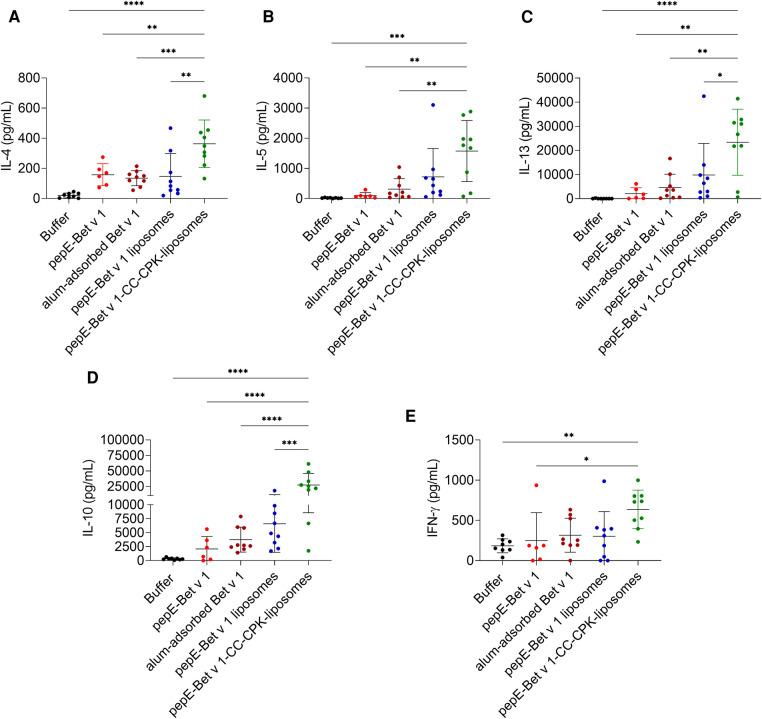
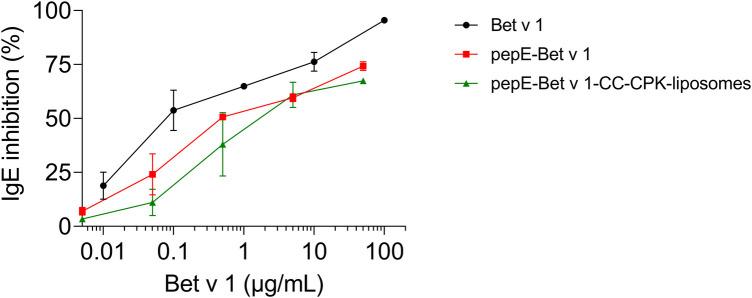
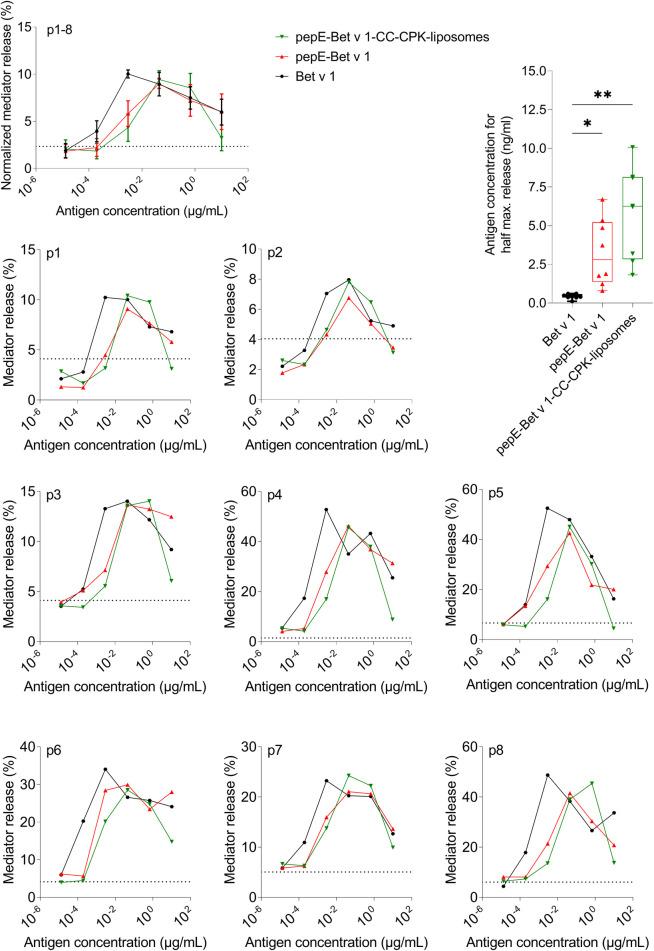
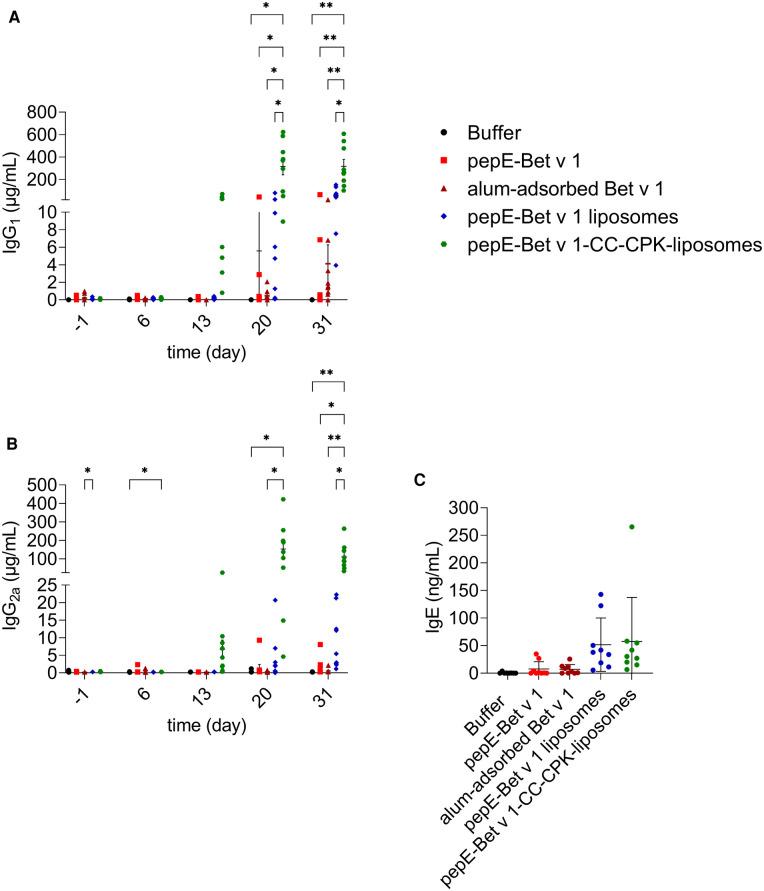
Although aluminum hydroxide (alum) is widely accepted and used as safe vaccine adjuvant, there is some concern about possible toxicity upon long-lasting repeated exposure during subcutaneous allergen immunotherapy (SCIT). Our objective was to evaluate allergen-bearing liposomes as possible alternative for alum-adsorption in SCIT. A self-assembling, coiled-coil forming peptide pair was used to anchor the major birch pollen allergen Bet v 1 to the surface of cationic liposomes. The resulting nanoparticulate liposomes were characterized with respect to their physicochemical, allergenic and immunological properties. Allergenicity was studied by ImmunoCAP inhibition and rat basophil leukemia (RBL) cell assays. Immunogenicity (immunoglobulin responses) and immune skewing (cytokine responses) were evaluated upon immunization of naïve mice, and compared to alum-adsorbed Bet v 1. Bet v 1-bearing cationic liposomes with a diameter of ∼200 nm showed a positive zeta potential. The coiled-coil conjugation of Bet v 1 to the surface of liposomes resulted in about a 15-fold lower allergenicity than soluble Bet v 1 as judged by RBL assays. Moreover, the nanoparticles induced Bet v 1-specific IgG/IgG responses in mice that were several orders of magnitude higher than those induced by alum-adsorbed Bet v 1. This strong humoral response was accompanied by a relatively strong IL-10 induction upon PBMC stimulation with Bet v 1. In conclusion, their hypo-allergenic properties, combined with their capacity to induce a strong humoral immune response and a relatively strong IL-10 production, makes these allergen-covered cationic liposomes a promising alternative for aluminum salt-adsorption of allergen currently used in SCIT.
尽管氢氧化铝(明矾)作为安全的疫苗佐剂已被广泛接受和使用,但对于在皮下过敏原免疫疗法(SCIT)期间长期反复接触可能产生的毒性仍存在一些担忧。我们的目标是评估携带过敏原的脂质体作为SCIT中明矾吸附的可能替代物。使用一种自组装、形成卷曲螺旋的肽对将主要桦树花粉过敏原Bet v 1锚定到阳离子脂质体表面。对所得的纳米颗粒脂质体的物理化学、过敏原和免疫学特性进行了表征。通过免疫捕获抑制和大鼠嗜碱性粒细胞白血病(RBL)细胞试验研究了过敏原性。在对未免疫的小鼠进行免疫后评估免疫原性(免疫球蛋白反应)和免疫偏向(细胞因子反应),并与明矾吸附的Bet v 1进行比较。直径约为200 nm的携带Bet v 1的阳离子脂质体显示出正的zeta电位。通过RBL试验判断,Bet v 1与脂质体表面的卷曲螺旋偶联导致其过敏原性比可溶性Bet v 1低约15倍。此外,纳米颗粒在小鼠中诱导的Bet v 1特异性IgG/IgG反应比明矾吸附的Bet v 1诱导的反应高几个数量级。在用Bet v 1刺激外周血单核细胞(PBMC)时,这种强烈的体液反应伴随着相对较强的IL-10诱导。总之,这些覆盖过敏原的阳离子脂质体具有低过敏原性,同时具备诱导强烈体液免疫反应和相对较强IL-10产生的能力,使其成为目前SCIT中用于吸附过敏原的铝盐的有前景的替代物。

 Zotero 插件