
硅酸钙基水门汀对根尖乳头干细胞培养的细胞毒性和生物活性
Cytotoxicity and Bioactivity of Calcium Silicate-based Cements in a Culture of Stem Cells from the Apical Papilla.
作者信息
Knorr Adriana, Mestieri Leticia Boldrin, Pinheiro Lucas Siqueira, Mendes Roberta Almeida, Gonzalez Hernandez Pedro Antonio, Barletta Fernando Branco, Grecca Fabiana Soares
机构信息
School of Dentistry, Brazilian Lutheran University (ULBRA), Canoas, RS, Brazil.
Department of Conservative Dentistry, School of Dentistry, Federal University of Rio Grande do Sul (UFRGS), Porto Alegre, RS, Brazil.
出版信息
Iran Endod J. 2021 Fall;16(4):225-231. doi: 10.22037/iej.v16i4.30747.
INTRODUCTION
The present study evaluated the cytotoxicity and bioactivity of commonly-used calcium silicate-based cements in a culture of stem cells from the apical papilla (SCAPs).
MATERIALS AND METHODS
NeoMTA Plus (Avalon Biomed), Biodentine (Septodont) and MTA HP Repair (Angelus) cements were evaluated using the 3-(4,5-dimethylthiazol-2-yl)-2,5-diphenyl-2H-tetrazolium bromide (MTT) and sulphorhodamine-B (SRB) viability assays. Cells were seeded (110 cells mL) in 96-well plates and exposed to 1:4 diluted extract in 24 h and 72 h. For the analysis of bioactivity, alkaline phosphatase (ALP) enzyme activity and Alizarin Red S (AZR) were assessed after 24 h of cell culture in 12-well plates (110 cells mL), where cells were exposed to 1:4 diluted extract on days 1 and 7. Minimum Essential Eagle's Medium alpha modification was used as control. ANOVA and Tukey's post hoc test were used to compare the different cements at each experimental time point.
RESULTS
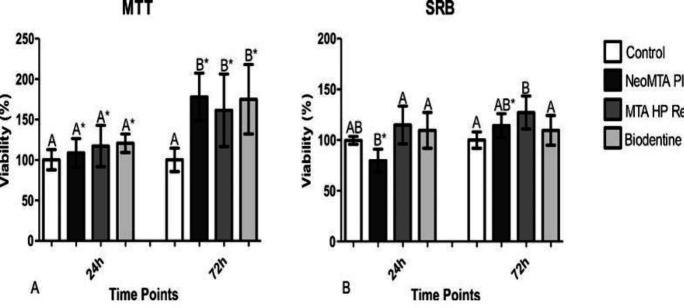
No significant differences were found between the cements and the control specimens on MTT at 24 h and 72 h (>0.05); however, the calcium silicate-based cement materials showed higher cell viability compared to the control group (<0.05). In the 24-h SRB, NeoMTA Plus showed lower cell viability than Biodentine and MTA HP Repair (<0.05), with all groups similar to the control group (>0.05). Compared to 24-h results, only NeoMTA Plus presented increased cell viability at 72 h (<0.05). ALP activity was similar across the materials at 1 day (>0.05). ALP activity was higher for Biodentine when compared to NeoMTA Plus (<0.05), nevertheless, it was similar to MTA HP Repair and control groups (>0.05) at 7 days. At 1- and 7-day periods of AZR assay, Biodentine presented higher levels of mineralized nodule formation (<0.05).
CONCLUSION
All evaluated calcium silicate-based cements demonstrated cell viability and bioactivity, suggesting that these (bio)materials may be indicated for use in regenerative dentine-pulp complex procedures.
引言
本研究评估了常用的硅酸钙基水门汀在根尖乳头干细胞(SCAPs)培养中的细胞毒性和生物活性。
材料与方法
使用3-(4,5-二甲基噻唑-2-基)-2,5-二苯基-2H-四唑溴盐(MTT)和磺酰罗丹明-B(SRB)活力测定法对NeoMTA Plus(阿瓦隆生物医学公司)、Biodentine(Septodont公司)和MTA HP Repair(安吉利斯公司)水门汀进行评估。将细胞(1×10⁴个细胞/mL)接种于96孔板中,并在24小时和72小时暴露于1:4稀释的提取物中。为了分析生物活性,在12孔板(1×10⁴个细胞/mL)中进行细胞培养24小时后,评估碱性磷酸酶(ALP)活性和茜素红S(AZR),细胞在第1天和第7天暴露于1:4稀释的提取物中。使用最低限度基本伊格尔培养基α改良型作为对照。在每个实验时间点,使用方差分析和Tukey事后检验来比较不同的水门汀。
结果
在24小时和72小时的MTT试验中,水门汀与对照样本之间未发现显著差异(>0.05);然而,与对照组相比,硅酸钙基水门汀材料显示出更高的细胞活力(<0.05)。在24小时的SRB试验中,NeoMTA Plus显示出比Biodentine和MTA HP Repair更低的细胞活力(<0.05),所有组与对照组相似(>0.05)。与24小时的结果相比,只有NeoMTA Plus在72小时时细胞活力增加(<0.05)。在第1天,各材料的ALP活性相似(>0.05)。与NeoMTA Plus相比,Biodentine在第7天的ALP活性更高(<0.0 [原文此处应为0.05]),不过,它与MTA HP Repair和对照组在第7天相似(>0.05)。在AZR试验的第1天和第7天,Biodentine呈现出更高水平的矿化结节形成(<0.05)。
结论
所有评估的硅酸钙基水门汀均显示出细胞活力和生物活性,表明这些(生物)材料可用于牙本质牙髓复合体再生程序。


 Zotero 插件