
胆固醇诱导的磷脂膜厚度的纳米级变化。
Cholesterol-Induced Nanoscale Variations in the Thickness of Phospholipid Membranes.
机构信息
Third Institute of Physics - Biophysics, Georg August University, Friedrich-Hund-Platz 1, 37077 Göttingen, Germany.
Cluster of Excellence "Multiscale Bioimaging: from Molecular Machines to Networks of Excitable Cells" (MBExC), Universitätsmedizin Göttingen, Robert-Koch-Str. 40, 37075 Göttingen, Germany.
出版信息
Nano Lett. 2023 Mar 22;23(6):2421-2426. doi: 10.1021/acs.nanolett.2c04635. Epub 2023 Jan 27.
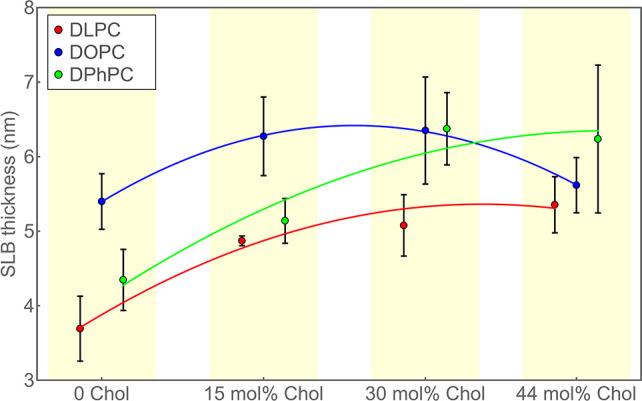
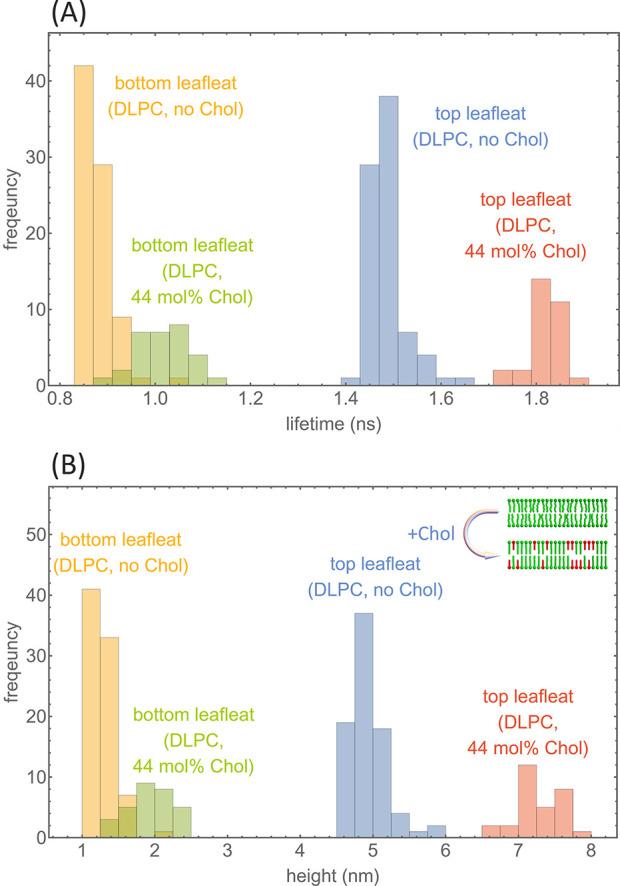
Graphene-induced energy transfer (GIET) is a recently developed fluorescence-spectroscopic technique that achieves subnanometric optical localization of fluorophores along the optical axis of a microscope. GIET is based on the near-field energy transfer from an optically excited fluorescent molecule to a single sheet of graphene. It has been successfully used for estimating interleaflet distances of single lipid bilayers and for investigating the membrane organization of living mitochondria. In this study, we use GIET to measure the cholesterol-induced subtle changes of membrane thickness at the nanoscale. We quantify membrane thickness variations in supported lipid bilayers (SLBs) as a function of lipid composition and increasing cholesterol content. Our findings demonstrate that GIET is an extremely sensitive tool for investigating nanometric structural changes in biomembranes.
石墨烯诱导能量转移 (GIET) 是一种最近开发的荧光光谱技术,可沿显微镜光轴实现荧光团的亚纳米级光学定位。GIET 基于从光学激发的荧光分子到单层石墨烯的近场能量转移。它已成功用于估计单层脂质双层的层间距离,并用于研究活线粒体的膜组织。在这项研究中,我们使用 GIET 来测量胆固醇诱导的纳米级膜厚度的细微变化。我们定量测量了支撑脂质双层 (SLB) 中膜厚度随脂质组成和胆固醇含量增加而变化的情况。我们的研究结果表明,GIET 是一种非常灵敏的工具,可用于研究生物膜中的纳米级结构变化。


 Zotero 插件