
创伤与心血管疾病风险相关的心理和生物学机制。
Psychological and biological mechanisms linking trauma with cardiovascular disease risk.
机构信息
Department of Psychology, University of California, Los Angeles, Los Angeles, CA, USA.
Department of Epidemiology, Boston University School of Public Health, Boston, MA, USA.
出版信息
Transl Psychiatry. 2023 Jan 27;13(1):25. doi: 10.1038/s41398-023-02330-8.
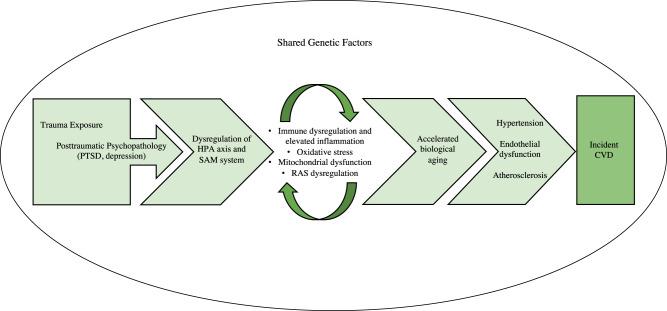
Cardiovascular disease (CVD) is the leading cause of death and disability worldwide, and experiences of psychological trauma have been associated with subsequent CVD onset. Identifying key pathways connecting trauma with CVD has the potential to inform more targeted screening and intervention efforts to offset elevated cardiovascular risk. In this narrative review, we summarize the evidence for key psychological and biological mechanisms linking experiences of trauma with CVD risk. Additionally, we describe various methodologies for measuring these mechanisms in an effort to inform future research related to potential pathways. With regard to mechanisms involving posttraumatic psychopathology, the vast majority of research on psychological distress after trauma and CVD has focused on posttraumatic stress disorder (PTSD), even though posttraumatic psychopathology can manifest in other ways as well. Substantial evidence suggests that PTSD predicts the onset of a range of cardiovascular outcomes in trauma-exposed men and women, yet more research is needed to better understand posttraumatic psychopathology more comprehensively and how it may relate to CVD. Further, dysregulation of numerous biological systems may occur after trauma and in the presence of posttraumatic psychopathology; these processes of immune system dysregulation and elevated inflammation, oxidative stress, mitochondrial dysfunction, renin-angiotensin system dysregulation, and accelerated biological aging may all contribute to subsequent cardiovascular risk, although more research on these pathways in the context of traumatic stress is needed. Given that many of these mechanisms are closely intertwined, future research using a systems biology approach may prove fruitful for elucidating how processes unfold to contribute to CVD after trauma.
心血管疾病(CVD)是全球范围内导致死亡和残疾的主要原因,而心理创伤经历与随后的 CVD 发病有关。确定将创伤与 CVD 联系起来的关键途径有可能为更有针对性的筛查和干预措施提供信息,以抵消升高的心血管风险。在这篇叙述性综述中,我们总结了将创伤经历与 CVD 风险联系起来的关键心理和生物学机制的证据。此外,我们描述了测量这些机制的各种方法,以期为潜在途径的未来研究提供信息。关于涉及创伤后精神病理学的机制,大多数关于创伤后和 CVD 中心理困扰的研究都集中在创伤后应激障碍(PTSD)上,尽管创伤后精神病理学也可以以其他方式表现出来。大量证据表明,PTSD 可预测创伤暴露的男性和女性一系列心血管结局的发生,但仍需要更多的研究来更好地全面了解创伤后精神病理学及其与 CVD 的关系。此外,创伤后和存在创伤后精神病理学时,许多生物系统可能会失调;这些免疫系统失调和炎症、氧化应激、线粒体功能障碍、肾素-血管紧张素系统失调以及生物衰老加速的过程都可能导致随后的心血管风险增加,但仍需要更多关于创伤应激背景下这些途径的研究。鉴于这些机制中的许多机制密切相关,使用系统生物学方法的未来研究可能有助于阐明创伤后这些过程如何展开从而导致 CVD。
 Zotero 插件