
直接裂解 3D 细胞培养物进行 RT-qPCR 基因表达定量。
Direct lysis of 3D cell cultures for RT-qPCR gene expression quantification.
机构信息
OncoRNALab, Cancer Research Institute Ghent (CRIG), Ghent, Belgium.
Department of Biomolecular Medicine, Ghent University, Ghent, Belgium.
出版信息
Sci Rep. 2023 Jan 27;13(1):1520. doi: 10.1038/s41598-023-28844-1.
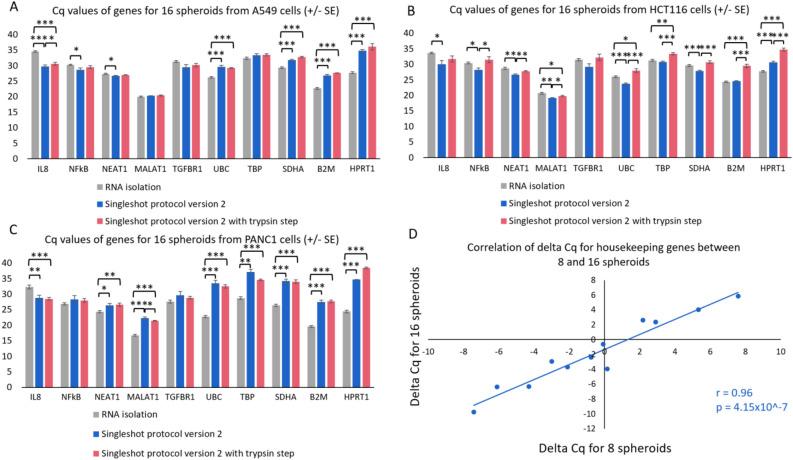
In vitro cell culture experiments are widely used to study cellular behavior in most biological research fields. Except for suspension cells, most human cell types are cultured as adherent monolayers on a plastic surface. While technically convenient, monolayer cultures can suffer from limitations in terms of physiological relevance, as their resemblance to complex in vivo tissue structures is limited. To address these limitations, three-dimensional (3D) cell culture systems have gained increased interest as they mimic key structural and functional properties of their in vivo tissue counterparts. Nevertheless, protocols established on monolayer cell cultures may require adjustments if they are to be applied to 3D cell cultures. As gene expression quantification is an essential part of many in vitro experiments, we evaluated and optimized a direct cell lysis, reverse transcription and qPCR protocol applicable for 3D cell cultures. The newly developed protocol wherein gene expression is determined directly from crude cell lysates showed improved cell lysis compared to the standard protocol, accurate gene expression quantification, hereby avoiding time-consuming cell harvesting and RNA extraction.
体外细胞培养实验广泛应用于大多数生物学研究领域中研究细胞行为。除了悬浮细胞外,大多数人类细胞类型都作为贴壁单层在塑料表面上培养。虽然在技术上方便,但单层培养在生理相关性方面可能存在限制,因为它们与复杂的体内组织结构的相似性有限。为了解决这些限制,三维(3D)细胞培养系统作为其体内组织对应物的关键结构和功能特性的模拟物受到了越来越多的关注。然而,如果要将基于单层细胞培养的方案应用于 3D 细胞培养,则可能需要进行调整。由于基因表达定量是许多体外实验的重要组成部分,因此我们评估和优化了适用于 3D 细胞培养的直接细胞裂解、逆转录和 qPCR 方案。直接从粗细胞裂解物中测定基因表达的新开发方案与标准方案相比,显示出更好的细胞裂解效果,准确的基因表达定量,从而避免了耗时的细胞收获和 RNA 提取。


 Zotero 插件