
2014-2020 年俄罗斯-乌克兰战争混合时期,战斗伤员中弹导致结肠扩张性枪弹伤。
Gunshot injury to the colon by expanding bullets in combat patients wounded in hybrid period of the Russian-Ukrainian war during 2014-2020.
机构信息
Medical Forces Command, Armed Forces of Ukraine, Kyiv, Ukraine.
Department of Military Surgery, Ukrainian Military Medical Academy, Kyiv, Ukraine.
出版信息
BMC Surg. 2023 Jan 27;23(1):23. doi: 10.1186/s12893-023-01919-6.
BACKGROUND
A gunshot wound to the colon is a frequent injury in armed conflicts. An example of a high-energy modern weapon is hollow-point bullets, which is associated with increased tissue damage and lethal outcome. The aim of this study was to evaluate gunshot injuries to the colon in combat patients and to assess the difference in clinical features of patients with colon injuries by hollow-point versus shape-stable bullets.
PATIENTS AND METHODS
Analyses of clinical data were performed on 374 male soldiers from the Armed Forces of Ukraine with gunshot abdominal wounds with injury to the colon in East Ukraine between 2014 and 2020. Out of 374 injured, 112 (29.9%) patients were diagnosed with penetrating gunshot bullet wounds: 69/112 (61.6%) were injured by shape-stable bullets, and the hollow-point bullets injured 43/112 (38.4%) patients.
RESULTS
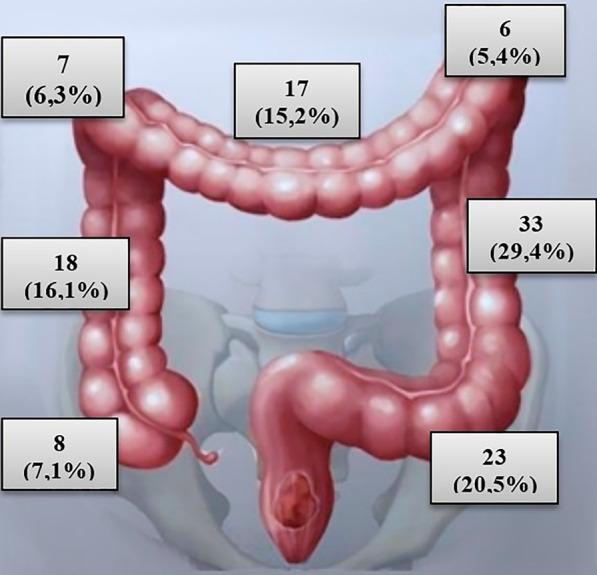
More severe hemorrhagic shock stages were in patients injured by hollow-point bullets: shock stages III-IV was in 25 (58.1%) patients injured by the hollow-point bullets vs. 17 (24.6%) patients injured by shape-stable bullets (p = 0.0004). Left colon parts were more frequently injured as compared to the right colon side or transverse colon: 21 (48.8%) patients were injured by the hollow-point bullets (p < 0.0001), and 41 (59.4%) patients were injured by the shape-stable bullets (p = 0.032). A significant difference was identified for the frequent injury to the middle colon within the entire cohort (p = 0.023). Patients injured by the hollow-point bullets demonstrated a higher frequency of 3-5 areas of colon gunshot defects, which was detected in 18 (41.8%) patients injured by hollow-point bullets and none with shape-stable bullets injury (p = 0.0001). Colon Injury Scale (CIS) IV was detected in 7 (16.3%) patients injured by the hollow-point bullets as compared to 2 (2.9%) patients injured by shape-stable bullets (p = 0.011). Colostomy was performed in 14 (69%) patients injured by shape-stable bullets and in 12 (27.9%) patients injured by hollow-point bullets (p > 0.05). 15 (35%) patients died after injury by the hollow-point bullet, whereas 9 (13%) patients after damage by the shape-stable bullets (p = 0.0089).
CONCLUSIONS
All patients should be suspected to have an injury by bullet with expanding properties in case of penetrating abdominal injury (absent of outlet wound) and careful revision of the abdomen must be performed to identify possible multiorgan injury as well as multiple gunshot defects of the intestine.
背景
结肠枪伤是武装冲突中常见的损伤。现代高能武器的一个例子是中空弹丸,它与组织损伤增加和致命后果有关。本研究的目的是评估在战斗患者中结肠的枪伤,并评估中空弹丸与形状稳定弹丸对结肠损伤患者的临床特征差异。
患者和方法
对 2014 年至 2020 年期间在乌克兰东部腹部有枪伤的 374 名男性乌克兰武装部队士兵进行了临床数据分析,其中结肠受伤。在 374 名受伤患者中,112 名(29.9%)被诊断为穿透性枪伤:69/112 名(61.6%)为形状稳定弹丸损伤,43/112 名(38.4%)为中空弹丸损伤。
结果
中空弹丸损伤的患者更严重的失血性休克阶段:休克阶段 III-IV 在 25 名(58.1%)中空弹丸损伤的患者中,而在 17 名(24.6%)形状稳定弹丸损伤的患者中(p=0.0004)。左侧结肠部分比右侧结肠侧或横结肠更常受伤:21 名(48.8%)中空弹丸损伤的患者(p<0.0001),41 名(59.4%)形状稳定弹丸损伤的患者(p=0.032)。在整个队列中,中间结肠经常受伤,差异有统计学意义(p=0.023)。中空弹丸损伤的患者更频繁地出现 3-5 个结肠枪伤部位,在 18 名(41.8%)中空弹丸损伤的患者中检测到,而在没有形状稳定弹丸损伤的患者中没有检测到(p=0.0001)。结肠损伤评分(CIS)IV 在 7 名(16.3%)中空弹丸损伤的患者中检测到,而在 2 名(2.9%)形状稳定弹丸损伤的患者中未检测到(p=0.011)。14 名(69%)形状稳定弹丸损伤的患者进行了结肠造口术,12 名(27.9%)中空弹丸损伤的患者进行了结肠造口术(p>0.05)。15 名(35%)中空弹丸损伤的患者死亡,9 名(13%)形状稳定弹丸损伤的患者死亡(p=0.0089)。
结论
在穿透性腹部损伤(无出口伤口)的情况下,所有患者都应怀疑有扩张性子弹造成的损伤,必须仔细检查腹部,以确定可能的多器官损伤以及肠道多处枪伤。



 Zotero 插件