
腰椎退行性疾病的斜入路与经椎间孔入路腰椎椎间融合术的比较:一项更新的荟萃分析。
Comparison of oblique and transforaminal approaches to lumbar interbody fusion for lumbar degenerative disease: An updated meta-analysis.
作者信息
Lin Guang-Xun, Xu Wen-Bin, Kotheeranurak Vit, Chen Chien-Min, Deng Zhi-Hong, Zhu Ming-Tao
机构信息
Department of Orthopedics, The First Affiliated Hospital of Xiamen University, School of Medicine, Xiamen University, Xiamen, China.
The School of Clinical Medicine, Fujian Medical University, Fuzhou, China.
出版信息
Front Surg. 2023 Jan 16;9:1004870. doi: 10.3389/fsurg.2022.1004870. eCollection 2022.
OBJECTIVE
Oblique lumbar interbody fusion (OLIF) and transforaminal lumbar interbody fusion (TLIF) are widely used in the treatment of lumbar degenerative diseases. A meta-analysis was performed to examine the clinical and radiological effects of these two techniques.
METHODS
A search of relevant literature from several databases was conducted until November 2021. Perioperative outcomes, clinical and radiological results, and complications were analyzed.
RESULTS
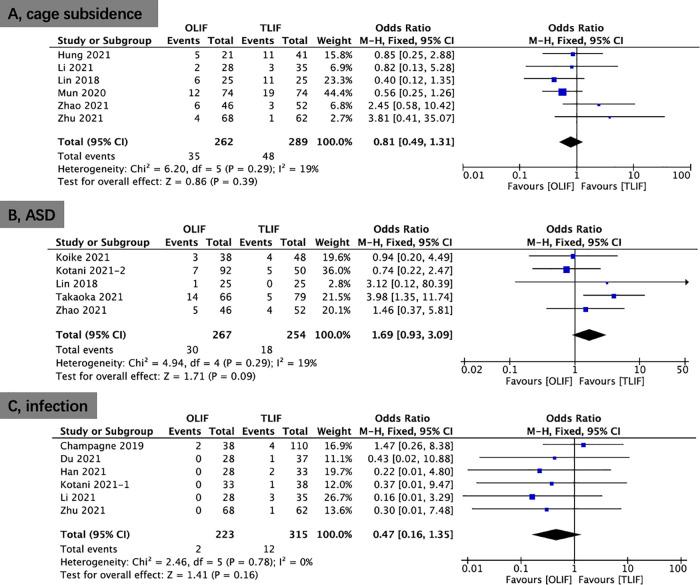
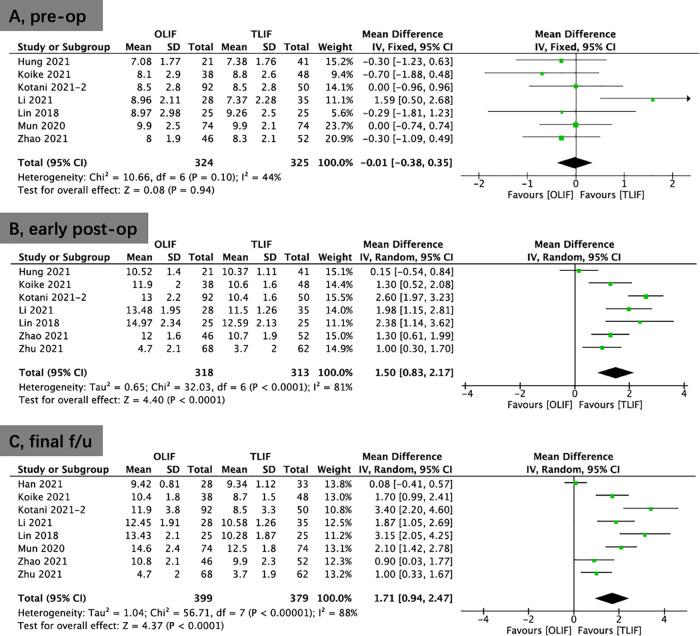
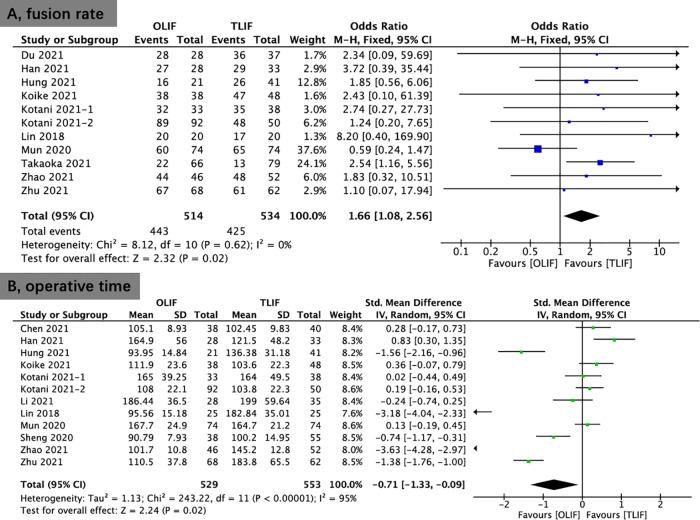
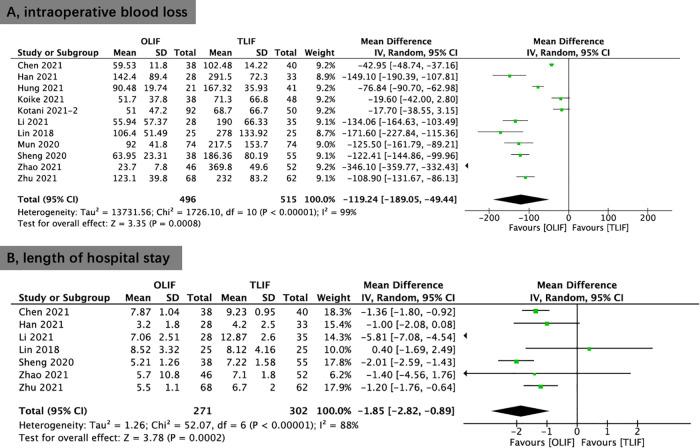
Fifteen qualified studies were included. OLIF showed a shorter operative time and length of hospital stay and less blood loss than TLIF. Early postoperative Visual Analogue Scale for back pain were significantly lower in OLIF than in TLIF ( = 0.004). Noteworthy, although the preoperative Oswestry Disability Index (ODI) of the OLIF group was higher than that of the TLIF group ( = 0.04), the postoperative ODI was significantly lower ( < 0.05). Radiologically, the results showed that the disc and foraminal heights of OLIF were significantly higher than those of TLIF postoperatively. Moreover, OLIF can restore more segmental lordosis than TLIF in the early postoperative period. Furthermore, OLIF showed better fusion rates than TLIF ( = 0.02), with no difference in cage subsidence (13.4% vs. 16.6%). No significant differences in overall and approach-related complications between the two groups.
CONCLUSION
The OLIF group showed an advantage in terms of operative time, hospitalization, intraoperative blood loss, early back pain relief, postoperative function recovery, disc and foraminal heights, early segmental lordosis, and fusion rate compared to TLIF. For both procedures, the incidence rates of overall and approach-related complications were comparable.
目的
斜外侧腰椎椎间融合术(OLIF)和经椎间孔腰椎椎间融合术(TLIF)广泛应用于腰椎退行性疾病的治疗。进行一项荟萃分析以研究这两种技术的临床和影像学效果。
方法
检索多个数据库的相关文献至2021年11月。分析围手术期结果、临床和影像学结果以及并发症。
结果
纳入15项合格研究。OLIF显示手术时间和住院时间更短,失血量比TLIF少。术后早期OLIF组的背痛视觉模拟量表评分显著低于TLIF组(P = 0.004)。值得注意的是,尽管OLIF组术前的奥斯维斯特里功能障碍指数(ODI)高于TLIF组(P = 0.04),但术后ODI显著更低(P < 0.05)。影像学方面,结果显示术后OLIF的椎间盘和椎间孔高度显著高于TLIF。此外,在术后早期OLIF比TLIF能恢复更多的节段性前凸。而且,OLIF显示出比TLIF更好的融合率(P = 0.02),椎间融合器下沉无差异(13.4%对16.6%)。两组在总体及与手术入路相关的并发症方面无显著差异。
结论
与TLIF相比,OLIF组在手术时间、住院时间、术中失血量、早期背痛缓解、术后功能恢复、椎间盘和椎间孔高度、早期节段性前凸以及融合率方面具有优势。对于这两种手术,总体及与手术入路相关的并发症发生率相当。




 Zotero 插件