
奥沙利铂诱导痛觉敏化的神经内分泌机制。
Neuroendocrine mechanisms in oxaliplatin-induced hyperalgesic priming.
机构信息
Departments of Oral and Maxillofacial Surgery and.
Preventative and Restorative Dental Sciences, UCSF Pain and Addiction Research Center, University of California at San Francisco, San Francisco, CA, United States.
出版信息
Pain. 2023 Jun 1;164(6):1375-1387. doi: 10.1097/j.pain.0000000000002828. Epub 2022 Dec 6.
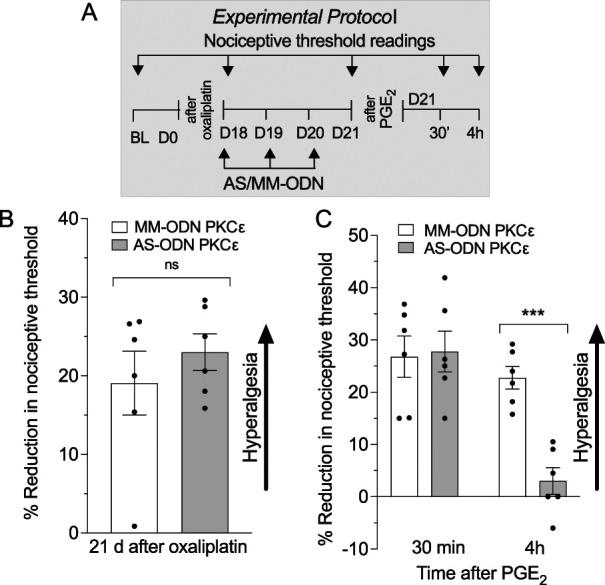
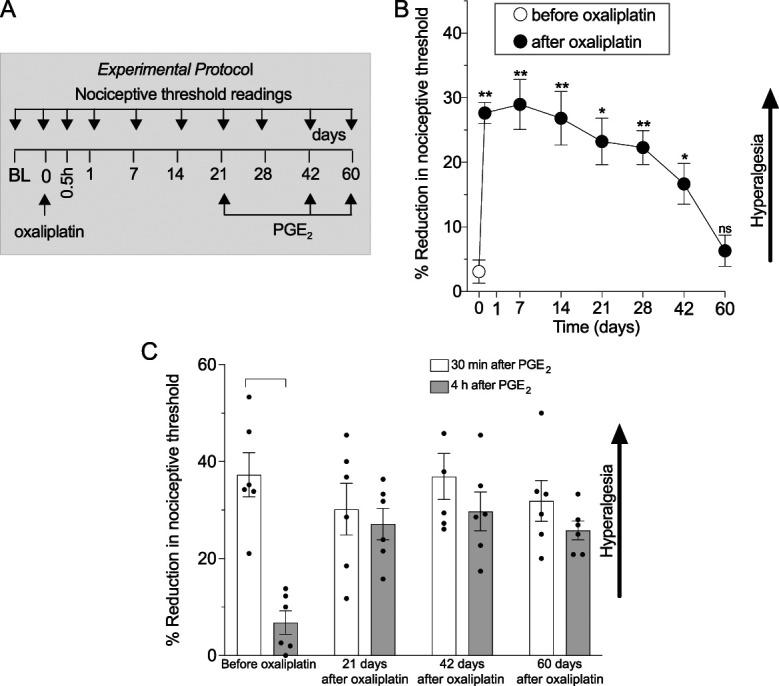
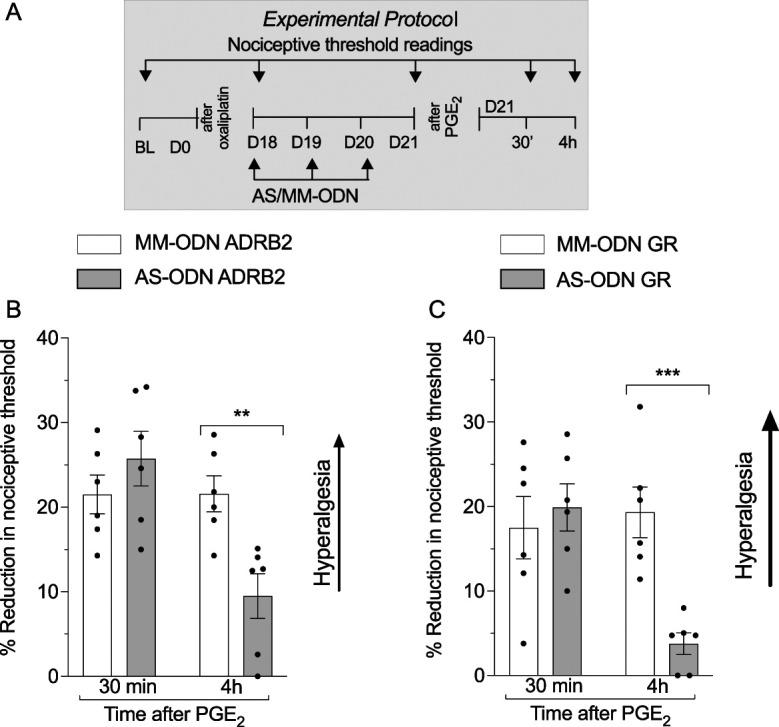
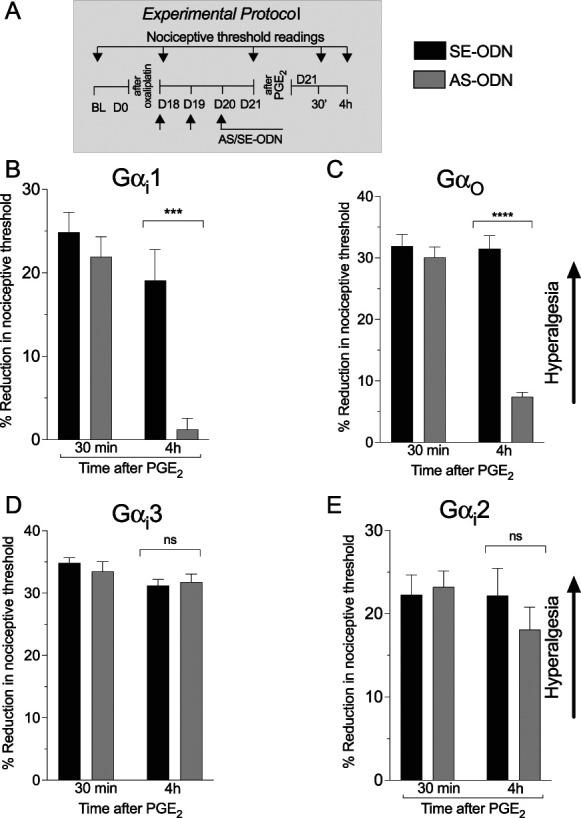
Stress plays a major role in the symptom burden of oncology patients and can exacerbate cancer chemotherapy-induced peripheral neuropathy (CIPN), a major adverse effect of many classes of chemotherapy. We explored the role of stress in the persistent phase of the pain induced by oxaliplatin. Oxaliplatin induced hyperalgesic priming, a model of the transition to chronic pain, as indicated by prolongation of hyperalgesia produced by prostaglandin E 2 , in male rats, which was markedly attenuated in adrenalectomized rats. A neonatal handling protocol that induces stress resilience in adult rats prevented oxaliplatin-induced hyperalgesic priming. To elucidate the role of the hypothalamic-pituitary-adrenal and sympathoadrenal neuroendocrine stress axes in oxaliplatin CIPN, we used intrathecally administered antisense oligodeoxynucleotides (ODNs) directed against mRNA for receptors mediating the effects of catecholamines and glucocorticoids, and their second messengers, to reduce their expression in nociceptors. Although oxaliplatin-induced hyperalgesic priming was attenuated by intrathecal administration of β 2 -adrenergic and glucocorticoid receptor antisense ODNs, oxaliplatin-induced hyperalgesia was only attenuated by β 2 -adrenergic receptor antisense. Administration of pertussis toxin, a nonselective inhibitor of Gα i/o proteins, attenuated hyperalgesic priming. Antisense ODNs for Gα i 1 and Gα o also attenuated hyperalgesic priming. Furthermore, antisense for protein kinase C epsilon, a second messenger involved in type I hyperalgesic priming, also attenuated oxaliplatin-induced hyperalgesic priming. Inhibitors of second messengers involved in the maintenance of type I (cordycepin) and type II (SSU6656 and U0126) hyperalgesic priming both attenuated hyperalgesic priming. These experiments support a role for neuroendocrine stress axes in hyperalgesic priming, in male rats with oxaliplatin CIPN.
应激在肿瘤患者的症状负担中起着重要作用,并且可以加重癌症化疗引起的周围神经病变(CIPN),这是许多化疗药物的主要不良反应。我们探讨了应激在奥沙利铂引起的疼痛持续期的作用。奥沙利铂引起超敏化启动,这是向慢性疼痛转变的模型,表现为前列腺素 E 2 产生的痛觉过敏延长,在雄性大鼠中,这种作用在肾上腺切除大鼠中明显减弱。一种新生处理方案可诱导成年大鼠产生应激抗性,从而防止奥沙利铂引起的超敏化启动。为了阐明下丘脑-垂体-肾上腺和交感肾上腺神经内分泌应激轴在奥沙利铂 CIPN 中的作用,我们使用鞘内给予针对介导儿茶酚胺和糖皮质激素作用的受体的信使 RNA 的反义寡核苷酸(ODN),以减少其在伤害感受器中的表达。尽管鞘内给予β 2 -肾上腺素能和糖皮质激素受体反义 ODN 可减轻奥沙利铂引起的超敏化启动,但只有β 2 -肾上腺素能受体反义可减轻奥沙利铂引起的痛觉过敏。百日咳毒素(一种非选择性 Gα i/o 蛋白抑制剂)的给药可减轻超敏化启动。Gα i 1 和 Gα o 的反义 ODN 也可减轻超敏化启动。此外,涉及 I 型超敏化启动的第二信使蛋白激酶 C epsilon 的反义 ODN 也可减轻奥沙利铂引起的超敏化启动。涉及 I 型(虫草素)和 II 型(SSU6656 和 U0126)超敏化启动维持的第二信使抑制剂均减轻超敏化启动。这些实验支持神经内分泌应激轴在奥沙利铂引起的 CIPN 雄性大鼠超敏化启动中的作用。




 Zotero 插件