
哮喘与注意力缺陷多动障碍之间的长期双向关联:一项大数据队列研究。
Long-term bidirectional association between asthma and attention deficit hyperactivity disorder: A big data cohort study.
作者信息
Park Hye Jin, Kim Young Hyeon, Na Da Ye, Jeong Seong Won, Lee Min Gyu, Lee Jong-Hwan, Yang Yun Na, Kang Min Gu, Yeom Sang Woo, Kim Jong Seung
机构信息
Department of Medical Informatics, Jeonbuk National University Medical School, Jeonju, Republic of Korea.
Department of Otorhinolaryngology, Jeonbuk National University Medical School, Jeonju, Republic of Korea.
出版信息
Front Psychiatry. 2023 Jan 19;13:1044742. doi: 10.3389/fpsyt.2022.1044742. eCollection 2022.
BACKGROUND
Previous studies have argued that attention deficit hyperactivity disorder (ADHD) is associated with asthma. However, reliable evidence to verify this association has not yet been reported.
OBJECTIVES
To investigate the bidirectional association between asthma and ADHD through a 12-year big data cohort study.
METHODS
The independent variable group was extracted from 3.5 million individuals randomly sampled by the National Health Insurance Service (NHIS). In Study 1, the incidence of ADHD according to asthma was evaluated, while in Study 2, the incidence of asthma according to ADHD was analyzed. Propensity score (PS) matching with several variables was used to obtain a control group.
MEASUREMENTS AND MAIN RESULTS
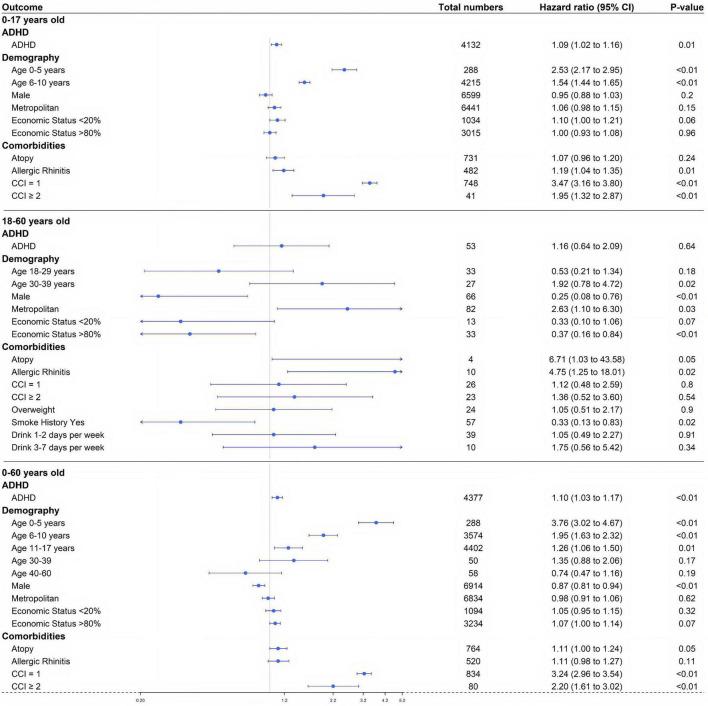
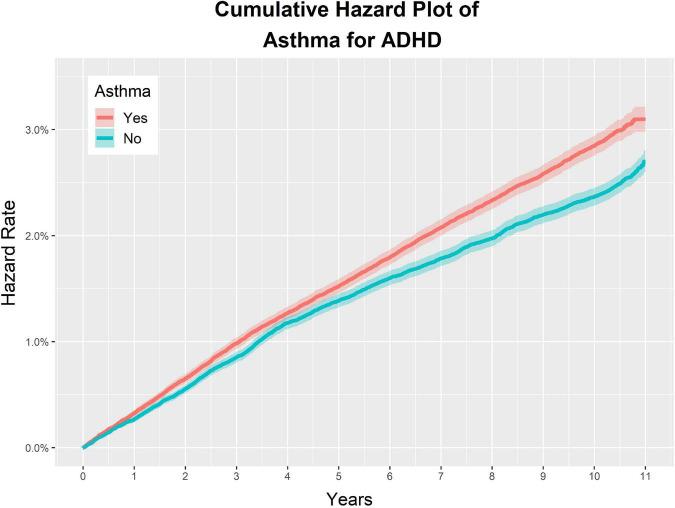
In Study 1, the asthma group included 131,937 individuals and the non-asthma group included 131,937 individuals. The adjusted hazard ratio (aHR) for ADHD in the asthma group was 1.17 [95% confidence interval (CI): 1.11-1.23]. In subgroup analysis, the aHRs for ADHD of individuals in the subgroups male sex, 0-5 years old, 6-10 years old, atopic dermatitis, allergic rhinitis, Charlson comorbidity index (CCI) 1, and CCI > 2 were significant (aHR: 2.83, 1.70, 1.79, 1.09, 1.15, 1.06, and 1.49, respectively). In Study 2, ADHD was found to significantly affect asthma in all age groups (aHRs of the subgroups 0∼60 and 0∼17 years old were 1.10 and 1.09, respectively). In the 0∼17 years old subgroup, the association of ADHD with asthma was greater with younger age (aHRs of the subgroups 0∼5 and 6∼10 years old were 2.53 and 1.54, respectively).
CONCLUSION
From long-term follow-up, the incidence of ADHD was 1.17 times higher in the asthma group than in the control group. The incidence of asthma was 1.10 times higher in the ADHD group than in the control group. Asthma and ADHD have a bidirectional relationship, and childhood asthma and ADHD should be rigorously managed.
背景
既往研究认为注意力缺陷多动障碍(ADHD)与哮喘有关。然而,尚未有可靠证据证实这种关联。
目的
通过一项为期12年的大数据队列研究,调查哮喘与ADHD之间的双向关联。
方法
自变量组从韩国国民健康保险服务(NHIS)随机抽取的350万个体中提取。在研究1中,评估哮喘患者中ADHD的发病率,而在研究2中,分析ADHD患者中哮喘的发病率。使用倾向评分(PS)匹配多个变量以获得对照组。
测量指标及主要结果
在研究1中,哮喘组包括131937人,非哮喘组包括131937人。哮喘组中ADHD的校正风险比(aHR)为1.17 [95%置信区间(CI):1.11 - 1.23]。亚组分析中,男性、0 - 5岁、6 - 10岁、特应性皮炎、过敏性鼻炎、查尔森合并症指数(CCI)为1以及CCI > 2亚组中ADHD的aHR均具有统计学意义(分别为aHR:2.83、1.70、1.79、1.09、1.15、1.06和1.49)。在研究2中,发现ADHD在所有年龄组均显著影响哮喘(0∼60岁和0∼17岁亚组的aHR分别为1.10和1.09)。在0∼17岁亚组中,ADHD与哮喘的关联在年龄越小的人群中越强(0∼5岁和6∼10岁亚组的aHR分别为2.53和1.54)。
结论
通过长期随访,哮喘组中ADHD的发病率比对照组高1.17倍。ADHD组中哮喘的发病率比对照组高1.10倍。哮喘与ADHD存在双向关系,儿童哮喘和ADHD应得到严格管理。



 Zotero 插件