
1990年至2019年中国总体及早发性结直肠癌的疾病负担以及癌症发病率和死亡率预测
Disease Burden of Total and Early-Onset Colorectal Cancer in China from 1990 to 2019 and Predictions of Cancer Incidence and Mortality.
作者信息
Shao Bule, Zhu Mengjia, Shen Kai, Luo Liang, Du Ping, Li Jun, Xu Jing, Deng Yanyong, Lin Ne, Wu Jiaguo, Hu Weiling
机构信息
Department of Gastroenterology, Sir Run Run Shaw Hospital, Zhejiang University School of Medicine, Hangzhou, People's Republic of China.
Institute of Gastroenterology, Zhejiang University, Hangzhou, People's Republic of China.
出版信息
Clin Epidemiol. 2023 Feb 1;15:151-163. doi: 10.2147/CLEP.S391058. eCollection 2023.
BACKGROUND
Understanding the temporal trends in the epidemiology of colorectal cancer (CRC) and early-onset CRC (EOCRC) in China is essential for policymakers to develop appropriate strategies to reduce the CRC burden.
METHODS
The prevalence, incidence, mortality, years of life lived with disability (YLDs), years of life lost (YLLs), and disability-adjusted life years (DALYs) of CRC were obtained from the Global Burden of Disease (GBD) Study 2019. The incidence and mortality of CRC over the next 25 years were predicted.
RESULTS
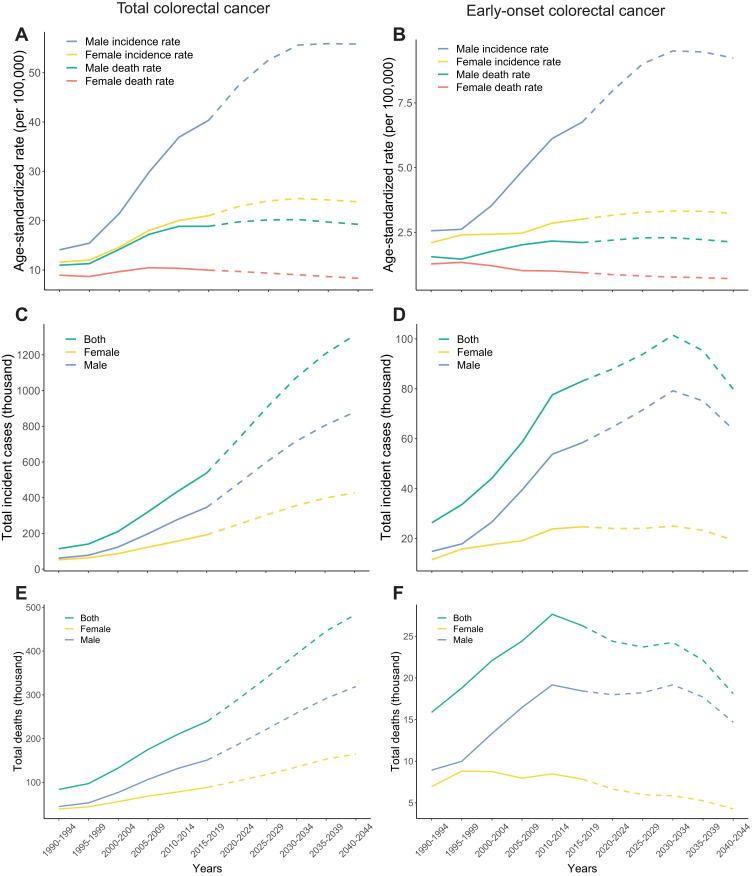
From 1990 to 2019, the prevalence, incidence, and mortality of total CRC and EOCRC significantly increased in males, with milder trends in females. In 2019, the number of people living with CRC (or EOCRC) in China was approximately 3.4 (0.59) million, which was over seven (five) times higher than that in 1990. The DALYs, YLDs, and YLLs moderately increased from 1990 to 2019 in both sexes. The age-standardized mortality rate (ASMR) for females has shown a stable trend in total CRC, and a downward trend in EOCRC since 2000. While the ASMR for males showed increasing trends in total CRC and EOCRC. In 2019, the highest incidence, prevalence, YLDs, YLLs, and DALYs were all observed in the 65 to 69 age group, while the highest mortality was in the 70 to 74. By 2044, the incidence and deaths of CRC are expected to reach 1310 thousand and 484 thousand, respectively. For EOCRC, the incidence will peak at about 101 thousand around 2034, and the mortality will continuously decrease to a nadir at about 18 thousand around 2044.
CONCLUSION
Although the age-standardized incidence and mortality of total CRC and EOCRC in China will reach a plateau, the number of incident cases and deaths of CRC have been increasing in the last three decades and will continue to increase in the next 25 years.
背景
了解中国结直肠癌(CRC)和早发性结直肠癌(EOCRC)流行病学的时间趋势,对于政策制定者制定减轻CRC负担的适当策略至关重要。
方法
CRC的患病率、发病率、死亡率、伤残损失生命年(YLDs)、生命损失年数(YLLs)和伤残调整生命年(DALYs)数据来自《2019年全球疾病负担研究》。预测了未来25年CRC的发病率和死亡率。
结果
1990年至2019年,男性全年龄段CRC和EOCRC的患病率、发病率和死亡率显著上升,女性变化趋势较平缓。2019年,中国CRC(或EOCRC)患者人数约为340万(59万),分别是1990年的7倍(5倍)多。1990年至2019年,两性的DALYs、YLDs和YLLs均呈适度上升趋势。2000年以来,女性全年龄段CRC的年龄标准化死亡率(ASMR)呈稳定趋势,EOCRC呈下降趋势。而男性全年龄段CRC和EOCRC的ASMR均呈上升趋势。2019年,65至69岁年龄组的发病率、患病率、YLDs、YLLs和DALYs均最高,而死亡率最高的是70至74岁年龄组。到2044年,预计CRC的发病率和死亡人数将分别达到131万和48.4万。对于EOCRC,发病率将在2034年左右达到峰值,约为10.1万,死亡率将持续下降,到2044年左右降至最低点,约为1.8万。
结论
尽管中国全年龄段CRC和EOCRC的年龄标准化发病率和死亡率将趋于平稳,但在过去三十年中,CRC的发病例数和死亡人数一直在增加,并且在未来25年仍将继续增加。


 Zotero 插件