
儿科神经重症监护病房患者对抗菌药物的多重耐药率
Rate of Multidrug-resistance to Antimicrobial Drugs in Patients in Pediatric Neurointensive Care.
作者信息
Patel Swapnil, Prabhakar Hemanshu, Kapoor Indu
机构信息
Department of Neuroanaesthesiology and Critical Care, All India Institute of Medical Sciences, New Delhi, India.
出版信息
Indian J Crit Care Med. 2023 Jan;27(1):67-72. doi: 10.5005/jp-journals-10071-24377.
BACKGROUND
Multidrug-resistant (MDR) organisms in the critical care unit are a worldwide concern. The vulnerability to MDR infection in pediatric patients admitted in neurocritical care are due to altered mental status, immature immune system, higher risk of aspiration, and more frequent use of invasive devices. We aimed to measure the burden of MDR infection in pediatric neurosurgical intensive care unit (NSICU) patients.
METHODS
All pediatric patients between 1 and 18 years for intracranial and spine surgeries admitted for more than 48 hours in NSICU were enrolled in the study. If patients showed a clinical picture of pneumonia, bloodstream infection (BSI), or urinary tract infection (UTI) after receiving mechanical ventilation or an indwelling device for at least 48 hours, samples of tracheal aspirates, urine, blood, and cerebrospinal fluid (CSF) were sent for microbiological culture. We noted the type of organism, MDR infection rate, and associated risk factors. Pearson Chi-squared test and Fisher's test were used for statistical analysis; < 0.05 was considered statistically significant.
RESULTS
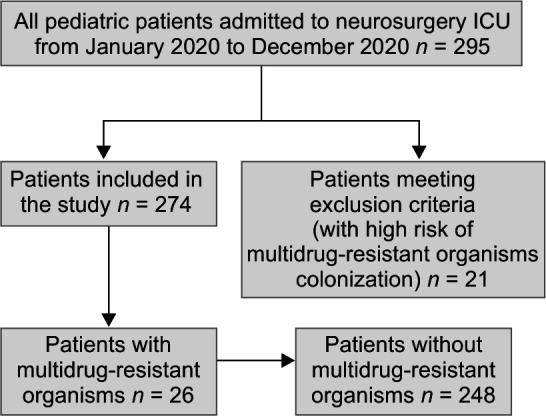
A total of 274 pediatric patients were studied. In 1 year, there was a total of 1,790 patient days. The inclusive MDR infection rate was 17.3/1,000 patient days. Also, (38.7%) was the commonest MDR pathogen. The commonest source of infection was BSI (32.3%). The risk factors associated with MDR infections were the length of stay in NSICU, mechanical ventilation of more than 5 days, emergency surgery, respiratory and cardiac comorbidities, and poor nutrition status ( < 0.05).
CONCLUSION
The MDR infection rate in our study was 17.3/1,000 patient days in pediatric patients. Also, was found to be the commonest MDR pathogen. Bloodstream was the commonest source of infection.
HOW TO CITE THIS ARTICLE
Patel S, Prabhakar H, Kapoor I. Rate of Multidrug-resistance to Antimicrobial Drugs in Patients in Pediatric Neurointensive Care. Indian J Crit Care Med 2023;27(1):67-72.
背景
重症监护病房中的多重耐药(MDR)微生物是一个全球性问题。入住神经重症监护病房的儿科患者易发生MDR感染,原因包括精神状态改变、免疫系统不成熟、误吸风险较高以及侵入性设备使用更为频繁。我们旨在衡量儿科神经外科重症监护病房(NSICU)患者中MDR感染的负担。
方法
纳入所有1至18岁因颅内和脊柱手术入住NSICU超过48小时的儿科患者。如果患者在接受机械通气或留置装置至少48小时后出现肺炎、血流感染(BSI)或尿路感染(UTI)的临床表现,则将气管吸出物、尿液、血液和脑脊液(CSF)样本送检进行微生物培养。我们记录了微生物类型、MDR感染率及相关危险因素。采用Pearson卡方检验和Fisher检验进行统计分析;P<0.05被认为具有统计学意义。
结果
共研究了274例儿科患者。1年中,总共有1790个患者日。MDR感染总发生率为17.3/1000患者日。此外,(具体微生物未给出)是最常见的MDR病原体。最常见的感染源是BSI(32.3%)。与MDR感染相关的危险因素包括在NSICU的住院时间、机械通气超过5天、急诊手术、呼吸和心脏合并症以及营养状况差(P<0.05)。
结论
我们研究中儿科患者的MDR感染率为17.3/1000患者日。此外,(具体微生物未给出)被发现是最常见的MDR病原体。血流是最常见的感染源。
如何引用本文
Patel S, Prabhakar H, Kapoor I.儿科神经重症监护患者对抗菌药物的多重耐药率。《印度重症监护医学杂志》2023;27(1):67 - 72。

 Zotero 插件