
婴儿及其母亲肠道病毒组的纵向比较。
Longitudinal comparison of the developing gut virome in infants and their mothers.
机构信息
Department of Microbiome Science, Max Planck Institute for Biology, Tübingen, Germany.
Department of Laboratory Medicine, University of California San Francisco, San Francisco, CA 94143, USA.
出版信息
Cell Host Microbe. 2023 Feb 8;31(2):187-198.e3. doi: 10.1016/j.chom.2023.01.003.
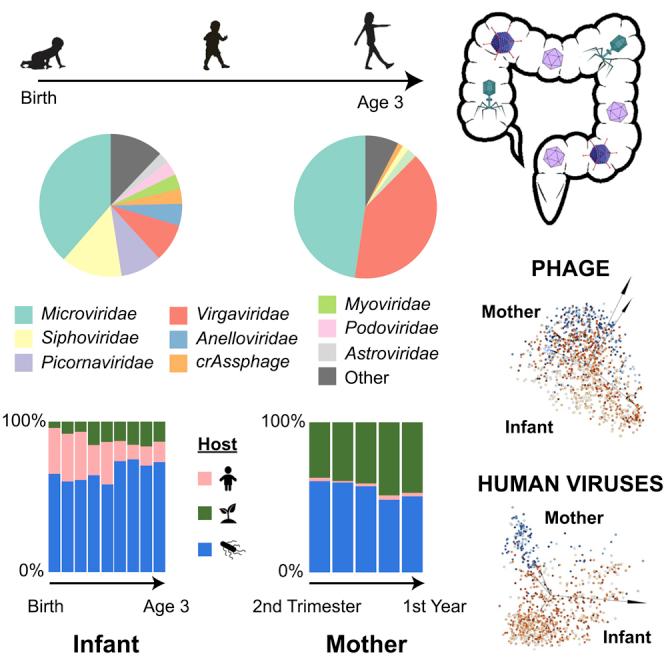
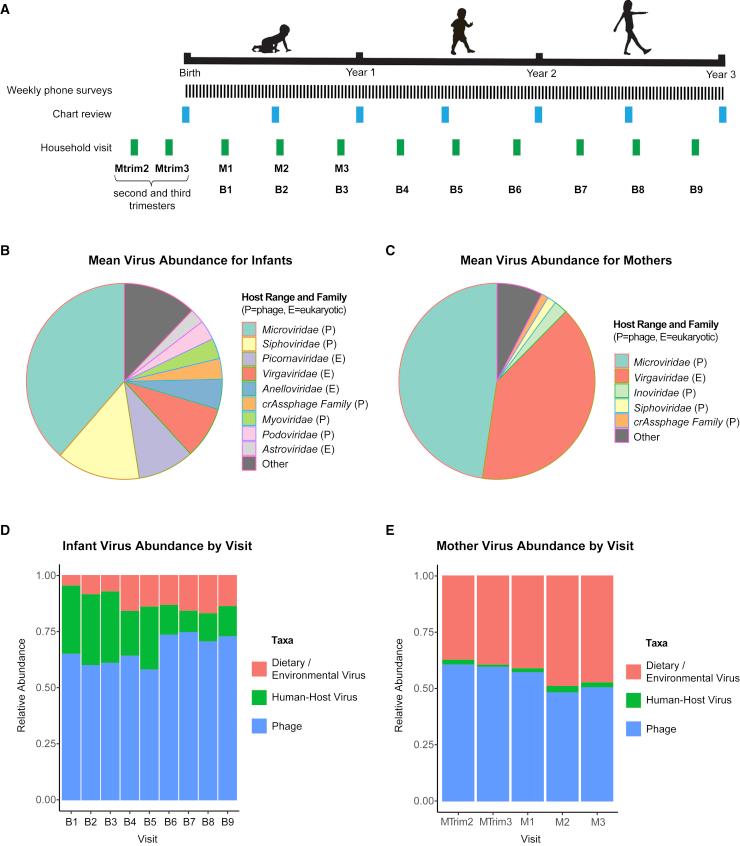
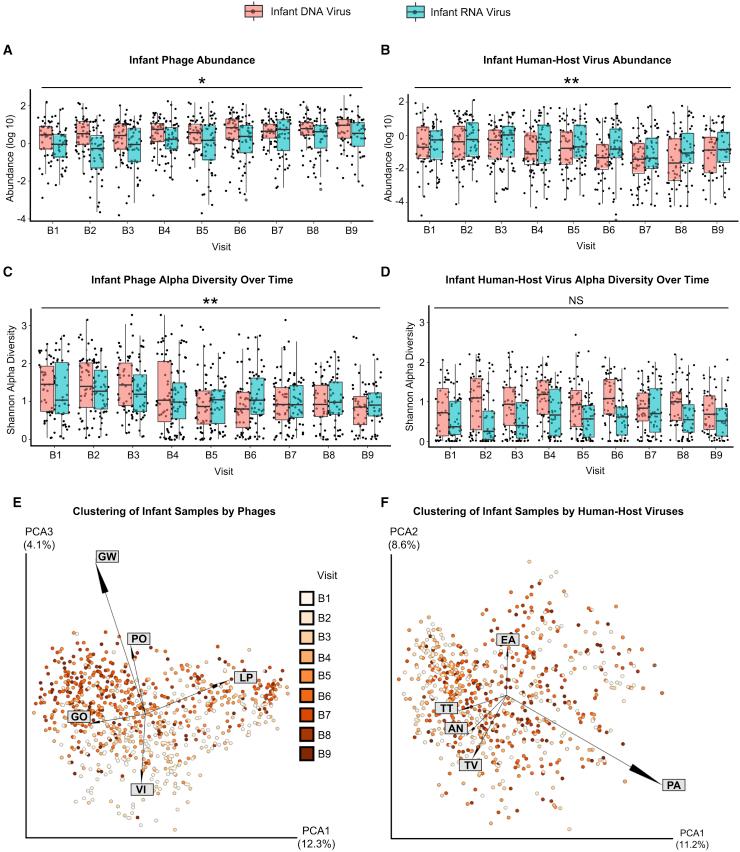
The human gut virome and its early life development are poorly understood. Prior studies have captured single-point assessments with the evolution of the infant virome remaining largely unexplored. We performed viral metagenomic sequencing on stool samples collected longitudinally from a cohort of 53 infants from age 2 weeks to 3 years (80.7 billion reads), and from their mothers (9.8 billion reads) to examine and compare viromes. The asymptomatic infant virome consisted of bacteriophages, nonhuman dietary/environmental viruses, and human-host viruses, predominantly picornaviruses. In contrast, human-host viruses were largely absent from the maternal virome. Previously undescribed, sequence-divergent vertebrate viruses were detected in the maternal but not infant virome. As infants aged, the phage component evolved to resemble the maternal virome, but by age 3, the human-host component remained dissimilar from the maternal virome. Thus, early life virome development is determined predominantly by dietary, infectious, and environmental factors rather than direct maternal acquisition.
人类肠道病毒组及其早期发育尚不清楚。先前的研究仅进行了单点评估,而婴儿病毒组的演变在很大程度上仍未得到探索。我们对来自 53 名婴儿的粪便样本进行了病毒宏基因组测序,这些婴儿的年龄从 2 周到 3 岁(807 亿个读数),以及他们的母亲(98 亿个读数),以检查和比较病毒组。无症状婴儿病毒组由噬菌体、非人类饮食/环境病毒和人类宿主病毒组成,主要是小核糖核酸病毒。相比之下,人类宿主病毒在母体病毒组中基本不存在。在母体病毒组中检测到了先前未描述的、序列差异的脊椎动物病毒,但在婴儿病毒组中没有检测到。随着婴儿年龄的增长,噬菌体成分进化得与母体病毒组相似,但到 3 岁时,人类宿主成分仍与母体病毒组不同。因此,早期生命病毒组的发展主要由饮食、感染和环境因素决定,而不是直接由母体获得。



 Zotero 插件