
一项关于与愤怒相关的恐音症症状以及与听力学特征、精神疾病和人格的遗传联系的全基因组关联研究。
A genome-wide association study of a rage-related misophonia symptom and the genetic link with audiological traits, psychiatric disorders, and personality.
作者信息
Smit Dirk J A, Bakker Melissa, Abdellaoui Abdel, Hoetink Alexander E, Vulink Nienke, Denys Damiaan
机构信息
Department of Psychiatry, Amsterdam University Medical Center, University of Amsterdam, Amsterdam, Netherlands.
Amsterdam Neuroscience, Amsterdam, Netherlands.
出版信息
Front Neurosci. 2023 Jan 24;16:971752. doi: 10.3389/fnins.2022.971752. eCollection 2022.
INTRODUCTION
People with misophonia experience strong negative emotional responses to sounds and associated stimuli-mostly human produced-to an extent that it may cause impairment in social functioning. The exact nature of the disorder remains a matter of ongoing research and debate. Here, we investigated the genetic etiology of misophonia to understand contributing genetic factors and shed light on individual differences in characteristics that are related to the disorder.
METHODS
For misophonia, we used an unpublished genome-wide association study (GWAS) from genetic service provider 23andMe, Inc., on a self-report item probing a single common misophonic symptom: the occurrence of rage when others produce eating sounds. First, we used gene-based and functional annotation analyses to explore neurobiological determinants of the rage-related misophonia symptom. Next, we calculated genetic correlations ( ) of this rage-related misophonia symptom GWAS with a wide range of traits and disorders from audiology (tinnitus, hearing performance, and hearing trauma), psychiatry, neurology, and personality traits.
RESULTS
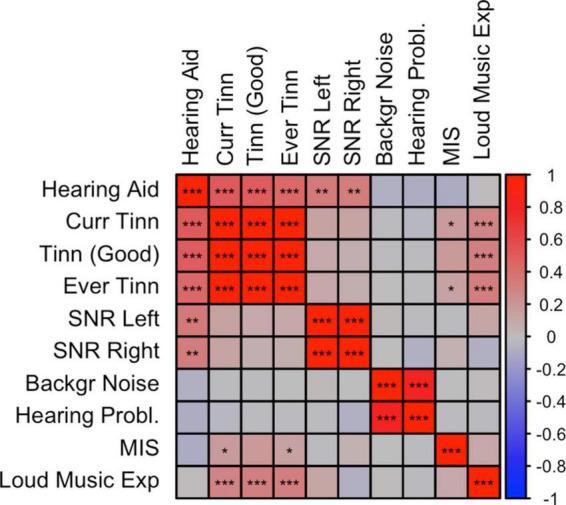
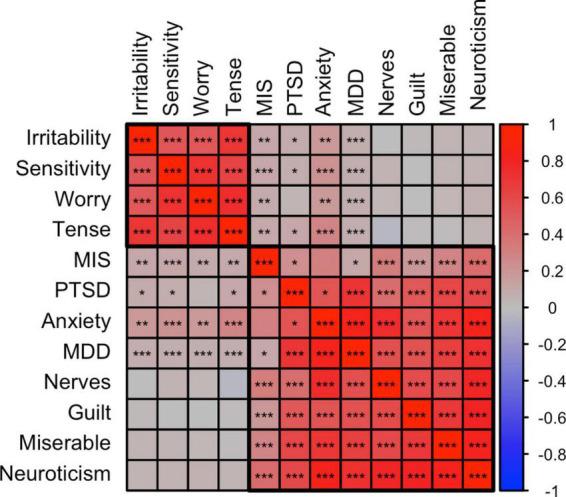
The rage-related misophonia symptom was significantly correlated with tinnitus, major depression disorder (MDD), post-traumatic stress disorder (PTSD), and generalized anxiety disorder (GAD; 0.12 < < 0.22). Stronger genetic correlations (0.21 < < 0.42) were observed for two clusters of personality traits: a guilt/neuroticism and an irritability/sensitivity cluster. Our results showed no genetic correlation with attention deficit and hyperactivity disorder, obsessive-compulsive disorder, and psychotic disorders. A negative correlation with autism spectrum disorder (ASD) was found, which may be surprising given the previously reported comorbidities and the sensory sensitivity reported in ASD. Clustering algorithms showed that rage-related misophonia consistently clustered with MDD, generalized anxiety, PTSD, and related personality traits.
DISCUSSION
We conclude that-based on the genetics of a common misophonia symptom-misophonia most strongly clusters with psychiatric disorders and a personality profile consistent with anxiety and PTSD.
引言
患有恐音症的人会对声音及相关刺激(主要是人为产生的)产生强烈的负面情绪反应,其程度可能会导致社交功能受损。该病症的确切性质仍是一个正在研究和辩论的问题。在此,我们研究了恐音症的遗传病因,以了解促成其发生的遗传因素,并阐明与该病症相关的个体特征差异。
方法
对于恐音症,我们使用了基因服务提供商23andMe公司一项未发表的全基因组关联研究(GWAS),该研究针对一个自我报告项目,该项目探究了一种常见的恐音症状:当他人发出进食声音时出现愤怒情绪。首先,我们使用基于基因和功能注释的分析方法来探究与愤怒相关的恐音症状的神经生物学决定因素。接下来,我们计算了这种与愤怒相关的恐音症状GWAS与来自听力学(耳鸣、听力表现和听力创伤)、精神病学、神经病学和人格特质等广泛性状和疾病的遗传相关性()。
结果
与愤怒相关的恐音症状与耳鸣、重度抑郁症(MDD)、创伤后应激障碍(PTSD)和广泛性焦虑症(GAD;0.12 < < 0.22)显著相关。在两组人格特质中观察到更强的遗传相关性(0.21 < < 0.42):一组是内疚/神经质,另一组是易怒/敏感。我们的结果显示与注意力缺陷多动障碍、强迫症和精神障碍无遗传相关性。发现与自闭症谱系障碍(ASD)呈负相关,鉴于先前报道的共病情况以及ASD中报告的感觉敏感性,这可能令人惊讶。聚类算法表明,与愤怒相关的恐音症始终与MDD、广泛性焦虑症以及PTSD和相关人格特质聚类。
讨论
我们得出结论——基于一种常见恐音症状的遗传学——恐音症与精神障碍以及与焦虑和PTSD一致的人格特征聚类最为紧密。


 Zotero 插件