
社会隔离不会改变圈养达马拉兰鼹形鼠的探索行为、空间学习和记忆()。
Social Isolation Does Not Alter Exploratory Behaviour, Spatial Learning and Memory in Captive Damaraland Mole-Rats ().
作者信息
Blecher Arantxa Silvia, Oosthuizen Maria Kathleen
机构信息
Department of Zoology and Entomology, University of Pretoria, Private Bag X20, Pretoria 0028, South Africa.
Mammal Research Institute, Department of Zoology and Entomology, University of Pretoria, Private Bag X20, Pretoria 0028, South Africa.
出版信息
Animals (Basel). 2023 Feb 3;13(3):543. doi: 10.3390/ani13030543.
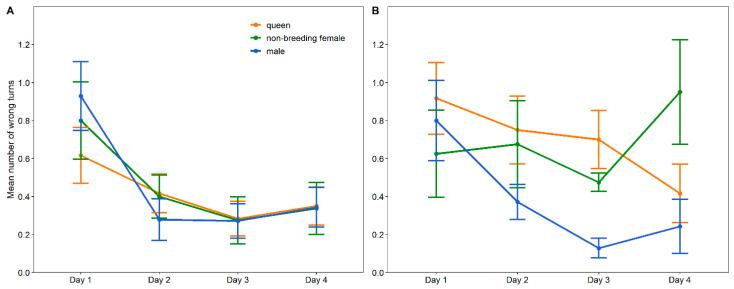
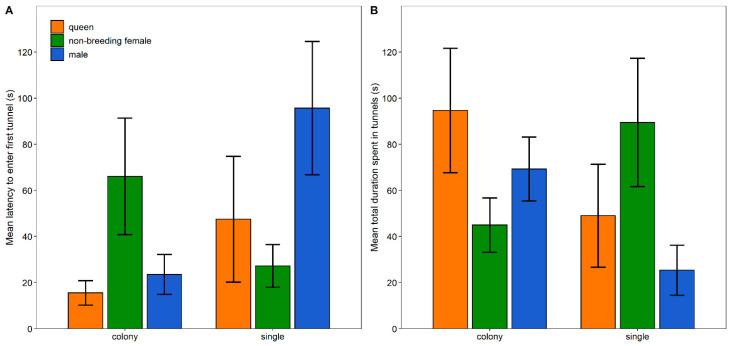
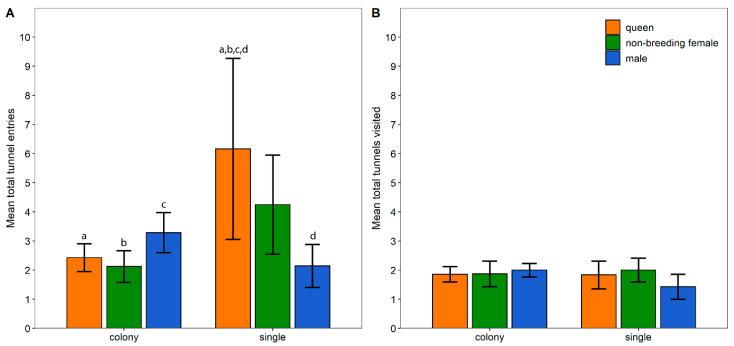
Exploratory behaviour, spatial learning and memory affect the survival of animals and appear to be dependent on the specific habitat that a species occupies. Good spatial navigation and memory are particularly important for subterranean animals, as it is energetically expensive to inhabit this niche. Damaraland mole-rats are subterranean mammals that live in colonies with organised social structures. Damaraland mole-rats have been maintained in the laboratory for many years and can be housed in groups or individually. We evaluated the effect of social isolation on the exploratory behaviour and spatial memory of single-housed and colony-housed animals and also considered potential differences in animals with different social statuses. We predicted that solitary housing would increase anxiety-like behaviour and result in higher activity and more errors when solving a maze. Exploration by colony- and single-housed mole-rats was tested in an open-field test, where all individuals explored readily. Single-housed queens and non-breeding females showed increased activity and spent more time in tunnels, which can be explained by increased anxiety. In the Y-maze, improvements in solving the maze were observed in all experimental groups, except in single-housed non-breeding females. In addition, all males showed a decrease in the number of errors in the maze. Spatial learning is thus apparent but could not be conclusively proven. It was possibly underestimated, as magnetic cues that may be used by mole-rats as stimuli for navigation were removed in the experimental setup. Overall, it appears that social isolation has a limited effect on the exploratory behaviour and spatial learning of Damaraland mole-rats.
探索行为、空间学习和记忆会影响动物的生存,并且似乎取决于物种所占据的特定栖息地。良好的空间导航和记忆对地下动物尤为重要,因为占据这个生态位需要耗费大量能量。达马拉兰鼹形鼠是地下哺乳动物,生活在具有有组织社会结构的群体中。达马拉兰鼹形鼠已经在实验室中饲养多年,可以成群或单独饲养。我们评估了社会隔离对单独饲养和群体饲养动物的探索行为和空间记忆的影响,同时也考虑了不同社会地位动物之间的潜在差异。我们预测,单独饲养会增加类似焦虑的行为,并导致在解决迷宫问题时活动量增加且错误更多。在旷场试验中测试了群体饲养和单独饲养的鼹形鼠的探索行为,所有个体都很乐意进行探索。单独饲养的女王鼠和非繁殖雌鼠活动量增加,并且在隧道中花费更多时间,这可以用焦虑增加来解释。在Y迷宫试验中,除了单独饲养的非繁殖雌鼠外,所有实验组在解决迷宫问题上都有进步。此外,所有雄性在迷宫中的错误数量都有所减少。因此,空间学习是明显的,但无法得到确凿证明。由于在实验设置中去除了鼹形鼠可能用作导航刺激的磁线索,空间学习可能被低估了。总体而言,社会隔离对达马拉兰鼹形鼠的探索行为和空间学习的影响似乎有限。

 Zotero 插件