
环状 RNA 在肝星状细胞激活和肝纤维化中的调控功能和机制。
Regulatory Functions and Mechanisms of Circular RNAs in Hepatic Stellate Cell Activation and Liver Fibrosis.
机构信息
Department of Biochemistry, Faculty of Medicine, Chulalongkorn University, Bangkok 10330, Thailand.
Center of Excellence in Hepatitis and Liver Cancer, Faculty of Medicine, Chulalongkorn University, Bangkok 10330, Thailand.
出版信息
Cells. 2023 Jan 19;12(3):378. doi: 10.3390/cells12030378.
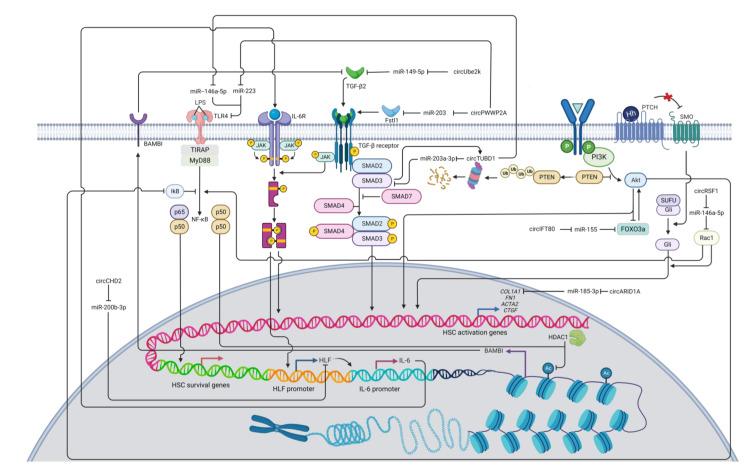
Chronic liver injury induces the activation of hepatic stellate cells (HSCs) into myofibroblasts, which produce excessive amounts of extracellular matrix (ECM), resulting in tissue fibrosis. If the injury persists, these fibrous scars could be permanent and disrupt liver architecture and function. Currently, effective anti-fibrotic therapies are lacking; hence, understanding molecular mechanisms that control HSC activation could hold a key to the development of new treatments. Recently, emerging studies have revealed roles of circular RNAs (circRNAs), a class of non-coding RNAs that was initially assumed to be the result of splicing errors, as new regulators in HSC activation. These circRNAs can modulate the activity of microRNAs (miRNAs) and their interacting protein partners involved in regulating fibrogenic signaling cascades. In this review, we will summarize the current knowledge of this class of non-coding RNAs for their molecular function in HSC activation and liver fibrosis progression.
慢性肝损伤诱导肝星状细胞(HSCs)激活为肌成纤维细胞,后者产生大量细胞外基质(ECM),导致组织纤维化。如果损伤持续存在,这些纤维性瘢痕可能是永久性的,会破坏肝脏结构和功能。目前,有效的抗纤维化治疗方法尚缺乏;因此,了解控制 HSC 激活的分子机制可能是开发新治疗方法的关键。最近的研究表明,环状 RNA(circRNA)作为一类最初被认为是剪接错误结果的非编码 RNA,在 HSC 激活中作为新的调控因子发挥作用。这些 circRNA 可以调节 miRNA(miRNA)的活性及其相互作用的蛋白伴侣,从而参与调控纤维生成信号级联反应。在这篇综述中,我们将总结这一类非编码 RNA 的最新知识,包括它们在 HSC 激活和肝纤维化进展中的分子功能。


 Zotero 插件