
解析细胞周期蛋白依赖性激酶 4/6 抑制剂在肿瘤微环境中的免疫调节作用。
Deciphering the Immunomodulatory Role of Cyclin-Dependent Kinase 4/6 Inhibitors in the Tumor Microenvironment.
机构信息
Department of Biotechnology, Noida Institute of Engineering and Technology, 19, Knowledge Park-II, Institutional Area, Greater Noida 201306, India.
Department of Biotechnology, Parul Institute of Applied Sciences and Centre of Research for Development, Parul University, Vadodara 391760, India.
出版信息
Int J Mol Sci. 2023 Jan 23;24(3):2236. doi: 10.3390/ijms24032236.
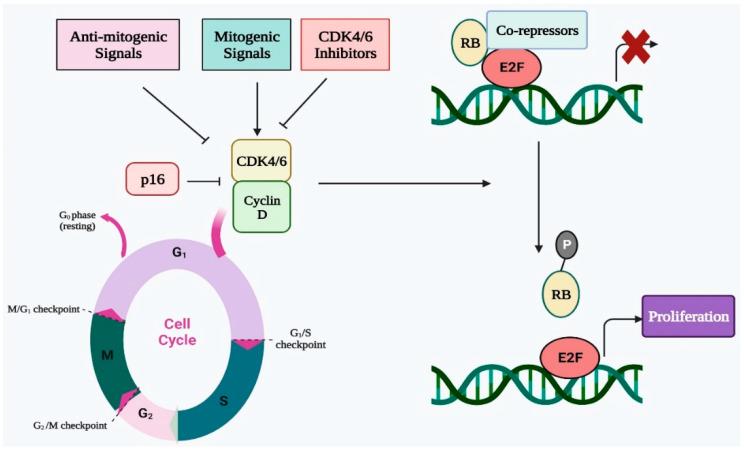
Cancer is characterized by persistent cell proliferation driven by aberrant cell cycle regulation and stimulation of cyclin-dependent kinases (CDKs). A very intriguing and potential approach for the development of antitumor medicines is the suppression of CDKs that lead to induction of apoptosis and cell cycle arrest. The shift of the cell cycle from the G0/G1 phase to the S phase, which is characterized by active transcription and synthesis, depends on the development of the cyclin D-CDK4/6 complex. A precise balance between anticancer activity and general toxicity is demonstrated by CDK inhibitors, which can specifically block CDK4/6 and control the cell cycle by reducing the G1 to S phase transition. CDK4/6 inhibitors have recently been reported to exhibit significant cell growth inhibition via modulating the tumour microenvironment in cancerous cells. One significant new understanding is that these inhibitors serve important functions in the interaction among tumour cells and the host immune system in addition to being cytostatic. Herein, we discuss the biological significance of CDK4/6 inhibitors in cancer therapeutics, as well as their biological impact on T cells and other important immune cells. Furthermore, we explore the integration of preclinical findings of these pharmaceuticals' ability to enhance antitumor immunity.
癌症的特征是细胞持续增殖,这是由细胞周期调控异常和细胞周期蛋白依赖性激酶(CDKs)的刺激引起的。开发抗肿瘤药物的一个非常有趣且有潜力的方法是抑制导致细胞凋亡和细胞周期停滞的 CDKs。细胞周期从 G0/G1 期向 S 期的转变,其特征是转录和合成活跃,这取决于细胞周期蛋白 D-CDK4/6 复合物的发展。CDK 抑制剂表现出抗癌活性和一般毒性之间的精确平衡,它们可以通过减少 G1 到 S 期的转变特异性地阻断 CDK4/6 并控制细胞周期。最近有报道称,CDK4/6 抑制剂通过调节癌细胞中的肿瘤微环境,显著抑制细胞生长。一个重要的新认识是,这些抑制剂除了具有细胞抑制作用外,在肿瘤细胞与宿主免疫系统的相互作用中也具有重要功能。本文讨论了 CDK4/6 抑制剂在癌症治疗中的生物学意义,以及它们对 T 细胞和其他重要免疫细胞的生物学影响。此外,我们还探讨了这些药物增强抗肿瘤免疫能力的临床前研究结果的整合。

 Zotero 插件