
膳食铁、铜、锌、锰摄入量与认知功能的关系:一项横断面研究。
Dietary Intake Levels of Iron, Copper, Zinc, and Manganese in Relation to Cognitive Function: A Cross-Sectional Study.
机构信息
Department of Nutrition and Food Safety, Zhejiang Provincial Center for Disease Control and Prevention, Hangzhou 310051, China.
School of Public Health, Zhejiang University School of Medicine, Hangzhou 310051, China.
出版信息
Nutrients. 2023 Jan 30;15(3):704. doi: 10.3390/nu15030704.
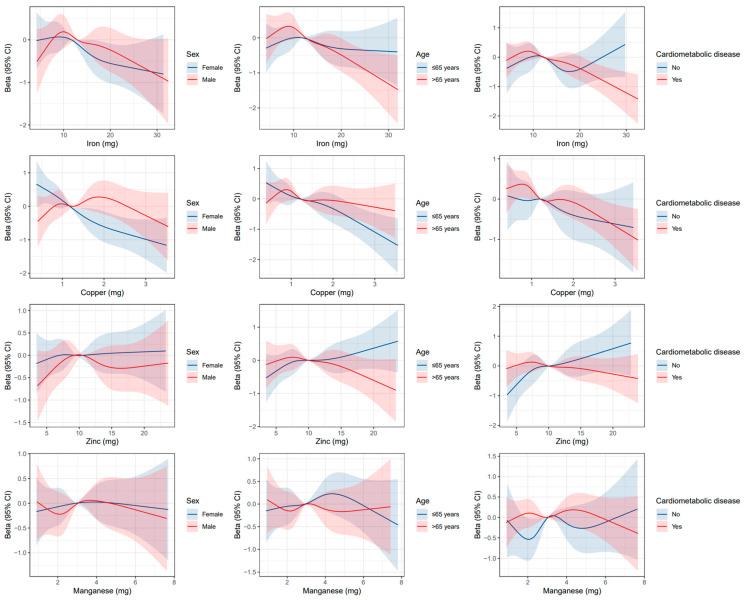
: Previous studies have related circulating levels of trace metal elements, of which dietary intake is the major source, to cognitive outcomes. However, there are still relatively few studies evaluating the associations of dietary intake levels of iron, copper, zinc, and manganese with cognitive function (CF). : We leveraged the data of 6863 participants (mean [standard deviation] age = 66.7 [10.5] years) in the Health and Retirement Study (2013/2014). Dietary intake levels of iron, copper, zinc, and manganese were calculated from a semi-quantitative food frequency questionnaire. CF was assessed using the 27-point modified Telephone Interview for Cognitive Status (TICS). We used linear regression models to calculate the mean differences in global CF scores by quintiles of dietary intake levels of trace metal elements. : Among the study participants, the mean (SD) values of daily dietary intake were 13.3 (6.3) mg for iron, 1.4 (0.7) mg for copper, 10.7 (4.6) mg for zinc, and 3.3 (1.6) mg for manganese. Compared with the lowest quintile of dietary iron intake (<8.1 mg), the highest quintile (≥17.7 mg) was associated with a lower cognitive score (-0.50, -0.94 to -0.06, P-trend = 0.007). Higher dietary copper was significantly associated with poorer CF (P-trend = 0.002), and the mean difference in cognitive score between extreme quintiles (≥1.8 vs. <0.8 mg) was -0.52 (95% confidence interval: -0.94 to -0.10) points. We did not observe significant associations for dietary intake of zinc (P-trend = 0.785) and manganese (P-trend = 0.368). : In this cross-sectional study, higher dietary intake of iron and copper was related to worse CF, but zinc and manganese intake levels were not significantly associated with CF.
: 先前的研究表明,痕量金属元素的循环水平与认知结果有关,而这些元素的主要来源是饮食摄入。然而,评估铁、铜、锌和锰的饮食摄入量与认知功能(CF)之间关联的研究仍然相对较少。 : 我们利用了健康与退休研究(2013/2014 年)中 6863 名参与者(平均[标准差]年龄=66.7[10.5]岁)的数据。痕量金属元素的饮食摄入量是从半定量食物频率问卷中计算得出的。使用 27 点改良电话认知状态测试(TICS)评估 CF。我们使用线性回归模型计算了 CF 全球评分的五分位组之间的平均差异。 : 在研究参与者中,每日饮食中痕量金属元素的平均(SD)值分别为铁 13.3(6.3)mg、铜 1.4(0.7)mg、锌 10.7(4.6)mg 和锰 3.3(1.6)mg。与最低五分位数的铁摄入量(<8.1mg)相比,最高五分位数(≥17.7mg)与认知评分较低相关(-0.50,-0.94 至-0.06,P 趋势=0.007)。较高的饮食铜与较差的 CF 显著相关(P 趋势=0.002),且两个极端五分位数之间的认知评分差异为-0.52(95%置信区间:-0.94 至-0.10)点。我们没有观察到锌(P 趋势=0.785)和锰(P 趋势=0.368)饮食摄入量与 CF 之间的显著关联。 : 在这项横断面研究中,较高的铁和铜饮食摄入量与较差的 CF 相关,而锌和锰的摄入量水平与 CF 无显著相关性。

 Zotero 插件