
食品安全问题与 COVID-19 大流行期间的饮食消费有关:来自 2019-2020 年韩国国家健康和营养检查调查的数据。
Food Insecurity Is Associated with Dietary Consumption during the COVID-19 Pandemic: Data from the Korea National Health and Nutrition Examination Survey 2019-2020.
机构信息
Department of Food Science and Nutrition, Keimyung University, 1095 Dalgubeol-daero, Daegu 42601, Republic of Korea.
出版信息
Nutrients. 2023 Feb 2;15(3):772. doi: 10.3390/nu15030772.
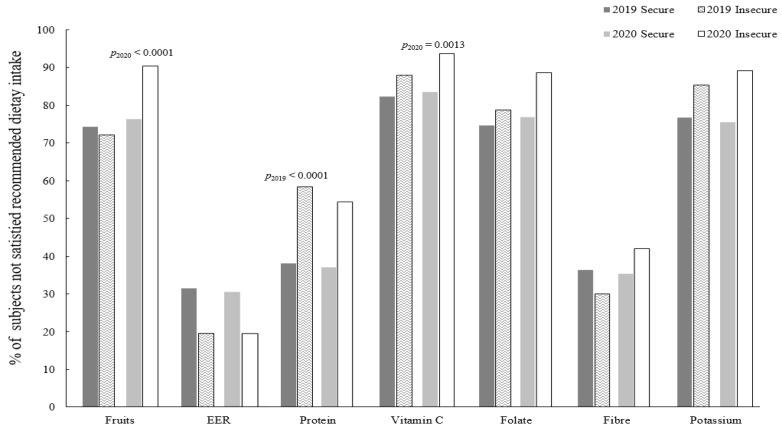
Coronavirus disease 2019 (COVID-19) has become a pandemic and has affected people's dietary behaviors, including food insecurity. This study aimed to ascertain whether COVID-19 may alter the prevalence of food insecurity, and if such food security status may be associated with dietary intake among Koreans. The general characteristics, dietary intake and food security status data in the Korea National Health and Nutrition Examination Survey VIII (2019~2020) were analyzed. The prevalence of food insecurity and food group and nutrient consumption by food security status were analyzed before (2019) and after the start of the pandemic (2020). Findings suggested 4.3% of Koreans experienced food insecurity during the first year of the pandemic, yet it did not differ from that in the year before the pandemic. Before COVID-19, there was no significant difference in food group or nutrition consumption by food security status. However, in 2020, the fruit and vitamin C intake of the food-insecure group was significantly lower than that of the food-secure group. Additionally, the food-insecure group's ratio of subjects who did not meet the recommended level of fruits and the vitamin was higher compared to that of the secure group. In conclusion, COVID-19 did not affect food insecurity status, but did have a negative influence on dietary intake for food-insecure Koreans.
新型冠状病毒病(COVID-19)已成为一种大流行疾病,影响了人们的饮食行为,包括食物不安全。本研究旨在确定 COVID-19 是否会改变食物不安全的流行率,以及这种食物安全状况是否与韩国人的饮食摄入有关。本研究分析了韩国国家健康与营养检查调查 VIII(2019-2020 年)的一般特征、饮食摄入和食物安全状况数据。分析了大流行开始前(2019 年)和大流行开始后(2020 年)的食物不安全和食物组以及营养素消费的流行率。结果表明,在大流行的第一年,有 4.3%的韩国人经历了食物不安全,但与大流行前一年没有差异。在 COVID-19 之前,食物安全状况对食物组或营养消费没有显著差异。然而,在 2020 年,食物不安全组的水果和维生素 C 摄入量明显低于食物安全组。此外,与食物安全组相比,食物不安全组未达到水果和维生素推荐水平的受试者比例更高。总之,COVID-19 并未影响食物不安全状况,但对食物不安全的韩国人的饮食摄入产生了负面影响。
 Zotero 插件