
根据每日给药时间,iGlarLixi(甘精胰岛素100 U/mL加利司那肽)治疗2型糖尿病的有效性和安全性:来自REALI汇总分析的数据。
Effectiveness and Safety of iGlarLixi (Insulin Glargine 100 U/mL Plus Lixisenatide) in Type 2 Diabetes According to the Timing of Daily Administration: Data from the REALI Pooled Analysis.
作者信息
Haluzík Martin, Seufert Jochen, Guja Cristian, Bonnemaire Mireille, Bigot Gregory, Tournay Mathilde, Kis János Tibor, Freemantle Nick
机构信息
Institute for Clinical and Experimental Medicine and Charles University, Prague, Czech Republic.
Division of Endocrinology and Diabetology, Department of Medicine II, Medical Centre-Faculty of Medicine, University of Freiburg, Freiburg, Germany.
出版信息
Diabetes Ther. 2023 Apr;14(4):639-652. doi: 10.1007/s13300-023-01375-8. Epub 2023 Feb 14.
INTRODUCTION
iGlarLixi (insulin glargine 100 U/mL plus lixisenatide) has demonstrated glycaemic efficacy and safety in adults with inadequately controlled type 2 diabetes mellitus (T2DM). Per the European Medicines Agency's product label, iGlarLixi should be injected once a day within 1 h prior to a meal, preferably the same meal every day when the most convenient meal has been chosen. It is however unknown whether iGlarLixi administration timing affects glycaemic control and safety, as clinical trial evidence is mainly based on pre-breakfast iGlarLixi administration. Therefore, we assessed the effectiveness and safety of iGlarLixi in clinical practice, according to its administration timing.
METHODS
Data were pooled from two prospective observational studies including 1303 European participants with T2DM inadequately controlled on oral antidiabetic drugs with or without basal insulin who initiated iGlarLixi therapy for 24 weeks. Participants were classified into four subgroups based on daily timing of iGlarLixi injection: pre-breakfast (N = 436), pre-lunch (N = 262), pre-dinner (N = 399), and those who switched iGlarLixi injection time during the study (N = 206).
RESULTS
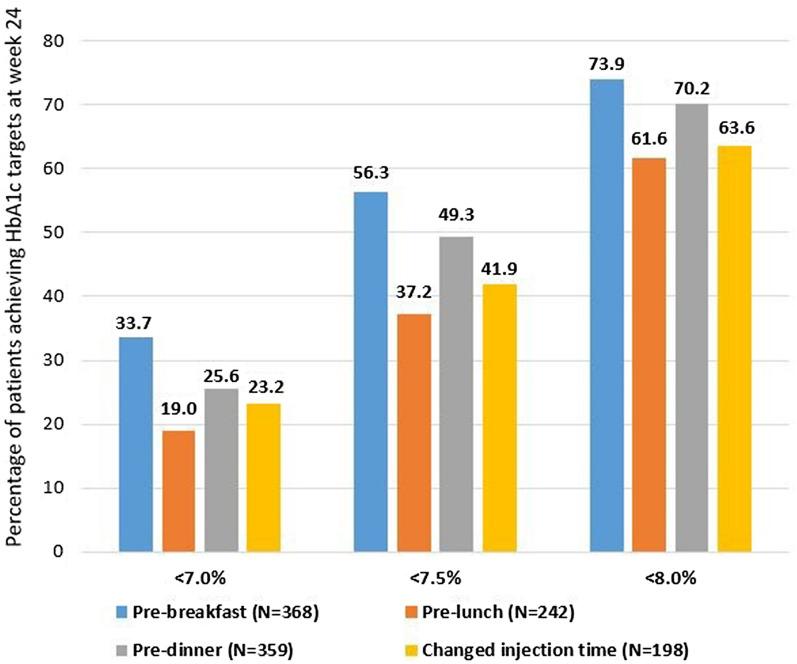
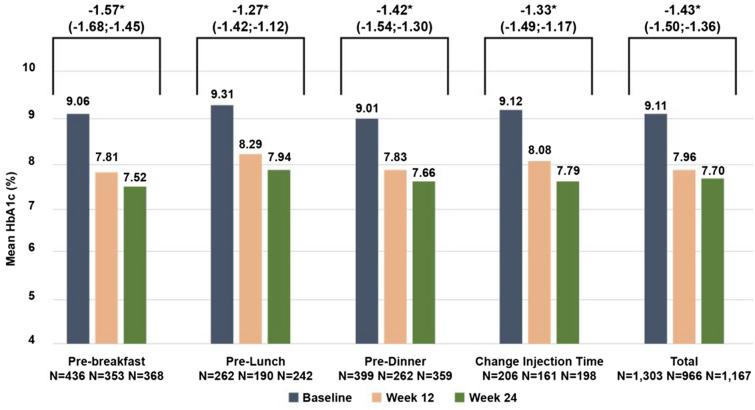
No meaningful differences in baseline characteristics were observed between the study groups. Least-squares mean reductions in haemoglobin A1c (HbA1c) from baseline to week 24 were substantial in all groups, with the numerically largest decrease observed in the pre-breakfast group (1.57%) compared with the pre-lunch (1.27%), pre-dinner (1.42%), or changed injection time (1.33%) groups. Pre-breakfast iGlarLixi injection also resulted in a numerically greater proportion of participants achieving HbA1c < 7.0% at week 24 (33.7% versus 19.0% for pre-lunch, 25.6% pre-dinner, and 23.2% changed injection time). iGlarLixi was well tolerated across all groups, with low rates of gastrointestinal disorders and hypoglycaemia. Mean body weight decreased similarly in all groups (by 1.3-2.3 kg).
CONCLUSION
iGlarLixi was effective and safe regardless of its daily administration time. However, pre-breakfast iGlarLixi injection resulted in a more effective glycaemic control.
简介
iGlarLixi(甘精胰岛素100 U/mL加利司那肽)已在2型糖尿病(T2DM)控制不佳的成人患者中证明了其降糖疗效和安全性。根据欧洲药品管理局的产品标签,iGlarLixi应每天在餐前1小时内注射一次,最好在选择了最方便的一餐时每天在同一餐之前注射。然而,由于临床试验证据主要基于早餐前注射iGlarLixi,因此iGlarLixi的给药时间是否会影响血糖控制和安全性尚不清楚。因此,我们根据给药时间评估了iGlarLixi在临床实践中的有效性和安全性。
方法
数据来自两项前瞻性观察性研究,包括1303名欧洲T2DM患者,他们口服抗糖尿病药物(无论是否使用基础胰岛素)血糖控制不佳,开始接受iGlarLixi治疗24周。根据iGlarLixi注射的每日时间将参与者分为四个亚组:早餐前(N = 436)、午餐前(N = 262)、晚餐前(N = 399)以及在研究期间改变iGlarLixi注射时间的参与者(N = 206)。
结果
各研究组之间在基线特征方面未观察到有意义的差异。从基线到第24周,所有组糖化血红蛋白(HbA1c)的最小二乘均值降幅均很大,早餐前组(1.57%)的数值降幅最大,相比午餐前组(1.27%)、晚餐前组(1.42%)或改变注射时间组(1.33%)。早餐前注射iGlarLixi还使在第24周时糖化血红蛋白<7.0%的参与者比例在数值上更高(33.7%,而午餐前为19.0%,晚餐前为25.6%,改变注射时间组为23.2%)。所有组对iGlarLixi的耐受性都很好,胃肠道疾病和低血糖发生率较低。所有组的平均体重下降情况相似(下降1.3 - 2.3千克)。
结论
无论每日给药时间如何,iGlarLixi都是有效且安全的。然而,早餐前注射iGlarLixi能实现更有效的血糖控制。
 Zotero 插件