
用于预防婴儿和儿童呼吸道合胞病毒的单克隆抗体:系统评价和网络荟萃分析。
Monoclonal Antibody for the Prevention of Respiratory Syncytial Virus in Infants and Children: A Systematic Review and Network Meta-analysis.
机构信息
Department of Intensive Care Unit, The First Hospital of Lanzhou University, Lanzhou, Gansu, China.
Evidence-Based Nursing Center, School of Nursing, Lanzhou University, Lanzhou, Gansu, China.
出版信息
JAMA Netw Open. 2023 Feb 1;6(2):e230023. doi: 10.1001/jamanetworkopen.2023.0023.
IMPORTANCE
Respiratory syncytial virus (RSV) is the leading cause of acute lower respiratory infection in children younger than 5 years; effective prevention strategies are urgently needed.
OBJECTIVE
To compare the efficacy and safety of monoclonal antibodies for the prevention of RSV infection in infants and children.
DATA SOURCES
In this systematic review and network meta-analysis, PubMed, Embase, CENTRAL, and ClinicalTrials.gov were searched from database inception to March 2022.
STUDY SELECTION
Randomized clinical trials that enrolled infants at high risk of RSV infection to receive a monoclonal antibody or placebo were included. Keywords and extensive vocabulary related to monoclonal antibodies, RSV, and randomized clinical trials were searched.
DATA EXTRACTION AND SYNTHESIS
The Preferred Reporting Items for Systematic Reviews and Meta-analyses reporting guideline was used. Teams of 2 reviewers independently performed literature screening, data extraction, and risk of bias assessment. The Grading of Recommendations, Assessments, Developments, and Evaluation approach was used to rate the certainty of evidence. A random-effects model network meta-analysis was conducted using a consistency model under the frequentist framework.
MAIN OUTCOMES AND MEASURES
The main outcomes were all-cause mortality, RSV-related hospitalization, RSV-related infection, drug-related adverse events, intensive care unit admission, supplemental oxygen use, and mechanical ventilation use.
RESULTS
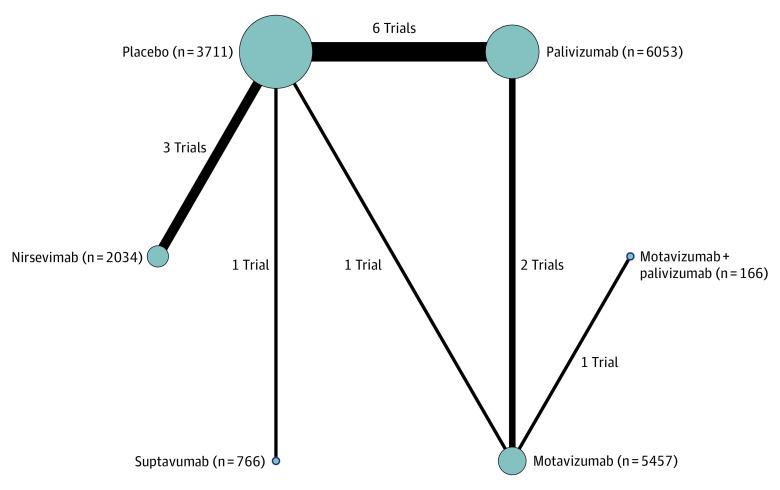
Fifteen randomized clinical trials involving 18 395 participants were eligible; 14 were synthesized, with 18 042 total participants (median age at study entry, 3.99 months [IQR, 3.25-6.58 months]; median proportion of males, 52.37% [IQR, 50.49%-53.85%]). Compared with placebo, with moderate- to high-certainty evidence, nirsevimab, palivizumab, and motavizumab were associated with significantly reduced RSV-related infections per 1000 participants (nirsevimab: -123 [95% CI, -138 to -100]; palivizumab: -108 [95% CI, -127 to -82]; motavizumab: -136 [95% CI, -146 to -125]) and RSV-related hospitalizations per 1000 participants (nirsevimab: -54 [95% CI, -64 to -38; palivizumab: -39 [95% CI, -48 to -28]; motavizumab: -48 [95% CI, -58 to -33]). With moderate-certainty evidence, both motavizumab and palivizumab were associated with significant reductions in intensive care unit admissions per 1000 participants (-8 [95% CI, -9 to -4] and -5 [95% CI, -7 to 0], respectively) and supplemental oxygen use per 1000 participants (-59 [95% CI, -63 to -54] and -55 [95% CI, -61 to -41], respectively), and nirsevimab was associated with significantly reduced supplemental oxygen use per 1000 participants (-59 [95% CI, -65 to -40]). No significant differences were found in all-cause mortality and drug-related adverse events. Suptavumab did not show any significant benefits for the outcomes of interest.
CONCLUSIONS AND RELEVANCE
In this study, motavizumab, nirsevimab, and palivizumab were associated with substantial benefits in the prevention of RSV infection, without a significant increase in adverse events compared with placebo. However, more research is needed to confirm the present conclusions, especially for safety and cost-effectiveness.
重要性:呼吸道合胞病毒(RSV)是导致 5 岁以下儿童急性下呼吸道感染的主要原因,急需有效的预防策略。
目的:比较单克隆抗体预防婴儿和儿童 RSV 感染的疗效和安全性。
数据来源:在这项系统评价和网络荟萃分析中,从数据库建立到 2022 年 3 月,检索了 PubMed、Embase、CENTRAL 和 ClinicalTrials.gov。
研究选择:纳入了高风险 RSV 感染的婴儿接受单克隆抗体或安慰剂的随机临床试验。检索了与单克隆抗体、RSV 和随机临床试验相关的关键词和广泛词汇。
数据提取与合成:采用系统评价和荟萃分析报告规范的 Preferred Reporting Items。由 2 名评审员独立进行文献筛选、数据提取和偏倚风险评估。采用 Grading of Recommendations, Assessments, Developments, and Evaluation 方法对证据的确定性进行评级。使用一致性模型下的概率框架进行随机效应模型网络荟萃分析。
主要结果和措施:主要结局是全因死亡率、RSV 相关住院、RSV 相关感染、药物相关不良事件、重症监护病房入院、补充氧气使用和机械通气使用。
结果:15 项随机临床试验纳入了 18395 名参与者,其中 14 项进行了综合分析,共纳入 18042 名参与者(研究入组时的中位年龄,3.99 个月[IQR,3.25-6.58 个月];中位男性比例,52.37%[IQR,50.49%-53.85%])。与安慰剂相比,具有中至高确定性证据表明,nirsevimab、palivizumab 和 motavizumab 与 RSV 相关感染(nirsevimab:-123[95%CI,-138 至-100];palivizumab:-108[95%CI,-127 至-82];motavizumab:-136[95%CI,-146 至-125])和 RSV 相关住院(nirsevimab:-54[95%CI,-64 至-38;palivizumab:-39[95%CI,-48 至-28;motavizumab:-48[95%CI,-58 至-33])的发生率显著降低。中确定性证据表明,motavizumab 和 palivizumab 均与重症监护病房入住(-8[95%CI,-9 至-4]和-5[95%CI,-7 至 0])和补充氧气使用(-59[95%CI,-63 至-54]和-55[95%CI,-61 至-41])的发生率显著降低有关,nirsevimab 与补充氧气使用的发生率显著降低有关(-59[95%CI,-65 至-40])。在全因死亡率和药物相关不良事件方面未发现显著差异。Suptavumab 对研究结果没有显著益处。
结论:在这项研究中,与安慰剂相比,motavizumab、nirsevimab 和 palivizumab 可显著降低 RSV 感染的发生率,且与安慰剂相比,不良反应发生率无显著增加。然而,仍需要更多的研究来证实目前的结论,特别是关于安全性和成本效益。


 Zotero 插件