
与蛇毒相关的天然抗菌物质的过去、现在与未来
Past, Present, and Future of Naturally Occurring Antimicrobials Related to Snake Venoms.
作者信息
Oguiura Nancy, Sanches Leonardo, Duarte Priscila V, Sulca-López Marcos A, Machini Maria Terêsa
机构信息
Laboratory of Ecology and Evolution, Instituto Butantan, Av. Dr. Vital Brasil 1500, São Paulo 05503-900, Brazil.
Aquatic Microbiology and Technological Applications, Department of Microbiology and Parasitology, Faculty of Biological Sciences, Universidad Nacional Mayor de San Marcos, Av. Venezuela Cdra. 34 s/n, Ciudad Universitaria, Lima 15081, Peru.
出版信息
Animals (Basel). 2023 Feb 19;13(4):744. doi: 10.3390/ani13040744.
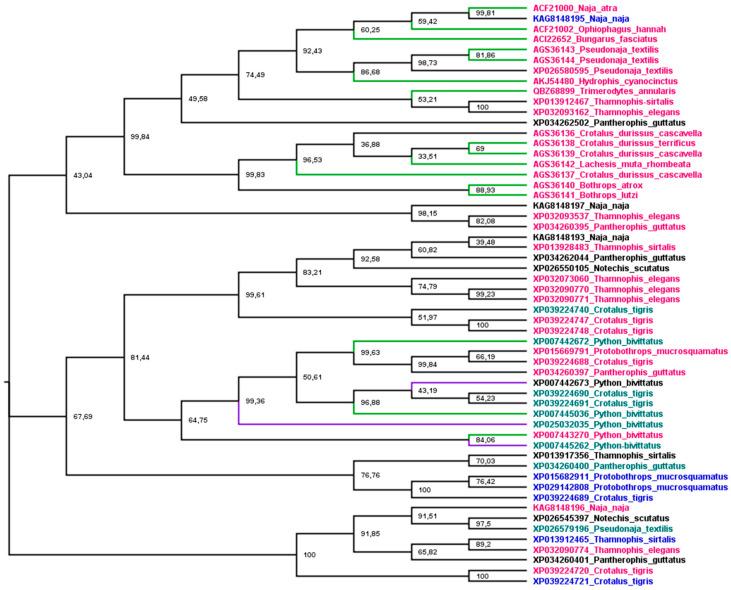
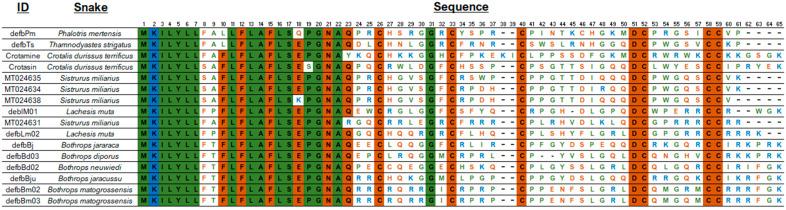
This review focuses on proteins and peptides with antimicrobial activity because these biopolymers can be useful in the fight against infectious diseases and to overcome the critical problem of microbial resistance to antibiotics. In fact, snakes show the highest diversification among reptiles, surviving in various environments; their innate immunity is similar to mammals and the response of their plasma to bacteria and fungi has been explored mainly in ecological studies. Snake venoms are a rich source of components that have a variety of biological functions. Among them are proteins like lectins, metalloproteinases, serine proteinases, L-amino acid oxidases, phospholipases type A, cysteine-rich secretory proteins, as well as many oligopeptides, such as waprins, cardiotoxins, cathelicidins, and β-defensins. In vitro, these biomolecules were shown to be active against bacteria, fungi, parasites, and viruses that are pathogenic to humans. Not only cathelicidins, but all other proteins and oligopeptides from snake venom have been proteolyzed to provide short antimicrobial peptides, or for use as templates for developing a variety of short unnatural sequences based on their structures. In addition to organizing and discussing an expressive amount of information, this review also describes new β-defensin sequences of that can lead to novel peptide-based antimicrobial agents, using a multidisciplinary approach that includes sequence phylogeny.
本综述聚焦于具有抗菌活性的蛋白质和肽,因为这些生物聚合物在对抗传染病以及克服微生物对抗生素耐药性这一关键问题方面可能会发挥作用。事实上,蛇在爬行动物中表现出最高的多样性,能在各种环境中生存;它们的先天免疫与哺乳动物相似,并且主要在生态学研究中探讨了其血浆对细菌和真菌的反应。蛇毒是具有多种生物学功能的成分的丰富来源。其中包括凝集素、金属蛋白酶、丝氨酸蛋白酶、L-氨基酸氧化酶、A 型磷脂酶、富含半胱氨酸的分泌蛋白等蛋白质,以及许多寡肽,如瓦普林、心脏毒素、cathelicidin 和β-防御素。在体外,这些生物分子已被证明对人类致病的细菌、真菌、寄生虫和病毒具有活性。不仅 cathelicidin,蛇毒中的所有其他蛋白质和寡肽都已被蛋白酶解以提供短抗菌肽,或用作基于其结构开发各种短非天然序列的模板。除了整理和讨论大量信息外,本综述还使用包括序列系统发育在内的多学科方法描述了可能产生新型基于肽的抗菌剂的新β-防御素序列。


 Zotero 插件