
握力与腰围的关系作为识别2型糖尿病老年人群中行动能力未受损的男性和女性的一种方法
Hand Grip Strength Relative to Waist Circumference as a Means to Identify Men and Women Possessing Intact Mobility in a Cohort of Older Adults with Type 2 Diabetes.
作者信息
Kis Ofer S, Buch Assaf, Eldor Roy, Moran Daniel S
机构信息
The Department of Health Systems Management, Ariel University, Ariel 40700, Israel.
Department of Nutritional Sciences, School of Health Sciences, Ariel University, Ariel 40700, Israel.
出版信息
Biomedicines. 2023 Jan 26;11(2):352. doi: 10.3390/biomedicines11020352.
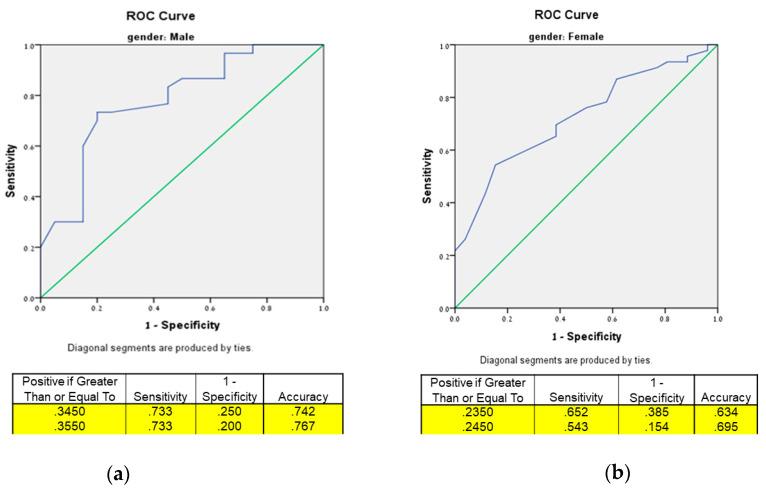
Possessing intact mobility in older adults assures their continued independence. The early identification of reduced mobility in older adults with type 2 diabetes (T2DM) is paramount for preventing their future physical deterioration. Hand grip strength (HGS), relative to body size, is associated with mobility in older T2DM patients. This study aims to identify an HGS index that best identifies mobilityintact older T2DM patients, along with its optimal cut-off point. The baseline data are from a cohort of 122 older T2DM patients (59% women) (mean age of 70.2 ± 4.4 years). Three mobility tests encompassing three main mobility domains were measured, including usual gait speed (UGS), timed up and go (TUG), and a two-minute walk test (2MWT). Passing scores were defined as those either above the established cut-off points or above the 25th percentile of population norms. Passing all three tests was considered as possessing intact mobility. Receiver operating characteristic (ROC) curves of the most relevant HGS indices were constructed to determine the area under the curve (AUC) that best identifies patients with intact mobility. In a sample of 122 older adults with T2DM, 63.9% of women and 60% of men were found to possess intact mobility. HGS relative to waist circumference (WC) was found to have the strongest association with intact mobility, presenting the highest AUC in both men (0.78) and women (0.72) for discriminating mobility status, with an optimal cut-off of 0.355 (kg/cm) and 0.245 (kg/cm) in men and women, respectively. HGS relative to WC best differentiated between mobility-intact older adults with T2DM and those with mobility limitations, especially in men. Using HGS/WC as a simple and safe screening mode for mobility in a clinical setting could potentially identify older patients with T2DM that require therapeutic interventions.
老年人保持完整的身体活动能力可确保他们持续保持独立。早期识别2型糖尿病(T2DM)老年患者的身体活动能力下降对于预防其未来身体机能衰退至关重要。相对于体型而言,握力(HGS)与老年T2DM患者的身体活动能力相关。本研究旨在确定能最佳识别身体活动能力完好的老年T2DM患者的HGS指数及其最佳截断点。基线数据来自122例老年T2DM患者队列(59%为女性)(平均年龄70.2±4.4岁)。测量了涵盖三个主要身体活动领域的三项身体活动测试,包括日常步态速度(UGS)、计时起立行走测试(TUG)和两分钟步行测试(2MWT)。及格分数定义为高于既定截断点或高于人群规范第25百分位数的分数。通过所有三项测试被视为具备完整的身体活动能力。构建最相关的HGS指数的受试者工作特征(ROC)曲线,以确定能最佳识别身体活动能力完好患者的曲线下面积(AUC)。在122例老年T2DM患者样本中,发现63.9%的女性和60%的男性具备完整的身体活动能力。发现相对于腰围(WC)的HGS与完整的身体活动能力关联最强,在区分身体活动状态方面,男性(0.78)和女性(0.72)的AUC最高,男性和女性的最佳截断点分别为0.355(kg/cm)和0.245(kg/cm)。相对于WC的HGS能最佳区分身体活动能力完好的老年T2DM患者和有身体活动能力受限的患者,尤其是在男性中。在临床环境中使用HGS/WC作为一种简单安全的身体活动筛查方式可能会识别出需要治疗干预的老年T2DM患者。
 Zotero 插件