
头颈癌中肿瘤芽生与部分上皮-间质转化之间的关系
Relationship between Tumor Budding and Partial Epithelial-Mesenchymal Transition in Head and Neck Cancer.
作者信息
Okuyama Kohei, Suzuki Keiji, Yanamoto Souichi
机构信息
Department of Periodontics and Oral Medicine, School of Dentistry, University of Michigan, 1011 North University Ave, Ann Arbor, MI 48109, USA.
University of Michigan Rogel Cancer Center, 1600 Huron Pathway, Ann Arbor, MI 48105, USA.
出版信息
Cancers (Basel). 2023 Feb 9;15(4):1111. doi: 10.3390/cancers15041111.
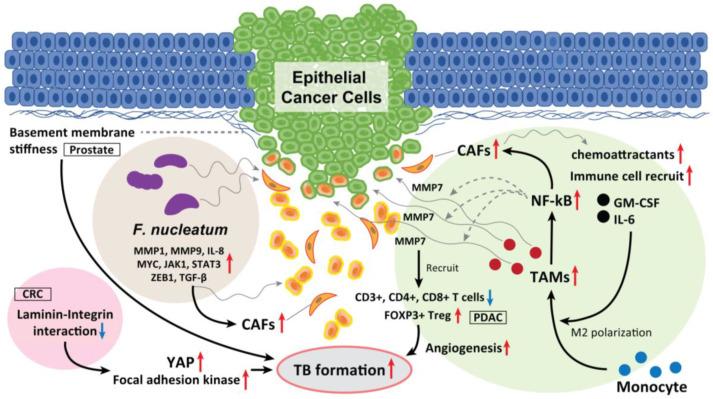
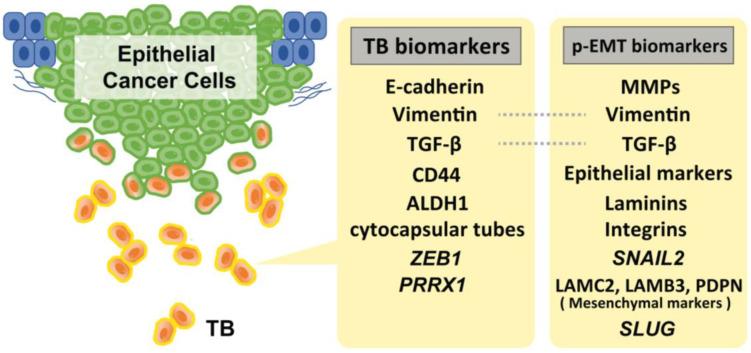
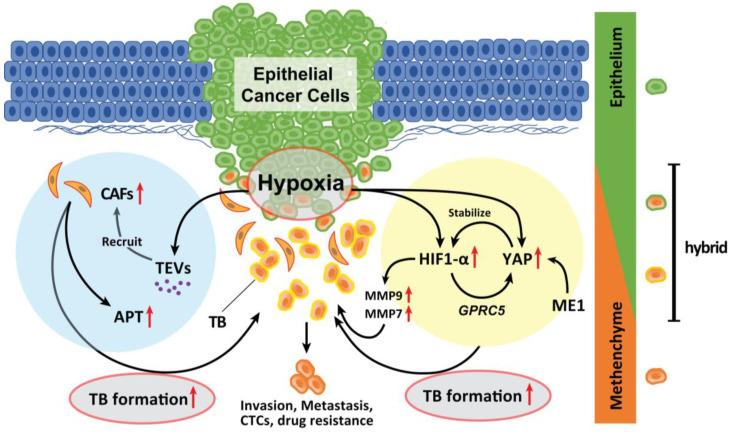
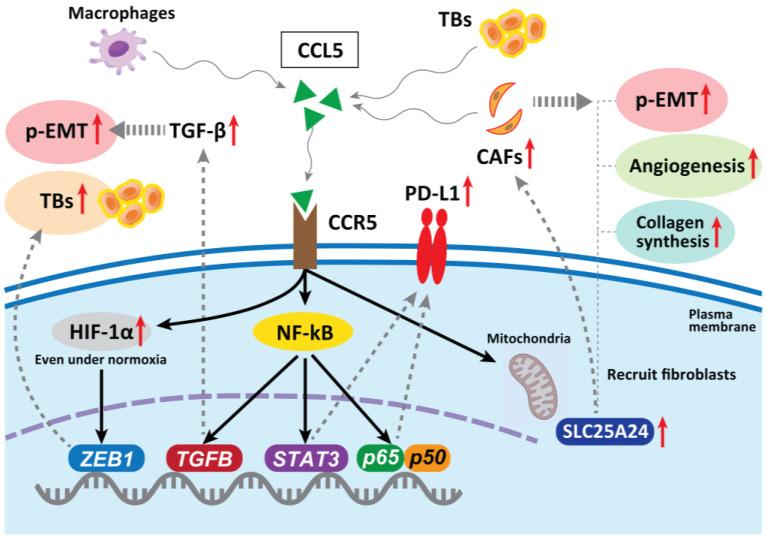
Tumor budding (TB), a microscopic finding in the stroma ahead of the invasive fronts of tumors, has been well investigated and reported as a prognostic marker in head and neck squamous cell carcinoma (HNSCC). Epithelial-mesenchymal transition (EMT) is a crucial step in tumor progression and metastasis, and its status cannot be distinguished from TB. The current understanding of partial EMT (p-EMT), the so-called halfway step of EMT, focuses on the tumor microenvironment (TME). Although this evidence has been investigated, the clinicopathological and biological relationship between TB and p-EMT remains debatable. At the invasion front, previous research suggested that cancer-associated fibroblasts (CAFs) are important for tumor progression, metastasis, p-EMT, and TB formation in the TME. Although there is biological evidence of TB drivers, no report has focused on their organized functional relationships. Understanding the mechanism of TB onset and the relationship between p-EMTs may facilitate the development of novel diagnostic and prognostic methods, and targeted therapies for the prevention of metastasis in epithelial cancer. Thus far, major pieces of evidence have been established from colorectal cancer (CRC), due to a large number of patients with the disease. Herein, we review the current understanding of p-EMT and TME dynamics and discuss the relationship between TB development and p-EMT, focusing on CAFs, hypoxia, tumor-associated macrophages, laminin-integrin crosstalk, membrane stiffness, enzymes, and viral infections in cancers, and clarify the gap of evidence between HNSCC and CRC.
肿瘤芽生(TB)是在肿瘤浸润前沿之前的基质中的一种微观表现,已得到充分研究,并被报道为头颈部鳞状细胞癌(HNSCC)的一种预后标志物。上皮-间质转化(EMT)是肿瘤进展和转移的关键步骤,其状态无法与TB区分开来。目前对部分EMT(p-EMT)(即所谓的EMT的中间步骤)的理解集中在肿瘤微环境(TME)上。尽管已经对这一证据进行了研究,但TB与p-EMT之间的临床病理和生物学关系仍存在争议。在浸润前沿,先前的研究表明,癌症相关成纤维细胞(CAF)对TME中的肿瘤进展、转移、p-EMT和TB形成很重要。尽管有关于TB驱动因素的生物学证据,但尚无报告关注它们的有组织的功能关系。了解TB发生的机制以及p-EMT之间的关系可能有助于开发新的诊断和预后方法,以及预防上皮癌转移的靶向治疗。到目前为止,由于大量的结直肠癌(CRC)患者,已经从CRC中建立了主要的证据。在此,我们综述了目前对p-EMT和TME动态的理解,并讨论了TB发展与p-EMT之间的关系,重点关注CAF、缺氧、肿瘤相关巨噬细胞、层粘连蛋白-整合素相互作用、膜硬度、酶和癌症中的病毒感染,并阐明了HNSCC和CRC之间的证据差距。
 Zotero 插件