
COVID-19大流行对原发性头痛障碍青少年影响的前瞻性评估
A Prospective Evaluation of the Effects of the COVID-19 Pandemic on Youth with Primary Headache Disorders.
作者信息
Connelly Mark, Dilts Jennifer, Boorigie Madeline, Gerson Trevor
机构信息
Children's Mercy Kansas City, Kansas City, MO 64108, USA.
School of Medicine, University of Missouri-Kansas City, Kansas City, MO 64108, USA.
出版信息
Children (Basel). 2023 Jan 19;10(2):184. doi: 10.3390/children10020184.
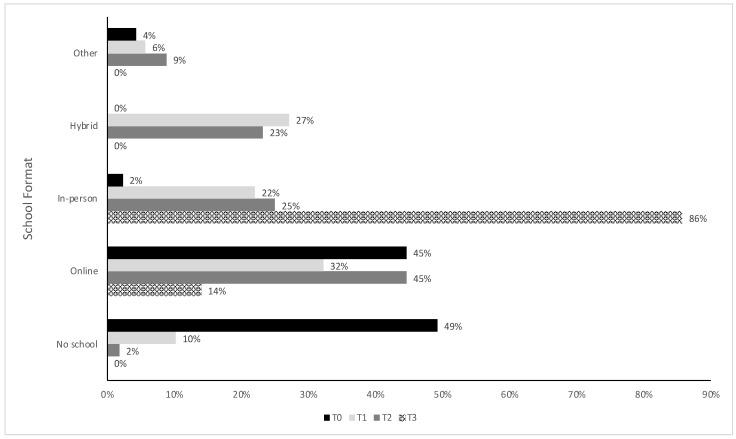
Alterations in certain academic and social/family routines during the COVID-19 pandemic have been speculated to be either a risk factor or buffer for poor health outcomes for youth with stress-sensitive health conditions such as primary headache disorders. The current study evaluated patterns and moderators of pandemic impacts on youth with primary headache disorders, with an aim of extending our understanding of the relationship between stress, resilience, and outcomes in this population. Children recruited from a headache clinic in the midwestern United States reported on their headaches, schooling, routines, psychological stress, and coping at four timepoints ranging from within a few months of the pandemic onset to a long-term follow-up 2 years later. Changes in headache characteristics over time were analyzed for association with demographics, school status, altered routines, and stress, and coping. At baseline, 41% and 58% of participants reported no change in headache frequency or intensity, respectively, relative to pre-pandemic levels, with the remainder almost equally divided between reporting an improvement or worsening. The results of multilevel growth model analyses indicated that headache intensity remained more elevated over time since the start of the pandemic for respondents whose stress scores were relatively higher ( = 0.18, = -2.70, = 0.01), and headache-related disability remained more elevated over time for older respondents ( = 0.01, = -2.12, = 0.03). The study results suggest, overall, that the outcomes of primary headache disorders in youth were not systematically altered by the COVID-19 pandemic.
据推测,在新冠疫情期间,某些学业以及社交/家庭日常活动的改变,对于患有压力敏感型健康状况(如原发性头痛疾病)的青少年而言,要么是健康状况不佳的风险因素,要么是一种缓冲因素。本研究评估了疫情对患有原发性头痛疾病青少年的影响模式及调节因素,旨在加深我们对该人群压力、恢复力和健康结果之间关系的理解。从美国中西部一家头痛诊所招募的儿童,在从疫情开始后的几个月到两年后的长期随访这四个时间点,报告了他们的头痛情况、学业、日常活动、心理压力和应对方式。分析了头痛特征随时间的变化与人口统计学、学校状况、日常活动改变、压力和应对方式之间的关联。在基线时,分别有41%和58%的参与者报告头痛频率或强度相对于疫情前水平没有变化,其余参与者在报告改善或恶化之间几乎平均分配。多层增长模型分析结果表明,对于压力得分相对较高的受访者,自疫情开始以来,头痛强度随时间保持更高水平(β = 0.18,t = -2.70,p = 0.01),而对于年龄较大的受访者,与头痛相关的残疾随时间保持更高水平(β = 0.01,t = -2.12,p = 0.03)。总体而言,研究结果表明,新冠疫情并未系统性地改变青少年原发性头痛疾病的结果。
 Zotero 插件